
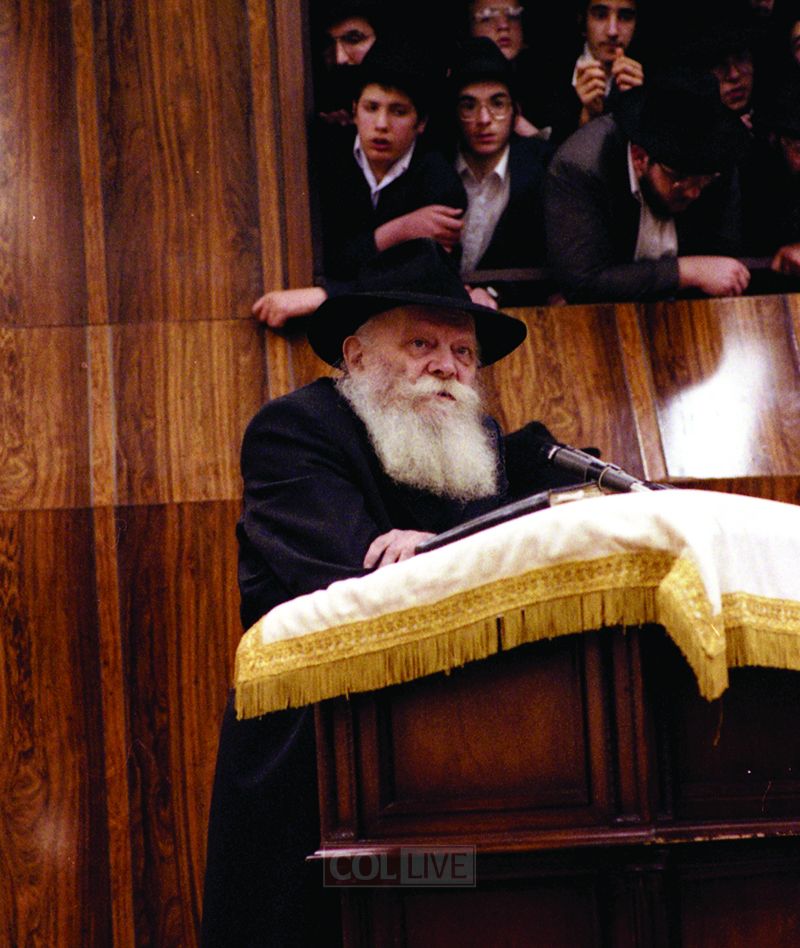
Women in the army. Denial of a blessing. How did the Rebbe’s reaction leave an indelible mark? The Avner Institute presents a series of anecdotes from those, young or old, who merited an audience in the Rebbe’s office and to this day remember his holy words, and his quiet yet powerful presence.
In loving memory of Hadassah Lebovic A”h
“One Need Not Have Mercy”
Rabbi Sholom Ber Chaikin relates:
It was 5709/1949. Rabbi Kramer once scheduled a yechidus, a private audience with the Rebbe Rayatz, the Sixth Lubavitcher Rebbe Yosef Yitzchak Schneersohn, on the eve of the seventh day of Passover. When Rabbi Kramer arrived, he was told to come back right after the holiday.
The eighth day over, Rabbi Kramer entered the Rebbe Rayatz’s office. Noticing the fatigue on the Rebbe’s face, he retreated and instead waited outside 770.
Suddenly he heard the sound of footsteps.
“Why aren’t you going in for the yechidus?” asked a gentle voice.
Rabbi Kramer looked up. It was Rabbi Menachem Schneerson, at the time head of the Chabad publishing house Merkos and on the cusp of greatness.
“The Rebbe seemed so tired,” Rabbi Kramer explained apologetically. “I don’t want to bother him.”
Rabbi Schneerson chuckled. “Nonsense. “Oif a rebbe darf men nit rachmonus hobin – for a Rebbe, one need not have mercy.”
So Rabbi Kramer entered the Rebbe Rayatz’s office.
Fast forward several years. Rabbi Menachem Mendel Schneerson had assumed the Chabad leadership following his father-in-law’s passing. Again Rabbi Kramer arranged a yechidus, this time to request a blessing on behalf on an acquaintance.
But the Rebbe did not respond.
Rabbi Kramer repeatedly asked him throughout that hour, but to no avail.
Finally the Rebbe demanded, “Why do you keep asking if I am not answering?”
Gently Rabbi Kramer reminded him of the Rebbe’s own words: for a Rebbe, one need not have mercy.
The Rebbe smiled. “Obir men darf nisht mehader zany – but one does not have to be so zealous about it!”
“Hard on my Heart”
Rabbi Yehuda Leib Zalmanov relates:
Over forty years ago Rabbi Shlomo Goren, then Chief Rabbi of the Israeli Defense Force, visited the Rebbe. When he returned to Israel, he had a letter sent out to the nation’s rabbis summoning delegations to his office so that he could give over what the Rebbe had said. Among the delegates were Rabbi Yisroel Leibov, director of Tzeirei Agudas Chabad (Lubavitch Youth Organization), and Rabbi Avrohom Chanoch Glitzenstein, of blessed memory.
Among the topics he related was the drafting of girls into the army.
“When will it be abolished?” the Rebbe had asked.
“The committee in charge of religious exemptions releases as many girls as possible,” Rabbi Goren had answered.
But the Rebbe waved his hand in distaste. “I don’t only mean religious girls.”
“But we have a terrible lack of manpower,” Rabbi Goren explained. “For now, we need them there.”
Then he brightened. “Fortunately, we have received a large number of Moroccan immigrants. In another two years, the men will have sufficient grasp of the Hebrew language and acclimate. Then they can replace the girls.” He smiled. “And then, the rabbis would be able to abolish the mandatory drafting of girls.”
Rabbi Goren then described the Rebbe’s reaction. “He said to me, ‘Hostu gemacht shver oif dem hartz oif tzvei yar – you made it hard on my heart for two years.”
“What Do You Remember?”
Rabbi Yitzchok Dovid Groner relates:
Rabbi Mendel Futerfas was a Chassid’s Chassid, a prominent portrait in the Chabad Hall of Fame. Named after his father, who died before he was born, he spent a part of his early life in the company of his grandmother Bracha Leah, a special lady in her own right who went far beyond the letter of law. She even wore tzitzis, the ritual fringes worn by Jewish men.
A good friend of Shterna Sarah Schneersohn, the wife of the fifth Lubavitcher Rebbe Sholom DovBer Schneersohn, she brought her seven-year-old grandson to the town of Lubavitch to meet with the Rebbe Rashab. She handed him over to Rebbetzin Shterna Sarah, who waited outside her husband’s office until the previous visitor’s audience was over. Then, clutching young Mendel’s hand, she entered.
The Rebbe was seated wearing a yarmulke, not a hat.
“This is Bracha Leah’s grandson,” said Shterna Sarah. “He is named for his father, and she wants you to bless him.”
Later, when the young Mendel Futerfas returned home, his grandmother asked him, “Nu, how did the Rebbe look?”
The child answered.
“And what was the blessing?”
He answered.
A half hour later, she asked him the same questions: How did the Rebbe look? What did the Rebbe say?
This went on for a month. Every half hour his grandmother reviewed the incident with him. Strange as it sounded, it was in keeping with a habit of the Rebbe Rashab, who repeatedly asked his young son, the future Rebbe Rayatz, “What do you remember?” But this was an ordinary Jewish lady!
Or not so ordinary.
Dozens of years later, Rabbi Futerfas still remembered how the Rebbe looked. Whoever saw the Rebbe, whoever attended a farbrengen with the Rebbe, must picture the Rebbe’s face.
Rabbi Groner recounted his own experience, which remained indelibly marked.
“I was at the harbor, when the Rebbe Rayatz’s ship arrived. I was also at the dock on 28 Sivan 5701 [June 23, 1941], when the Rebbe arrived. It was on a Monday, and his first Shabbos in America was 3 Tammuz.
“The night before 28 Sivan, I was supposed to be in yeshiva, Tomchei Tmimim. Back then it was a small place, about thirty-four students. I had switched there after learning at Yeshivat Chaim Berlin, a Lithuanian place. Anyway, I waited with my father upstairs, on the second floor of 770, for yechidus with the Rebbe.
“Just then, Rabbi Yisroel Jacobson, the Rebbe’s secretary, came out. He ran straight to my father and announced, ‘The Rebbe said that the entire yeshiva should go and welcome his son-in-law. His son-in-law is proficient in Talmud, commentary – Tosafos, Rosh, RaN – and all the printed works of Chassidism.’
“The next day we all went to the harbor. You know, we saw the Rebbe Rayatz only on rare occasions. Back then we didn’t see the future seventh Rebbe much either. The Rebbe Rayatz said about him, ‘He is such a modest person that he is even modest with me.’”
Rabbi Groner quietly finished his story. “But I don’t want to get into that today. That’s not today’s topic. Our topic today? We need to know what our mission is, what is the call of the hour.”
To receive to your inbox email: [email protected]



Rachel Leah (not Bracha Leah), was R. Mendel Futerfase’s Grandmother. She was know as “Rochel Laya with the tzitizis”.