
By COLlive reporter
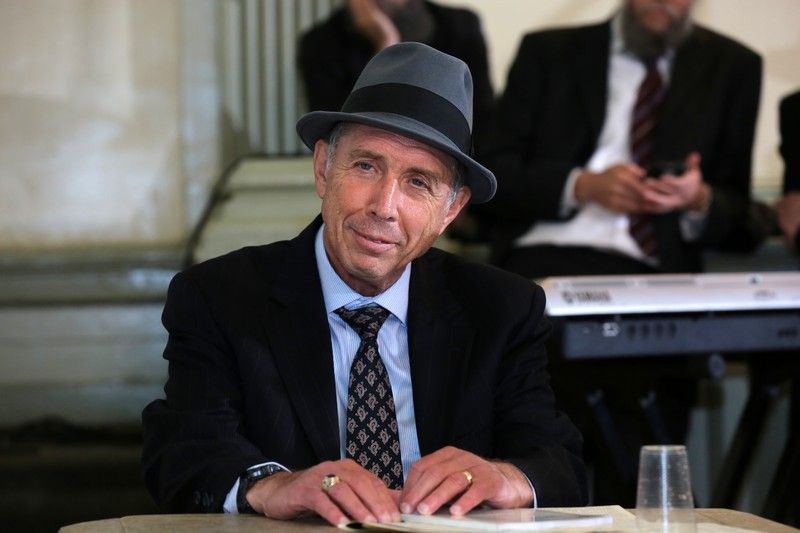
Dr. Ira Weiss, Senior Attending Cardiologist at Evanston Hospital in Evanston, IL, was a guest speaker at the Gobal Siyum Harambam held last week at Oholei Torah hall in Crown Heights.
Having merited an extremely close and unique relationship with the Rebbe, he shared how he was one of the few that the Rebbe confided in for his medical care after suffering a heart-attack on Shemini Atzeret, 1977.
The following are excerpts from his fascinating speech:
Thank you Rabbi Shmuel Butman for inviting me to join you… and I will tell you, that just coming into this room seeing some old friends of mine is very uplifting to me, and it is a big honor to address you at the Siyum Harambam.
As you know, the Rambam, like me, practiced medicine. I think he practiced it at a little higher level than I did and he had some added skills as well, but like the Rambam, I was confronted with very challenging problem when the Rebbe had a significant heart attack.
It was very unexpected and there were no symptoms that preceded this that gave any clues that this would happen, so everyone was caught off guard.
I myself was comfortably situated in Chicago getting ready for Yom Tov and having just finished our last major meal in the sukkah that night, we went to bed happily and waking up the next morning to go to shul when unexpectedly my medical emergency phone rang and it was Rabbi Yehuda Krinsky calling about a dire situation.
You see, normal doctors who are attending the Farbrengen at the time, or the joyful holiday at the time, wisely said that they could only take care of such a severe heart attack at the hospital. I think I would certainly credited them for using good medical judgement, but on the other hand the Rebbe himself had expressed such a strong desire to be treated there amongst his Chassidim and all the doctors in attendance thought that this was impossible to do, and they probably were right in most cases.
It happens that through my own exposure and training in Boston I had seen my mentor Dr. Bernard Lown, who ultimately won a Nobel Prize, a very fine cardiologist, he was capable, with the proper resources and energy, to put together private care for very important people of the society who didn’t want to be on display in a hospital.
And so he was familiar with how this was done, and I’ve seen this given to people like the Baroness de Rothschild when she had a heart problem with her heart valve. She assembled a private team that took her in her private jet to New Zealand where she had her heart valve replaced at the best center where this could be done. And low and behold, our little private team had to actually resuscitate her on a couple of occasions on the long plane flight to new Zealand, so I saw that you could really create a coronary care unit in a small space if you have the right equipment and the right personnel.
Rebbetzin Chaya Mushka Schneerson was concerned with the Rebbe’s wishes that he should stay with the Chassidim. I knew that this can be done.
I was coming in with the idea that I would be coming in at least 4 hours later. So, on a whim, I decided to call one of my old professors from Harvard who had been given the position of being one of the Heads of the Mount Sinai Hospital’s Cardiology Section in Manhattan, Dr. Louis Teichholz.
My mentor, Dr. Teichholz who is a very kindhearted man and a very fine person dropped what he was doing and promised that he would assemble the needed material and go into Crown Heights immediately.
I was given a police escort. I came into crown heights with a massive crowd all saddened by what was going on. And they took one look at me getting out of the police escort, I looked so young like a bar mitzvah, their hearts just sunk, they were thinking a big professor’s coming in, you know, who would have all the answers and solve all the problems.
So, I think I didn’t make the most logical impression when I got out of the police escort, but when I came to 770 I was greeted at the door by Rebbetzin Schneerson who told me, Dr. Teichholz, my friend, from Mount Sinai, had already arrived, plugged the Rebbe into therapies that were already really working dramatically well.
The Rebbe’s blood pressure restored, the Rebbe was now talking again like he normally talks, and it looked like he was on the upswing…and the rest became almost like a fable of how cooperatively we worked out, a team of doctors, we made a hospital that was second to none.
Why was it better than a regular hospital? Well, first of all, we had a very dedicated staff of doctors who worked in shifts that were not too long, so no one got exhausted. We didn’t make someone so exhausted they couldn’t think straight. We didn’t have a much of intermediaries like secretaries on the floor transcribing orders to the pharmacy, that would have to transcribe the order and ship the medicines back to the floor, we made our own single handed decisions on the medicines and carried out our orders as wen dictated them to ourselves as we worked in shifts for the Rebbe.”
Also because in those days patients who were in hospitals were heavily strapped to harnessed of wires that went to stationary monitors. There were no such things as wireless monitoring or, you know, telemonitoring. There was no such technology to the public.
Well, Dr. Teichholz, having friends at the National Aeronautics and Space Administrations, had someone go to the northern part of the New Jersey Turnpike to get Telemonitoring equipment for the Rebbe just like if he was in the space program. The spaceship telemonitored his results back to the space stations.
The Rebbe was wired for these important monitorings in a way that the Rebbe was able to walk around freely in his room. When the Rebbe put on his Kapote he looked like the Rebbe looked all the time.
And we had a very, very close association with the Rebbe we as the doctors were a body of about five or six people and each of us had different specialties and training along the lines of cardiology but we didn’t have identical opinions, so the Rebbe would sit with us daily to listen to what each of us offered and he, with his wisdom, would harmonize these divergent opinions that meant meaningful care that only someone as wise as the Rebbe could formulate by putting together the divergent opinions.
Just as if you went to five consultants you might get five different ideas and not know where to turn. The Rebbe knew where to turn.
Not only the Rebbe knew where to turn, he had ideas that were way beyond our imaginations. We explained to him what a heart attack was; it was a loss of a whole heart muscle so that the heart would not contract like this, but part of it would contract against scar tissue it would form where the injury was, and the Rebbe asked us, “Why settle for scar tissue? It doesn’t do anything.” He said, “Have you never heard of Stem cells and transforming Stem cells into muscle cells?”
We’ve never heard of Stem Cells, we didn’t even know what the Rebbe was talking about! We had to learn about Stem Cells because the Rebbe brought it up in his conversation. The Rebbe did this even in his confinement. Things like this went on and on.
We had so many examples of how the Rebbe showed that his training as an engineer, as well as a Rebbe, really paid off handsomely. He managed his case very intelligently and managed the subsequent years to get the most mileage out of his heart, and as you’ll recognize at the 15 years he was active after the heart attack he put such thrust in many endeavors, including the Siyum Harambam.
Also in the whole project of Shlichus that the Rebbe developed, a program that just expanded astronomically. It has one of the most important lasting legacies that even a non-Lubavitch person would be able to cite, when you would say the Lubavitcher Rebbe or the Lubavitcher movement, it would come to mind that you will find a representative at almost any part of the world. Through the Rebbe’s strong effort which were only strengthened in the time following his heart attack.
I got also to meet the Lubavitcher Rebbe’s wife, the Rebbetzin, he loved dearly. I can only remember that when he was freed from our coronary care unit, on Rosh Chodesh Kislev, I just happened to ask him, “How do you feel about being released?” Expecting like a mundane answer, like “I’m happy to get away from you guys and off all this monitoring,” but he gave me a very serious answer.
He said, “It’s not a medical victory, Dr. Weiss, it’s actually a family victory because I have a chance to have my daily tea with my wife in our home, and it’s a privilege I treasure as much as the privilege as putting on Tefillin in the morning.”
In other words to him it was that important, in that important part of the day, to honor his wife, to enjoy her company, and banter about a few things intellectually that they get a chance to do when they’re in private domain.
Over the years I also had many other wonderful stories to tell I can’t go into detail with them right now, but I will tell you that we are left with a leadership that put us in a direction where all of us in the room have the privilege and obligation to continue the Rebbe’s work.
And to understand how important this is, we’re at a point in the world where we need the Rebbe’s leadership more than ever and his not being here, right here physically with us, can be perhaps be partially compensated by our energy we put into what he taught us.
Meeting at convocations like this the Siyum HaRambam, doing the work that he recommended that we all do in our personal lives in our community lives, could only expand what the Rebbe did and make the difficult outcome that we were about to face, almost forty years ago, into a very positive outcome.
I want to thank you all for inviting me to give this brief little summary, all too brief. There is so much to tell but I wish you all very well a Gut Gebentched Yohr and with success in all the endeavors, especially those that have to do with improving this world under the direction of our dear Rebbe. Thank you.



The quote was said by the Rebbe, not Dr. Weiss.
You can see a real Onov when you look at Dr. Weiss. He can be a great mashpia to the young generation. When was the last time you heard a Rov or Mashpia say: He said, “It’s not a medical victory, Dr. Weiss, it’s actually a family victory because I have a chance to have my daily tea with my wife in our home, and it’s a privilege I treasure as much as the privilege as putting on Tefillin in the morning.” In other words to him it was that important, in that important part of the day, to honor… Read more »
Very interesting and informative speech. Thank you dr. Weiss for sharing this information and your thoughtfur analysis
Thanks again Dr Weiss for sharing. Great to hear of your Shelichus in helping the Rebbe get well.
Uplifting !!!
Moshiach Now!!!
PS – must pretty interesting for Dr weiss looking back
” And they took one look at me getting out of the police escort, I looked so young like a bar mitzvah, their hearts just sunk, they were thinking a big professor’s coming in, you know, who would have all the answers and solve all the problems.”
Dear Dr. Wiess we all worldwide want a published book for where you can and will elaborate on all of the above and more you were zoche to experience
please do so we are waiting and needing thank you!