
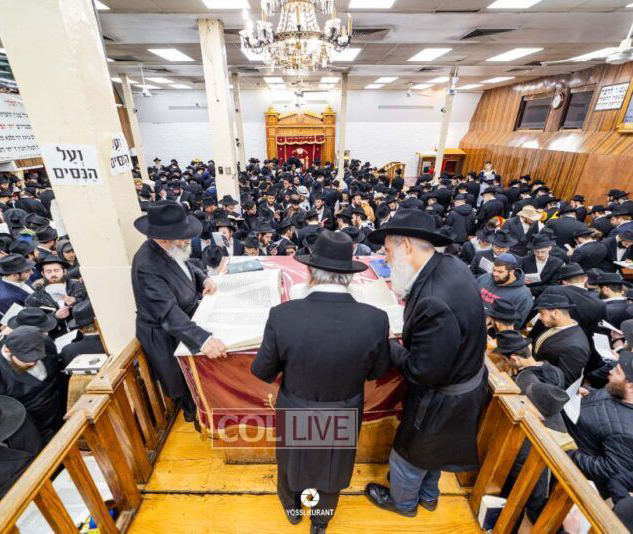
In this week’s Olam Hahalachah, Rabbi Mendel Prescott, Rosh Yeshiva of Machon Smicha, examines why we don’t celebrate two days of Purim.
Question: Why doesn’t Purim have two days is chutz la’aretz like the other Yamim Tovim do because of sfeika d’yoma?
Answer: The concept of sfeika d’yoma is rooted in the history of Jewish communal life during the times of the Mishna. In those times, Rosh Chodesh was not determined by a fixed calendar but rather through the testimony of two witnesses who had sighted the new moon. However, the calendar was not entirely dependent on this process. The Chachamim also applied a detailed system known as the sod ha’ibbur to calculate Roshei Chadashim,[1] creating a hybrid system — partly calendrically fixed but still effected by the timing of the testimony. Consequently, the exact day of Rosh Chodesh could never be predicted with certainty.
Originally, the announcement of the new month was transmitted via signal fires lit on mountaintops, which allowed for rapid communication.[2] This method was abandoned after the Minnim began deliberately creating confusion by lighting fires at incorrect times, to undermine the authority of the Perushim.[3] The system was then replaced by a slower but more reliable method — sending verified messengers from the central Beis Din to convey the information.[4]
In months containing Yom Tov, distant communities received the news only after Yom Tov had already begun. Due to the safek about the true date, these communities would observe two days of Yom Tov called Yom Tov sheini shel galuyos.
The Rishonim discuss why Yom Tov sheini shel galuyos is not observed for Purim; several explanations are offered. The Abudarham[5] quotes an early work called Mishmeres HaMo’ados who explains that a Yom Tov d’rabanan is not subject to halachos of sfeika d’yoma. Why?
The Gemara[6] notes that after the establishment of the fixed calendar, there was technically no longer any reason to observe two days, since there was no uncertainty about the correct date. Nevertheless, the original practice was preserved in case circumstances deteriorate and the calendar is forgotten. The Mishmeres HaMo’ados suggests that this concern was only for Yomim Tovim d’oraysa; since Purim is d’rabanan and less stringent, Chazal left it dependent on the fixed calendar.
The Pri Chadash[7] offers a similar but slightly different approach, explaining that for Yamim Tovim d’rabanan, Chazal chose not to impose the extra burden of an additional day. (He says this about Chanuka, but it can be extended to Purim as well.)
Another explanation, particular to Purim, is given by the Mordechai,[8] who cites the passuk “v’lo ya’avor” (“and it shall not pass”) as the reason why a sfeika d’yoma day cannot be established. The Gemara[9] uses this passuk as a basis for having the kfarim (villages)—who read the Megillah on a different day—perform the kri’ah before the fourteenth rather than after. The Mordechai applies this to sfeika d’yoma as well, saying that Purim cannot be celebrated on any day later than the fourteenth. (He seems to tie-in to this reasoning the issur of bal tosif as well).
From the wording of the Mordechai, it appears that his discussion primarily concerns kri’as Megillah rather than all the mitzvos of Purim. Many acharonim assume that he mentioned kri’as Megillah merely as an example, intending his reasoning to apply to all Mitzvos of Purim. Others, however, differentiate and argue that the Mordechai was indeed speaking only about kri’as Megillah.
The Munkatcher Rebbe[10] quotes Rav Chaim Vital, who reportedly practiced giving mishloach manos and matanos la’evyonim on Shushan Purim as well. He explained that this practice was because of sfeika d’yoma. He bases it on the Ran[11] in the context of Purim Meshulash (when Purim falls on Shabbos). The Ran writes that the Mitzvos of mishteh and simcha are fulfilled on Sunday – which is after the fourteenth day, since the rule of lo ya’avor applies only to kri’as Megillah, not to other Mitzvos. According to this reasoning, the Munkatcher Rebbe concludes that sfeika d’yoma could apply to the other Mitzvos of Purim which explains Rav Chaim Vital’s custom.
He further suggests[12] that this is why many Tzadikim in earlier generations observed Shushan Purim with a special seudah; the minhag originated from the concept of sfeika d’yoma. Following in Rabv Chaim Vital’s footsteps, the Munkatcher Rebbe himself observed this practice, performing mishloach manos and matanos la’evyonim on Shushan Purim.[13]
Another answer, offered by some Acharonim, such as Rav Shlomo HaKohen of Vilna[14] is based on the calendrical system. He explains that even during the times of the Mishna the months of the year by default alternated as malei and chaser (full and deficient)—Nissan being malei, Iyar chaser, and so on (as explained above). This result in Shevat normally being a malei unless otherwise declared by Beis Din. Hence, the sefak that distant communities faced was not about whether Purim should be delayed to the fifteenth, but whether it should be moved earlier to the thirteenth (in case Shevat had only twenty-nine days). To observe sfeika d’yoma on the thirteenth was not possible since the thirteenth is a ta’anis, inappropriate for Purim celebrations.
The question remains on the Mordechai: why does he focus his discussion on the fifteenth day, when the real issue concerns the thirteenth—and his explanation based on lo ya’avor does not address that? Several acharonim (the Chasam Sofer,[15] the Tepliker Rav,[16] and others) note that under certain calendar configurations the safek could indeed involve the fifteenth—for example, if Cheshvan or Kislev were chaseir (which is possible according the fixed calendar) then the fifteenth of Adar is included in the safek because of the chance that one of them ended up being maleh pushing off the next few months one day.[17]
Still, we must ask why the Mordechai ignores the possible safek of the thirteenth, which would seem to create a three‑day safek.
Perhaps we can suggest that he dismissed day thirteen and only address the fifteenth due to the principle of rov—with two days opposing one, the minority day becomes halachically insignificant. But, once the thirteenth passes, only two days remain in the safek; since they are equal, both must be observed mi’safek.
Read the answer and download the full Olam Hahalachah publication.
Sign up to receive the Olam Hahalachah each week straight to your inbox by clicking here.
[1] ראה מס‘ ראש השנה (כ, ב). עיין עוד ברבינו בחיי פרשת בא (יב, ב). ובפרקי דרבי אליעזר (פרק ח) תיארו חז“ל השתלשלות מסירתו מדור לדור.
[2] מס‘ ראש השנה (כב, ב)
[3] שם
[4] שם
[5] תפילות פורים
[6] ביצה (ד, ב)
[7] סימן תרע (ד“ה והטעם)
[8] מס‘ מגילה (רמז תשעה)
[9] מס‘ מגילה (ב, א)
[10] נימוקי אורח חיים (סימן תרצה אות ז)
[11] מס‘ מגילה (ג, א דפי הרי“ף, ד“ה מתני‘)
[12] בשו“ת מנחת אלעזר חלק ב (סימן ה)
[13] ספר דרכי חיים ושלום (אות תתנד)
[14] בספרו חשק שלמה מס‘ מגילה (ד, ב). ראה עוד בהר צבי (או“ח ח“ב סי‘ קכד) שדן בדבריו. ע“ע שו“ת מנחת עני (סי‘ כז) על זה.
[15] בהגהותיו על השו“ע בט“ז סימן תרפח (סק“ד)
[16] בספרו דברי אהרן סימן ח (אות ג)
[17] עיין במקור חיים (לבעל נתיה“מ) בהערות בסוף הספר על הט“ז (הלכות מגילה סימן תרפח) שהשיג על זה מהגמ‘ בר“ה (כא, א) דאמרינן תרי ירחי חסירי [זה אחר זה] קלא אית להו, וה“ה לענין תרי ירחי מלאי. ונמצא דלעולם א“א שיחול הספק ביום ט“ו, ע“ש. אבל בדבר אהרן יישב קושייתו.




The Rebbe speaks about this during the Farbrengen of Purim 5719 And gives a beautiful answer al pi chassidus
It used to be it could be 2 days, if on 14th Adar was not known there will be second Adar or not so celebrated, and then if it turns out there will be second Adar, it is celebrated again because somuch legeulah it is not just chasidishe vort, it is a law from mishna