By COLlive reporter
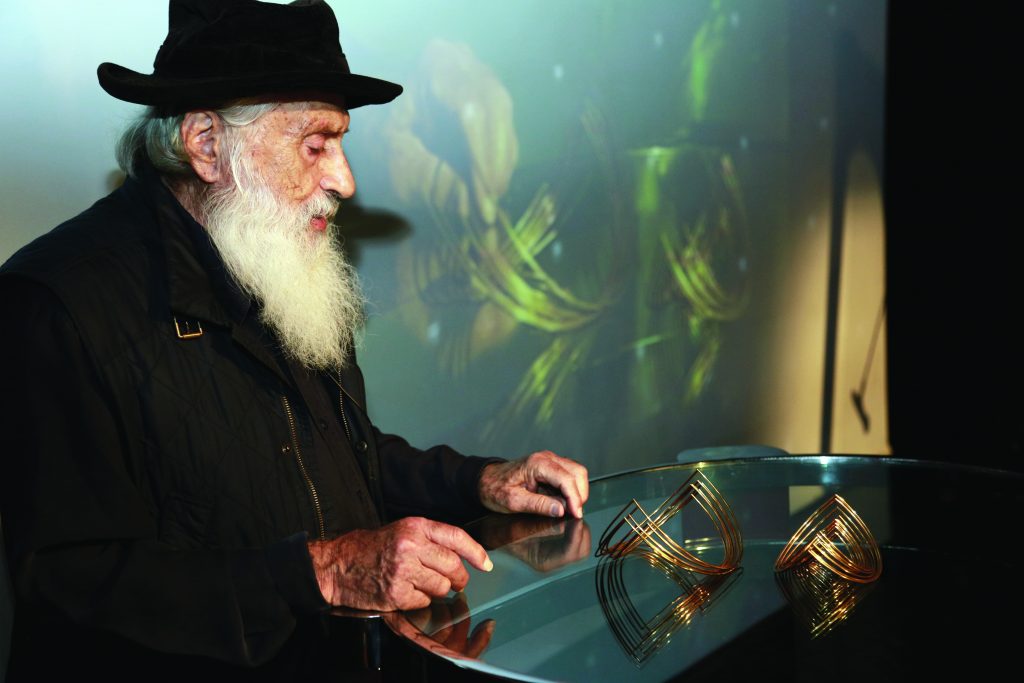
Israel’s highest cultural honor, the Israel Prize, will be awarded this year to renowned artist Yaacov Agam, whose work has left an indelible mark on Jewish life, Israeli culture, and public spaces around the world.
The 2026 Israel Prize for Visual Arts—Painting, Sculpture, and Photography—will be formally presented following Israel’s 78th Independence Day.
Education Minister Yoav Kisch announced the selection, citing Agam’s pioneering role in kinetic and op art and his decades-long contributions to Israeli and international visual culture.
The prize committee—chaired by Dr. Chaim Perluk and joined by Prof. Gilad Dovshani and Dr. Nurit Sirkis-Bank—praised Agam for “breaking the boundaries of traditional visual art” and creating works defined by movement, transformation, and the active participation of the viewer.
His art, the committee noted, reflects a worldview in which reality itself is dynamic and continuously unfolding.
For Chabad and Jewish communities worldwide, Agam’s legacy holds a particularly profound resonance through one iconic creation: the world’s largest menorah, erected at Manhattan’s Grand Army Plaza and lit publicly every Chanukah since 1986.
From Chutzpah to a Jewish Masterpiece
The story of the menorah began in late 1977, when Lubavitch Youth Organization (Tzach) activists first erected a towering menorah in Manhattan. It stood proudly, but aesthetics were not yet part of the equation.
That changed when Atara Ciechanover, following a meeting with the Rebbe, suggested commissioning a true artist for the task. She proposed approaching her close friend, Yaacov Agam, already internationally celebrated and then based in Paris.
Agam accepted the request out of deep reverence for the Rebbe, though not without hesitation, according to an article on Chabad.org. The project, he felt, carried immense symbolic and spiritual weight.
What followed was a meticulous, months-long process, with Agam donating his artistic services and personally overseeing every stage of the design and construction together with Tzach’s Executive Director, Rabbi Shmuel Butman OBM.
Sketches were reviewed, refined, and even brought before the Rebbe for approval. When questions arose about deviations from the Rambam’s classic menorah form, the Rebbe emphasized that while the diagonal branches were essential, an artist of Agam’s stature must be given room for authentic expression.
After a miniature model sat on the Rebbe’s desk for several days, approval was given.
When the menorah was lit for the first time on December 26, 1986, it immediately transformed the Chanukah landscape. No longer merely large, it was unmistakably Jewish, modern yet ancient, bold yet rooted in tradition.
“I didn’t only want to create something beautiful,” Agam once explained. “The Romans could also create something beautiful. I wanted something beautiful and Jewish—modern, yet true to its roots.”
That vision succeeded beyond measure. Millions of people—Jews and non-Jews alike—have encountered the menorah over the decades, making it one of the most recognizable Jewish symbols in the public square.
VIDEO: Artist and sculptor Yaakov Agam presents the Rebbe with a small model of his newly designed public Menorah on 26 Kislev, 5747 (1986)
Now 97, Agam is one of Israel’s most celebrated artists, with works displayed at the Guggenheim Museum in New York, museums across Europe, and iconic public sites in Israel. Yet for countless Jews, his most enduring contribution is the menorah that stands each Chanukah at the heart of New York City, proclaiming Jewish pride, faith, and continuity.
With the awarding of the Israel Prize, the State of Israel formally honors an artist whose work has illuminated not only galleries and plazas, but Jewish identity itself—quite literally bringing light to the world.
VIDEO: