
by Rabbi Dovid Hordiner
For an artist, creative expression, like Chassidus for the Chossid, reveals the depths of the G-dly soul. Creating a work of art brings Hashem into the mind (idea), heart (feeling), and body (act of creation). In this way, communicating Torah teachings in artistic form unifies the spiritual and the physical, both in Torah and in the artist, and by extension, in the audience. This article will explore the Lubavitcher Rebbe’s perspective on the importance of the arts and share insights from many of today’s active and prominent Jewish artists.
In the maamer V’Shavti V’Shalom 5738, the Rebbe teaches that when we serve Hashem in the areas of our lives that are not inherently ‘kedusha’ and purify our material existence, this accomplishes the greatest Dirah B’Tachtonim.
Further, “Art can help an individual document his or her attempts to turn a life into a Dirah B’Tachtonim in especially moving or striking ways…” writes poet Yehoshua November, “…and in this sense, the art itself becomes part of the Dirah B’Tachtonim.”
Visual artist Yitzchok Moully explains how this connects to each artist personally in that, “Creativity is about making what matters to you come alive. The process of Chochma, Bina and Daas is very much a creative process. The question is what matters to us, and how do we express that through our unique lens on life.”
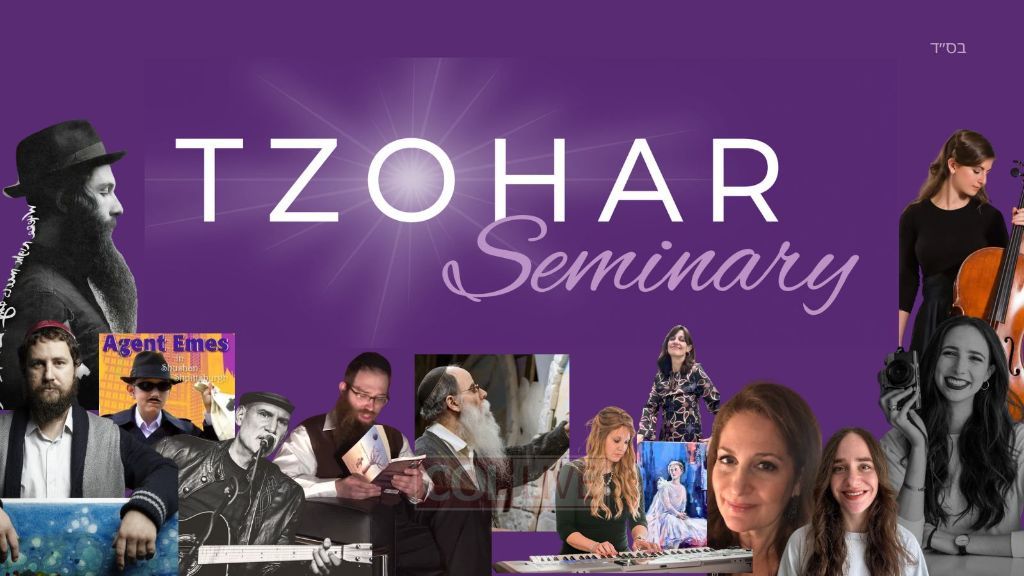
Amy Guterson is a Playwright, Theatre Artist, and the founder of Tzohar Seminary, the only seminary in the world dedicated to Chassidus and the arts. Noting how the arts allow an individual to emulate Hashem’s ways, she says, “The creative process exists in every part of Creation. Hashem is the Great Creator, creating something from nothing, and we mirror His in our smaller way of creating. In fully living in Hashem’s image, we have a duty to create, each of us in our own way. The creative process itself is G-dly and the different arts are languages to express our piece of revealed Holiness, that only we can express.”
Echoing Guterson, composer and songwriter Sarah Dukes shares, “The unique talents that Hashem gives each of us are His special gifts to us. He trusts us to use them to inspire others and bring more beauty into the world. Sharing our talents is not just a personal mission— it is a Divine responsibility.”
On top of this responsibility, the arts can express “the rich and vast treasures of Chassidic teaching,” writes Chassidic Artist Michoel Muchnik. “…[Art] offers creatively minded individuals a beautiful way to meditate on these truths, while the finished works of art can inspire and teach others.”
This reflects sentiments from the Rebbe in a letter dated 5 Kislev, 5728. The Rebbe writes that art is “…the ability to transform, to a certain extent, the material into spiritual…how much more so if the art medium is used to advance ideas, especially reflecting Torah and Mitzvot, which would raise the artistic skill to the highest level.” In this way, elevating creative expression and the arts to holiness fulfills the value of ‘b’chol deracheha deihu’— serving Hashem in all areas of our lives.
In support of this idea, Leibel Cohen, creator of the Agent Emes video series, says that “When aligned with Chassidus, the arts don’t compete with spirituality—they reveal it. During my years teaching at Tzohar Seminary, I was able to apply lessons I learned while creating Agent Emes, seeing firsthand how disciplined creativity can become a powerful keili in Avodas Hashem.”
In a letter from 24 Adar II 5711, the Rebbe likens artistic representation to refinement of the mundane, in that it has the power to bring forth the subject’s inner truth. The Rebbe writes that just as “An artist reveals in his art, the essence and being of his subject…[so too] each of us must bring to the surface the G-dlineness inherent in everything in our lives.”
This mirrors the power of the arts to reveal that same truth, not just in the subject, but in the artist. “Art is a spiritual practice,” says singer-songwriter and musician Levi Robin. “Art can really help a person bring forth their own pnimiyus, bring their own inner world right to the gates of Chassidus, and thereby you bring your Chassidus back into your own art.”
Highlighting the arts’ ability to refine the artist, Freelance photographer and Tzohar alumna Arianna Sharfman reflects that “Through my photography, I’ve learned how much beauty and meaning exist in the ordinary. The arts matter because they help us become more present, more sensitive, and more aware of the G-dliness around us.”
Ultimately, artistic expression is G-dly revelation, which achieves the ultimate mission of bringing the wellsprings of Chassidus out into the world. “As Jews and Chasidim our community understands the power and importance of everything we see and hear,” writes Tzohar alumna Chana Corna, lighting artist at Netflix Animation Studios and former animator at Marvel Studios. “The arts harness that profundity and have the power to speak to the deepest parts of our Neshama.”
“Never before,” says Tanya Cohen, visual artist, “has something so unordinary taken place; learning Chassidus through artistic interpretation, and art through a Chassidic perspective,” writing about Tzohar Seminary when it first opened in 2011. “The Rebbe said that music reaches deep into the human soul, to places we cannot reach in ordinary ways. I believe this is true for any form of art.”
Taking this idea even further, Peter Himmelman, singer-songwriter and musician, visited Tzohar Seminary where he led a musical farbrengen with the students. “Tzohar Seminary is unique in that it draws upon the strengths of two fundamental elements of Judaism: Torah and its lived expression in the real world. Creativity, in its truest sense, is not tangential to life,” says Himmelman. “Creativity is imperative—not something to shy away from. Tzohar understands that where creativity lives, so too does the Jewish spirit.”
When someone gets the chance to live that imperative and explore their creative talents, their ability to bring the light of Torah into themselves and the world increases. The earlier in life this opportunity arises, the more foundational it can be to a person’s way of living. The period after graduation from high school is ideal for this type of exploration, just before the wide possibilities of the world begin to unfold for a young mind and heart.
“I see Tzohar Seminary as being an ideal environment for young Jewish women to gain meaningful and deep experiences with both Judaism and the arts,” says cellist Laura Melnicoff, “and they can gain critical skills as well as showcase their work among the support of mentors and peers who value them for who they are. I believe this will serve them in all facets of their life.”
Tzohar Seminary, located in the vibrant and supportive Jewish community of Pittsburgh, is the only seminary that brings Chassidus and the arts together. At Tzohar, young women deepen their connection to Hashem with the study, embodiment, and expression of Chassidus, through various artistic media, under expert instruction. In this unique way, Tzohar provides a crucial piece of the picture of spiritual development in young adults.
Tzohar Seminary is currently accepting applications for the 5787/2026-27 seminary year.
Click here to apply: www.tzoharseminary.com/application.

Beautiful piece!
🎉❤️
would be soooooooo nice
Until Moshiach is fully here, and may it be now, we do need to acknowledge that not everyone is going to heal just by learning Torah and Chassidus. We still go to doctors, therapists etc There are Yidden that for whatever reason don’t have a mashpia, and/or are not using Tanya and Maamorim and Sichos… to help them grow emotionally and mentally. So we do as a community need to ensure that there are places and ways for everyone to have a safe space to work on their growth, that is completely in line with the Torah (and Chabad Hashkafos… Read more »