
The following Q & A is an excerpt from the Olam Hahalachah weekly publication, produced by Machon Smicha. Download this weeks Olam Hahalachah.
Sign up to receive the Olam Hahalachah each week straight to your inbox by clicking here.
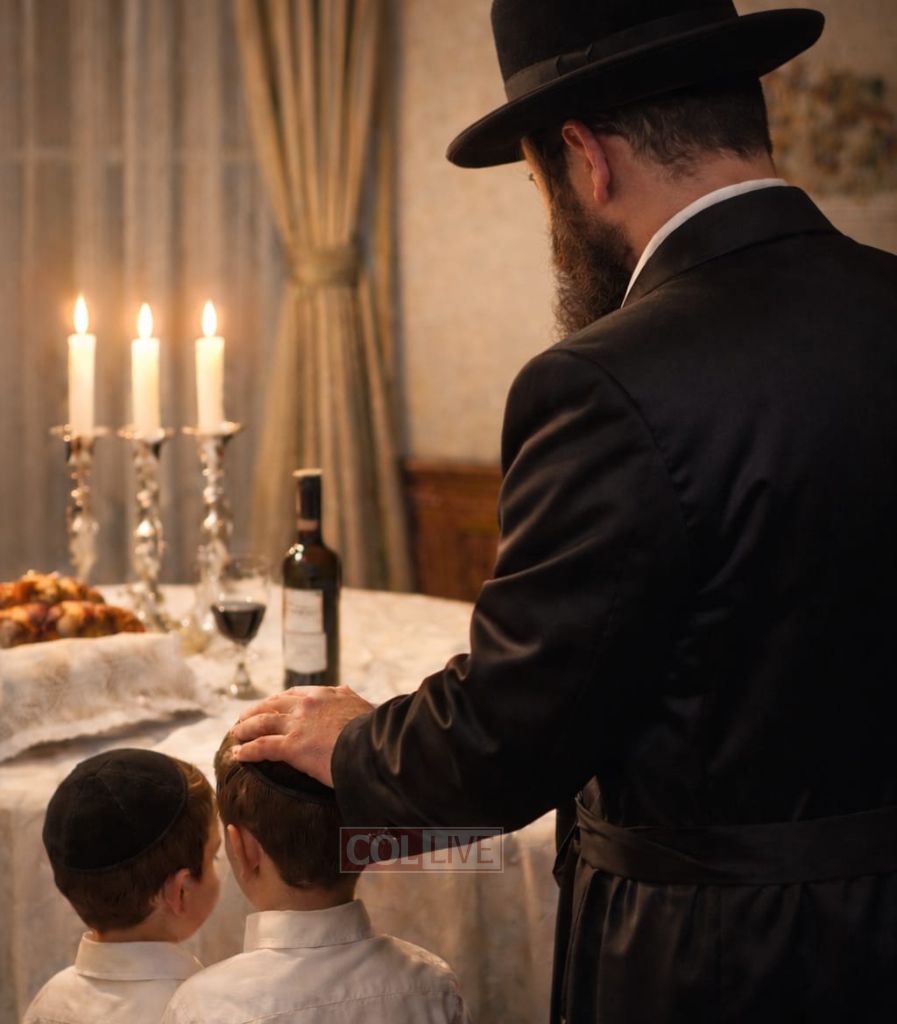
Question: Many people have the minhag to bentch their children on Friday night saying “yesimcha Elokim k’efrayim…” while placing their hands on the child’s head. What is significant about Friday night? And why do some people use only one hand?
Answer: The prevailing minhag in Chabad is to give Birchas HaBonim only on erev yom kippur; however, the minhag of doing so every leil Shabbos is widely practiced and can be traced back quite far. Its earliest source is in the sefer Me’ah She’arim, written by Rav Eliyahu Kapsali. He was one of the great Torah personalities of the 15th century, born in Candia, Crete (off mainland Greece), educated under the European gedolim, and eventually serving as chief Rabbi of Candia. He first encountered the minhag in Padua, Italy, while studying in the Mahari Mintz’s yeshiva and he was apparently very taken by it.
He describes as follows: Every leil Shabbos and Yom Tov after Maariv, children approach their fathers and bow before them, and kiss their palms. The father places his hands on the child’s head and benches him. Even older men, with children and grandchildren of their own, demonstrate humility by approaching their parents with deference to receive a bracha.
He writes that upon witnessing this minhag, he resolved to practice it when returning home – and hoped that his own children would continue the tradition. (Unfortunately, he wasn’t blessed with children, as he notes with sorrow, and was unable to pass on the minhag.)
He cites a possible source for the minhag from the Gemara, which records Ulla’s practice after leaving the Beis Midrash. Rashi explains that this practice was common after leaving shul. People would kiss the palms or knees of their parents as a sign of honor.
A later source can be found in the writings of the Maharal’s older brother, Rav Chaim, who references the minhag in Sefer HaChaim, adding that some receive a bracha from their rebbe as well. During the same time period, Rav Aharon Berechya (of Modina, Italy) refers to the minhag and highlightes that Friday night is an auspicious time for the bracha.
The Peleh Yoetz also mentions the minhag and adds that a child fulfills the mitzva of kibud av through this as he respectfully submitts himself to his father when requesting a bracha.
The minhag has yet earlier origins, though in a different form. The sefer Minhagei Worms records the custom of children approaching the Rav on Friday night after Kiddush (done in Shul), who then would bless each child.
Why leil Shabbos?
Various reasons are given for this significace of this time. One reason is that on leil Shabbos brachos are more potent, it is a time when the channels of bracha open. Similarly, some sources say that at the onset of Shabbos, the Satan and other negative forces have no power to interfere with brachos.
Another more practical, approach is that during the pressures of the week, a father may reprimand his children harshly. Therefore, the week begins with a bracha blessing to counterbalance any potential negativity that might arise.
The Chasam Sofer and Chida explain that for a bracha to be most effective, the mevareich needs to be in good spirits. This is why Yitzchak Avinu instructed Eisav to prepare him mat’amim before the bracha.
Likewise, the Rama writes that Birkas Kohanim is done only on Yom Tov when people are in good moods. So, during leil Shabbos, as the grind of the week eases and tranquility reigns, one is in the proper frame of mind to give a bracha.
Why are the hands placed on the child’s head?
In the Torah, brachos are given by placing hands on the recipient’s head, as demonstrated in this week’s Parsha when Yaakov Avinu benched Efrayim and Menashe. The Yaavetz notes that malachim also have this practice, as mentioned in the Gemara about the two malachim that escort a person from shul on leil Shabbos. They bentch the man with placing their hands in his head.
The Yaavetz addresses why both hands are used for this minhag although Yaakov Avinu used only one hand per child. He explains that both boys approached Yaakov Avinu at the same time, leaving him no choice but to use one hand for each. Barring such circumstances, the Yaavetz strongly advises that brachos should be given with both hands. The Chida gives various reason b’derech remez supporting the use of both hands.
However, there is another side to the coin. Some sources argue against using both hands because it resembles birkas kohanim which is also done with two hands. Since birkas kohanim is off-limits for a Yisrael, as the Rama paskens, a visible difference is observed by using just one hand. This concern is brought up by Rav Baruch Epstein in his Torah Temimah where he recounts a story of the Vilna Gaon benching Rav Landau at his chuppa with placing just one hand on the chosson’s head. When asked why only one hand was used, the Gaon answered that only Kohanim gives brachos with two hands.
Despite this, the minhag of using both hands is the more common way to betnch nowadays. Several ideas are said to answer the birkas kohanim issue. The Ksav Sofer and Kaf HaChaim maintain that the issur for a Yisrael to perform birkas kohanim applies only when the intention is to give the bracha with the as a birkas kehunah, not when giving an ordinary bracha.
The truth is that this aside from the issue of placing the hands, the minhag itself raises the same question since the text of the bracha is that of birkas kohanim. The Biur Halacha addresses this and suggests, similar to the Ksav Sofer and Kaf Hachaim, that reciting this bracha without intent for birkas kehunah is permitted.
Another answer is based on the Pnei Yehoshua and Minchas Chinuch, who say that the issur is limited to the Beis HaMikdash, not elsewhere.
The Chazon Ish explains the idea for the issur, which may indicate why it does not apply here. The problem with a Yisrael performing birkas kohanim is that he encroaches upon the Kohanim’s role thereby detracting from their honor. But a father giving a bracha to his son is natural, and doesn’t indicate usurping the kohanim’s position.
It is worth noting that the story told by Rav Baruch Epstein is just one version. Others recount that the Vilna Gaon intended to place both hands on the chassan’s head but refrained because one hand was not clean. When asked if one hand would suffice, he responded that two hands are only needed for birkas kohanim. This version suggests that two hands, while not necessary, is permitted.
Rav Moshe Dovid Rivkin shares accounts from the final moments of the Rebbe Rashab’s life. The Rebbe placed both hands on the head of his son, the Friedike Rebbe, and benched him with the pesukim of birkas kohanim. Rav Rivkin cites the Torah Temimah’s reservations, but strongly disagrees, asserting that the true story about the Vilna Gaon is the second version.



The explanation that it is “natural” and therefore doesn’t contradict the Chazon Ish’s approach is not halachically sound. A father certainly does not need to use Bircas Kohanim! There are other Brachos (see approach of the Ramban to Brachos at a Pidyon HaBen for example). On the contrary, a Chashash of countermanding VeKidashto would imply the opposite! By the way, I’m informed that the Rayatz didn’t use the Lashon of Bircas Kohanim on Erev Yom Kippur?
יצחק הכהן בלבין
If the father is not present? Or wifes with their husband?
The Mateh Efraim records that the minhag was for both father AND mother to bench their children Erev Yom Kippur
יצחק הכהן בלבין
With the hands thing also?
And, also during a regular shabbos then it will be the same?
I think that our Rebbe said that when we meet another Yid, we can give the Brocha of Birchas Kohanim. (Bshaim U’vmalchus) I always say this Brocha to people who go on a trip.
Provide a Mekor please for this. Either way it is NOT Birkas Kohanim because Chabad precede it with Vayedaber and end with VeSamu (as we say after Birkas HaTorah in the morning). In my opinion that obviates Halachic irregularity.
יצחק הכהן בלבין
My father benched me every LeilShabbos Kodesh and Yom Tov. Because it is ingrained in me, when benching my children before Kol Nidrei, many Lubavitcher in shul see me and quickly round up their kids to bentch.
The prevailing minhag in Chabad is to give Birchas HaBonim only on Erev Yom Kippur.
I have a question for everyone.
Which way did the Rebbe turn around when the singing of lecho dodi. Was it to the left counter clockwise and which way did he turn back.
I remember the rebbe turning to his left (not towards the wall).
As far as I know he turned left counter clockwise. He turned back also left counter clockwise
תהילת השם brings that it’s to the left and then left. Double check there
And when done finish the full circle.
Do people say ושמו את שמי etc in regular shabbos too? After boy and after girl?
BS”D Is it correct that the Rebbe said words to the effect of “Why are we bringing in new minhogim”?
I think you are referring to the yechidus with Rabbi Emanuel schochet. A young child at the time rabbi Yitzchok Schochet cried so the Rebbe gave him birchas kohanim. Beautiful story