The following Q & A is an excerpt from the Olam Hahalachah weekly publication, produced by Machon Smicha. Download this week’s Olam Hahalachah.
Sign up to receive the Olam Hahalachah each week straight to your inbox by clicking here.
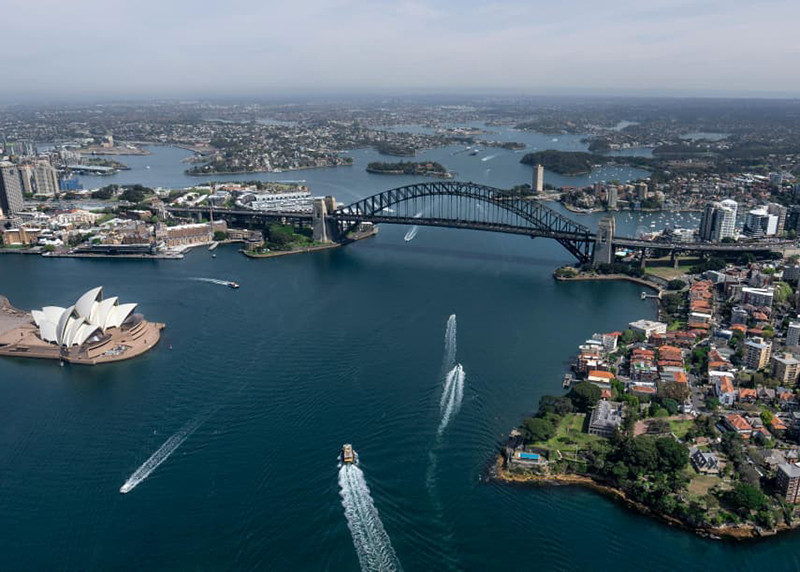
Question: I live in Australia, and as the rest of the world begins saying v’sein tal umatar, our summer is just beginning. It seems strange to ask for rain when it is neither needed nor helpful here. Why are we expected to follow the seasons of the northern hemisphere instead of our own local seasons?
Answer: The idea of making a distinction in the timing for v’sein tal umatar by location is not new. The Gemara teaches that in Eretz Yisrael, it begins two weeks after Sukkos, while in chutz la’aretz, it starts in early December the 4th or 5th, depending on the year). This difference is not related to kedushas ha’aretz; rather to the natural features of the land which influence its rainfall needs, as explained by Rashi. Eretz Yisrael is at a higher altitude and retains less water than other areas of lower altitudes, such as Bavel, where the land is wetter and only requires rain later in the season.
In principle, each region should be evaluated individually based on its needs. The Rosh was of this opinion, and in the year 1313, when Spain suffered a winter-long drought, he announced on the first day of Pesach that mashiv haruch and v’sein tal umatar should continue after Pesach due to the needs of the land. This psak led to a stir in the community, as his contemporaries held otherwise. They cited the Gemara saying that the community in Ninveh, which needed rain during the summer, asked Rabbi Yehudah Hanasi whether they should continue v’sein tal umatar after Pesach, to which the answer was negative. He instructed them to say it in shomeah tefillah instead. (The Rosh differentiated between a city, like Ninveh, and an entire region.) Ultimately, the Rosh retracted his psak to avoid division within the community.
Following this, the Shulchan Aruch rules that the time for v’sein tal umatar is fixed for all of chutz la’aretz, both for when to start and stop. If a region needs rain, she’eilas matar should be added in shema koleinu.
This brings us back to your central question: what should be done in the Southern Hemisphere? The fact that all of chutz la’aretz follows one practice regardless of specific regional needs, may only apply to the Northern Hemisphere, where all regions share a common seasonal cycle. But in the Southern Hemisphere, where the seasons are opposite, it seems unreasonable to ask for rain when it is unneeded and unwanted.
This question is not addressed by the Rishonim as it did not have practical relevance in their time. The earliest discussion of this issue can be found in a teshuva by Rav Chaim Shabsi (1557–1647) of Thessaloniki Greece, in the 17th century addressed to members of an early Jewish settlement in Recifi Brazil who inquired about the timing for v’sein tal umatar.
After a detailed explanation of the geographical and climate facts, he analyzes the halacha and concludes that they should not say v’sein tal matar during their winter (from Pesach until Sukkos) even though they may need rain. He saw no reason to treat the Southern Hemisphere differently due to its inverse climate. However, he states that during their summer (after Sukkos), they should not say v’sein tal umatar since rain would be detrimental for them. In short, the Brazilian community should never say v’sein tal umatar, except in shema koleinu when in need.
In the mid-19th century, the question resurfaced as more Jewish communities began to emerge in the Southern Hemisphere, notably the Syrian community in Buenos Aires, Argentina. They were instructed by Rav Ezra Trab of Damascus, to follow the way the Maharchash ruled for Brazil. During the same period, communities in Australia and New Zealand posed the same question to Rav Nosson Adler of London, who also advised them to adhere to the Maharchash’s ruling. When a community was established in Sydney, Rav Shmuel Salant of Yerushalayim was consulted and likewise instructed them to follow the Maharchash.
Later, in 1891, Rav Avraham Ever Hershowitz arrived in Melbourne to serve as Rav of the Shomer Emunim kehillah.He took particular interest in the question of v’sein tal umatar and dedicated a significant portion of his sefer, Beis Avraham, to this topic. Rav Hershowitz rejected the comparison between Australia and Brazil, explaining that rainfall in Australia is beneficial throughout the year. Since rain is not a siman klalah, there is no reason to refrain from she’eilas geshamim during the Australian summer.
His ruling was that Australians should recite v’sein tal umatar just like the rest of the Northern Hemisphere, outside of Eretz Yisrael. He explained his reasoning in a letter to his rebbe, Rav Yitzchok Elchanan Spector of Kovno, who subsequently gave his approval. He also wrote to Rav Shmuel Salant, who withdrew his original psak agreeing with Rav Hershowitz based on the new information he provided.
Some poskim note that in more recent times, technological advances allow for the repurposing of excess water for later uses. Many Australian homes and farms invest in rainwater harvesting systems which collects and stores water, evening out the water supply. This is another consideration when determining whether rain is a siman klalah in the summer.
In the 1970s, the Minchas Yitzchok addressed the issue again for a newer community in Buenos Aires that sought guidance. He noted that it is difficult to issue a blanket psak for the Southern Hemisphere since the need for rain varies by region. He quoted the Satmar Rebbe, who advised those communities to err on the side of caution and insert v’sein tal umatar in shema koleinu during their summer. But the chazzan should not include it during chazaras hashatz. Rav Bentzion Abba Shaul also ruled in this manner.
Among the poskim, there is yet another school of thought differing from the Maharchash, saying that Southern communities need not adopt a different practice than the rest of the world. V’sein tal umatar l’vracha is a general bakashah for all of Klal Yisrael, and can be meant for those who need it. Rav Yehoshua Aharonberg held this view and ruled it for the community in Uruguay, although he noted that any community that had already accepted the ruling of the Maharchash should continue to do so. This opinion is also supported by Rav Moshe Sternbuch, who gave a similar ruling for Cape Town, South Africa.
Rav Shmuel Wosner presented a unique approach, suggesting that the Southern Hemisphere’s practice should be inversely compared to the Northern Hemisphere. He explained that even though the poskim established a fixed practice for all of chutz la’aretz, that is true for regions where winter follows Sukkos, like in Eretz Yisrael. In locations where the cycle is opposite, the same pattern applies but in reverse, starting v’sein tal umatar on Pesach and concluding at Sukkos. [It is debatable, according to this, whether the tefillas geshem should be said on the last day of Pesach like on Sukkos or perhaps on the first day, since there is no siman klalah for rain on Pesach.] Nonetheless, Rav Wosner considered this approach a chiddush, and hesitated to apply it l’maaseh.
When Chabad Chassidim began to settle in Australia, the minhag there was to follow Rav Hershowitz’s opinion that Australians do as the rest of chutz la’aretz. In 1982, on Tu B’Av, the Rebbe discussed the matter and favored Rav Wosner’s approach. Chabad rabbonim asked the Rebbe whether they should change their minhag. The Rebbe response was, “don’t change anything lest you cause machalokes. Instead, invest your energies in ahavas Yisrael.” Later, the Rebbe requested that the sugya be organized with all the sources included, allowing the lomdim to analyze the inyan for themselves.