
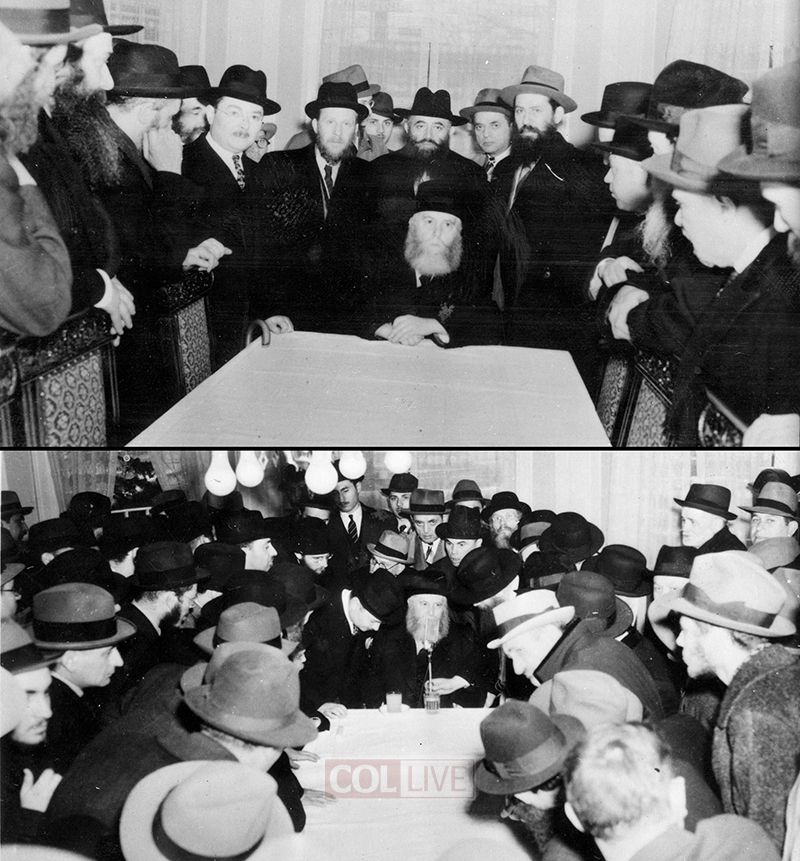
How did the Rebbe heal a gravely ill – and religiously skeptical – woman? How was his father-in-law revived by a Chassid’s blessing? The Avner Institute presents two fascinating anecdotes, as told by Rabbis Yekutiel Farkash and Akiva Wagner a”h: one, of the Rebbe’s powers of insight and spiritual remedy; the second, a follower’s earnest devotion which can restore a Rebbe’s health and vigor.
In loving memory of Hadassah Lebovic A”h
“Because the Mind was Blocked”
Rabbi Yekutiel Farkash relates:
Thanks to my wife, who worked for a neurologist at Hadassah Hospital, I became a regular visitor there. In time I developed a friendship with a certain doctor there, an oncologist from South America. Although his family had been cut off from Judaism, he managed to renew certain ties because of patients who asked him to write to the Lubavitcher Rebbe for a blessing. He did so willingly: he would sit down and compose letters. The answers always came.
Taking advantage of his interest in Kabbalah — the “in thing” for many secular Jews – I started learning Hassidism regularly with him at his house. The Tanya, the seminal Lubavitcher work and foundation of faith and Torah, would be the vehicle through which, I hoped would lead to practice. It did in fact get the doctor started: he began laying tefillin every day, wearing a kippa even at work, and keeping Shabbos.
But his wife, despite my convincing arguments, remained stubborn. She insisted she was happy with the status quo and absolutely refused to change. She even served as the “Shabbos goy” in the house – turning lights on and off, checking the stove, etc., while her husband tried to avoid these activities.
Tragic Condition
I had had to go away for a while before I returned to town and went to the doctor’s home for the usual lesson. I knocked again and again, but no one answered. Finally, the doctor opened the door. He looked haunted and pale, as if in great shock.
He bade me in. I noticed right away that the house was dark and shuttered, the atmosphere eerily gloomy.
“Is something wrong?” I asked.
“My wife,” he whispered. Apparently over the past week she had suffered a series of seizures. Her entire body would convulse violently. She had been hospitalized at Hadassah and attended to by her employer, a renowned expert, but to no avail. She was finally sent home. So debilitated had she become that she could not get off the bed without being carried.
“I’m afraid that she’ll soon . . .” the husband couldn’t finish.
I placed my arm around his shoulder in sympathy. “It is forbidden to despair. When there is life there is hope. You must write to the Rebbe for blessing and advice.”
The husband mumbled, “I’m afraid I don’t act that simply. I must ask my wife’s permission.”
His wife lay in her room, alert but haggard. When we entered she stared at her husband impassively – at me, in contempt.
When the husband told her my suggestion, she somehow summoned enough strength to snap, “That is absurd. What would the Rebbe know? He doesn’t have my medical file. He can’t tell me anything.”
“But Señora,” I ventured, “what you say would be correct if we were talking about an ordinary human being. But the Rebbe . . . .”
She still said no. Watching her there, lying helpless but defiant on the bed, I decided that extreme measures were called for.
“All right,” I countered, “you must remain obstinate. But what happens when you won’t survive? On your gravestone it will say, ‘She died and left her husband a young widower and two children orphans because she sacrificed her life not to write to the Rebbe.’”
At the mention of her two children, something stirred within. To my surprise, she agreed.
Fateful Message
I sat down and wrote a long letter to the Rebbe. I turned to the husband, who kept glancing over my shoulder, and said, “I’ll get this faxed. Meanwhile, you must sleep in the living room near the phone. You don’t know when you will receive a call.”
On Friday, I called the doctor’s home. The wife answered.
“Nu?” I asked. “Any news?”
She said, “The Rebbe called.”
I stiffened. “Well? What did he say?”
“Something about the kashrus of food and drink. He said, ‘I will mention at the tziyun.’” Meaning the gravesite of his father-in-law Rabbi Yosef Yitzchak Schneersohn, the Frierdike (Previous) Rebbe.
She then asked, “What does that mean? No more shrimp and we’ll have to buy kosher food?”
“No, that’s not enough,” I answered. “We’ll meet after Shabbos; you’ll have to have your whole kitchen kashered. You’ll need to keep milk and meat separate, etc. I’ll explain more later.”
“But I don’t want to go through all of that,” she groaned.
“Señora,” I answered firmly, “remember my warning about the gravestone.”
“Oh all right,” she muttered.
Speedy Recovery
Several weeks passed and one Friday afternoon, I mustered the courage to phone the doctor’s residence. The wife answered.
“So how are you, Señora?” I asked. “Are you still suffering the seizures?”
“Rabbi Farkash, don’t talk to me anymore about seizures,” she said. Her voice sounded stronger, more vibrant. “Last night I slept for seven hours straight, and there have been no more seizures.”
“Baruch Hashem!” I exclaimed.
“So, the Rebbe is smart,” she continued admittedly. “It wasn’t like you said that I needed to be religious and keep everything. He only asked for kashrus.”
“Right,” I replied. “The Rebbe is wise. He also has a prophetic spirit and he knows that I already tried to persuade you for months for become religiously observant. But it got nowhere, because the mind was blocked by forbidden foods. The moment you start eating kosher, all the previous efforts will produce results.”
In short, one thing led to another. They slowly began keeping everything and even took their children out of the secular school and transferred them to a religious school, and finally a Chabad school.
As a postscript: while writing the letter to the Rebbe, I had asked the woman, according to custom, for her name and her mother’s name. Neither sounded very Jewish. Nevertheless, I included these in the letter. Several years later, when a question arose about her Jewishness, the fact that the Rebbe instructed her about kashrus left no doubt about her being Jewish.
“He Revived Me”
Rabbi Akiva Wagner A”H relates:
There was a Chassid by the name of Reb Yisroel. Originally from Poland, he later made the acquaintance of the Frierdike Rebbe, with whom he subsequently became quite attached.
Once, a large crowd had gathered outside of the Frierdike Rebbe’s office, awaiting audience. During the middle, however, the Rebbe began to feel faint – so much, that yechidus had to be discontinued. An attendant went out to ask the crowd to go home.
Everyone dutifully backed away. Only one person remained.
Reb Yisroel practically threw himself at the attendant’s feet. “Please, I must see the Rebbe! It is urgent! It cannot wait.”
The attendant hesitated. But noticing the desperate, tear-streaked face outside, and anticipating a warm reception inside, he opened the door.
“Be very brief,” he commanded. “You must respect the Rebbe’s condition.”
Reb Yisroel rushed in. The Rebbe was resting in his chair, wan but focused on his follower.
“What is it?” he whispered. “How can I help you?”
Reb Yisroel waved his arms before the great figure, like a Temple priest. “I wish to bless the Rebbe with good health, long life, success, happiness, and only good things revealed.”
With a bow, he exited.
Color seeped into the Rebbe’s face, which soon glowed with cheer. “Er hot mur mechayeh geven,” he said to his attendant. “He revived me.”
In fact, the Frierdike Rebbe felt so much better that he was able to resume right away the yechidus meetings!
To receive in your email inbox: [email protected]



It would be helpful to know the approximate dating of the first story.