
By Rabbi Yossi Yaffe
In memory of my father, who loved telling stories and loved people. www.rabbichaimyaffe.org
L’zecher Nishmas Rabbi Chaim Ben Avraham Eliezer Yaffe A”H on the occasion of his Yartzeit on 2 Shevat, 5786.
—
The maamer we are studying this year can be intimidating, filled with many subtle and esoteric ideas. Of course, you should sweat over the maamer itself. However, since the Rebbe teaches in this maamer that the deepest ideas can be conveyed in stories and parables, I want to focus on the parables that the Rebbe quotes in the maamer and the messages I believe are being conveyed.
The Five Lessons:
- You are indispensable to G-d’s purpose and mission in creating the world and being victorious in His war.
- The greatest pleasure of the king is having you come back home.
- Bringing Jews home (including ourselves) is through communicating the deepest ideas in their own language. Not watering down, but packaging.
- You will achieve and experience the greatest possible pleasure through the observance of Torah and mitzvos.
- This treasure of bliss is waiting for you, and it is not static. As we await the final redemption, this treasure store of your deeds is producing dividends to be experienced in the future.
Emptying the innermost treasuries of the king
The king opens his treasures for one reason only: victory.
Victory stands above everything. It is greater than calculation, greater than measure, greater even than the value of the treasures themselves. When victory is the goal, nothing is held back.
There are wars of plunder and spoils, but there is a war driven by a greater purpose. The true aim of war is to defeat the enemy. And when that is the aim, everything else becomes secondary.
For the sake of victory, the king opens all his treasures—those he gathered himself and those stored away by his ancestors. Treasures, that are normally hidden and untouched, now are opened and spent when victory is at stake.
The treasures are placed in the hands of the officers, but the intent is clear: they must reach the soldiers. For it is the soldiers who fight, who engage, who bring about the victory.
And only through them is the will of the king fulfilled.
So too, G-d is opening His treasure house to give us the greatest treasures—treasures that will enable us to be victorious in His battle to bring Moshiach and make G-dliness revealed to all. –from Chapter1
The maamer spends a great deal of time discussing the location of this treasure in the higher spiritual realms. The Rebbe insists it is higher than the source of divine energy that will flow into our world, yet lower than Hashem Himself (Atzmus). That is the bulk of the maamer, and it is deep and abstract.
I believe that the Rebbe is telling us something very important. The treasure is only the means to the end. The true purpose is something higher than the treasure—it is the Jewish people who are rooted in Hashem (Atzmus).
In an earlier maamer, it is explained that Hashem’s midas hanitzachon (necessity to be victorious) is rooted in His very essence. The impetus for this is because we, the Jewish people, are in this world fighting the battle.
When we hear the parable of soldiers fighting a war for G-d, the soldiers seem to be a tool for the king’s interest, and the treasures as an incentive to get them to fight the battle.
The Rebbe says in this maamer that there is more to the story.
You are not just soldiers. You are His only child. G-d’s deepest pleasure is when you come back home.
There is a method to bring the child home, it is to give the king’s message in the language of the child. We have to ensure that we talk to G-d’s only child in the language they relate to, and at the same time ensure that the core essence of G-d’s message is transmitted and not corrupted.
The Parable of the Only Son and the Minister who Dressed Up
The Baal Shem Tov shared a teaching on the intent of the stories of the Torah.
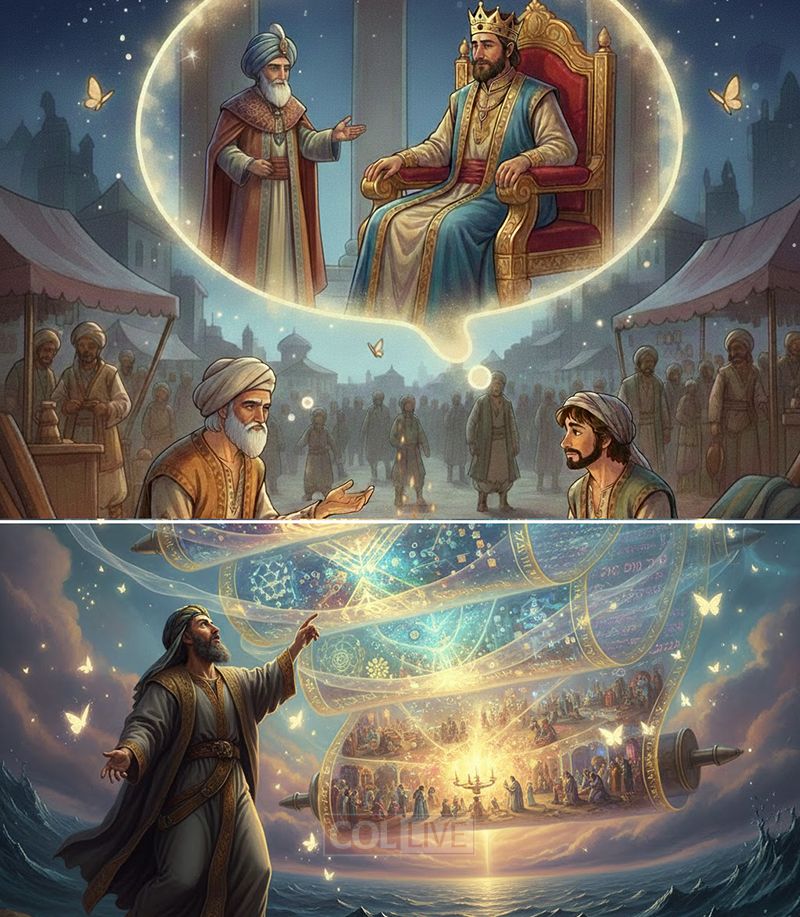
A king had an only son. The king took pleasure from his son when he was near, but he desired a greater pleasure—the pleasure that comes from reunion after distance.
And so the king sent his beloved son far away. As time passed, the prince forgot everything about the king and did not return home. The king sent distinguished ministers to convince him to return, but they were not successful.
Nothing worked until a wise minister had an idea. He changed his clothing and speech to match the prince’s clothing and speech. In this way, he brought the prince back to his father the king.
This is the intent of the stories of the Torah: to take the Father’s message—the deepest ideas, beyond our grasp—and dress them in our language—the language of story—in order to effect our return home to our Father the King, thus giving Him the greatest pleasure of reunion. – from Chapter 6
That is beautiful—but it can still feel like it is more about the King than the child, more about G-d than about me. He wants me home.
Here the Rebbe brings a second teaching to broaden and deepen our perception: the greatest pleasure for each one of us is found in doing the physical mitzvos.
How Torah Appears in Different Worlds But is Experienced Deepest in this World
In a Talmudic passage, King David says, “Your mitzvos are exceedingly broad.” Iyov says, “Its measure is longer than the earth and broader than the sea.” Yechezkel describes being shown the scroll of the supernal Torah, written inside and outside. Zechariah, however, sees a scroll with actual measurements—vast beyond comprehension, described as thousands of times larger than all of creation.
The Maggid of Mezritch explains that all of these descriptions are true. The Torah in its supernal source is without end. But as the Torah descends into the worlds—Beriah (thought), Yetzirah (speech), and Asiyah (action)—it takes on contours and form, laws and details, as we experience it here.
The Maggid teaches that the greater a person’s spiritual insight, the more expansive the Torah appears. With fewer limitations, the Torah is more capacious, and the pleasure of Torah and mitzvah study becomes deeper at each progressively higher level.
Yet a person must link his actions here below with the higher Torah of the upper worlds, for the ultimate focus is the pleasure found in mitzvah observance through action. Paradoxically, although the world of Asiyah is the lowest and most concealed, the greatest pleasure can be found specifically here. from Chapter 6
The Rebbe explains that when we combine the teaching of the Baal Shem Tov—that the highest secrets are concealed within the stories of the Torah—with the teaching of the Maggid, we arrive at a deeper understanding: the highest pleasure is concealed specifically within physical action.
Every Day that Passes the Treasure is Expanding
Do we always feel that pleasure? Not always. But it is there, waiting to be experienced with the coming of Moshiach. “This pleasure you are telling me about—we have been waiting for it for so long,” says the Jew to G-d. G-d responds, “This treasure is growing exponentially each year of this long and bitter exile, and I promise you it will be yours.” Just like the treasure of Pinchas Ben Yair, as the sages say, “from the faithfulness of a human being, one can understand the faithfulness of the Holy One, blessed be He.”
There is a story of Rabbi Pinchas ben Yair, who lived in a town in the south. People came there to earn their livelihood. They had with them two se’ah of barley. They entrusted it to him, forgot about it, and went on their way.
Year after year, Rabbi Pinchas ben Yair sowed the grain, threshed it, and gathered it in. After seven years, those same people returned to claim what they had left with him. Rabbi Pinchas ben Yair immediately recognized them and said, “Come and take your treasures.”
And through the delay, through the waiting, the matter grew and increased. It continued to grow, to expand, ever greater, until what began as a single measure became a great treasure.
The Final Victory
And this is the intent: even though the treasure is given over to the officers of the army, the purpose is that through them it should reach the soldiers themselves, so that they may carry out the victory of the war.
And when they achieve victory in the war, they fulfill the will of the King—the King of the world.
Until the destined day, when “the glory of G-d will be revealed, and all flesh together will see that the mouth of G-d has spoken.” Chapter 8




Powerful.
Thanks for posting this
Amazing and eye opening ideas
Beautiful article. I just would like to point out, that when the rebbe brings the story of the king and his son and that his son decides to come back, it’s that the son comes back how he is as the changed person he became in the distant place. Meaning he doesn’t “go back” to royalty. This is stressed in the fact that only the שר who switched his clothing etc to match the son was the one who convinced him unlike all the other שרים. Practically this means that even a Jew who still remains “far” even HE/ SHE… Read more »
The prince is convinced to come back home by the minister conveying the essence of being with the king, through getting dressed up. What does it mean to come home? It always means teshuvah, Torah and mitzvos that is home. The desire to come home is from the minister. what is home? Home is what the magid is talking about Torah and mitzvos in this physical world. When the Rebbe strings together stories they complement not replace
First of all Beautiful article, way to bring such deep concepts in to simple practical terms. My one question is you seem to be explaining the treasures as the reward, but where in the storys or in the mammar does spell out the point in the beginning of the the splurging of the treasures if the coach to win the war
In Chassidus we ask: Are the Jews created for Torah or is Torah created for the Jews? Or “What came first in G-d’s mind Torah or Jews?” We answer it says in the Primordial Torah to “Tzav es Bnei Yisroel command the Jews” so the Jews must “preexist to Torah, clearly the Jews come first, the Jew is more important than Torah! From this perspective, if we need like Moshe to destroy the Torah (e.g breaking the luchos) to save the Jews, we do it! That being said of course the ultimate good for the Jew is Torah. Now we… Read more »