
By COLlive staff
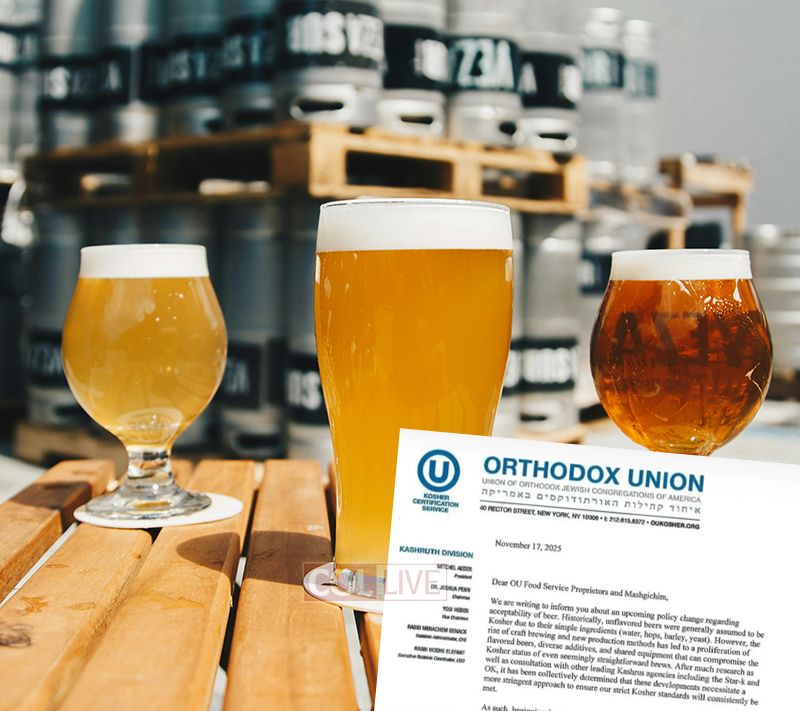
A significant update to national Kashrus standards will soon impact restaurants, caterers, and events across the country. OU Kosher has announced that beginning January 1, 2026, all beer served in OU-certified establishments or at OU-approved functions will require reliable kosher certification, marking a major shift from long-standing industry practice.
In a letter sent to OU food-service proprietors and Mashgichim on Monday, the Rabbinic Coordinators of OU Kosher – Rabbis Yermia Indich, Dov Schreier, and Lenny Steinberg – explained that the change comes in response to sweeping developments in the beer industry.
Historically, unflavored beers were assumed to be kosher due to their simple ingredient list. But, the OU writes, “the rise of craft brewing and new production methods has led to a proliferation of flavored beers, diverse additives, and shared equipment that can compromise the kosher status of even seemingly straightforward brews.”
After extensive research and collaboration with major Kashrus organizations, including Star-K and OK Kosher, the collective conclusion was that a stricter, more uniform standard is now necessary. “These developments necessitate a more stringent approach to ensure our strict kosher standards will consistently be met,” the letter states.
Under the new guidelines:
Only beers with reliable certification may be served at OU establishments and certified events
A partial list of nearly 1,000 currently certified beers has already been released
Many major national brands will remain acceptable, even without a printed symbol
All craft beers will require a visible kosher symbol or letter
The OU encouraged all caterers and food-service operators to reach out in advance of any event to review beer and alcohol selections. The agency emphasized that while the policy represents a major shift, they are committed to a smooth transition and will be working closely with establishments over the coming weeks.
The letter also noted that the policy is being adopted jointly by the OU, OK, Star-K, and a number of local Kashrus agencies, signaling a nationwide alignment of standards.
“Thank you in advance for your partnership with OU Kosher and your commitment to ensuring the highest standards of Kosher,” the coordinators wrote.
The update is expected to have a wide impact across the kosher food-service world, particularly in communities where craft beer has grown in popularity. Many restaurant owners noted that while the change will require adjustments, they welcomed the clarity and consistency it brings to an increasingly complex market.
As the January implementation date approaches, Mashgichim and proprietors are encouraged to review their current inventories and plan accordingly.





Please note, according to the letter, this is for restaurants. For private purposes, all unflavored beer appears to still be kosher!
Your obligated to keep kosher in the privacy of your as well!
It is to avoid restaurants making mistakes. If you follow regular guidelines, you still don’t need a hechsher on beer for personal consumption
It has nothing to do with mistakes. The proliferation of weird and wonderful ingredients means that EVEN UNFLAVORED beer is now problematic because it’s made on the same equipment as the potentially treife ones. Nearly 20 years ago there was an issue at Annhauser-Busch, in which otherwise kosher beer was being processed on equipment that was also used for Chelada, which contains clam powder. The cRc got involved in negotiations with the company, and manged to resolve the issue, but the fact that it ever was one shows what kind of risks exist. Now, nearly 20 years later, the problem… Read more »
It’s crazy that Hashgachos are making decisions based on what’s profitable for them and not what’s kosher or not!
Get back to doing what you’re there for!
If this decision were all about profit, how come they did not adopt the policy before? How come they are waiting until January?
it’s unhealthy
It’s healthier than soda. Soda is full of chemicals. Beer typically has four main ingredients: water, malt (usually barley), hops, and yeast. How many ingredients does soda have
brain cells alcohol kills
Our community has bad eating habits, most of them being magnitudes worse than drinking an occasional beer or two. All the processed foods and mezonos at kiddush and farbrengens. If you want to talk about addressing dietary habits, let’s focus where the majority falter. I am not here to introduce my novel solutions, though I can identify with confidence the key issues.
Drink beer in moderation, and enjoy it. But now do it only with a hechsher.
Traditional German beer has the same simple (Kosher) ingredients and methods for literally hundreds of years, and they are not allowed to change it.
To claim that they now require Kosher certification clearly has nothing to do with kashrus.
People need to stop creating problems where none exists.
Here in the USA, beer companies can put whatever they want in their beers. It’s not like in Germany where they have strict purity laws. So it is a problem. Thankfully many beer companies here are already certified.
True, but we do get a ton of beer imported from Europe (including Germany).
The law is not so clear any more.
This is a precautionary measure set by the OU to ensure that those establishments don’t end up deciding that they can use absolutely not kosher beer.
Regular people, can still drink beer as long as its unflavored etc. Unless you are certified by the OU and adjacent, you are not doing an aveirah ch”v, and you are still keeping kosher.
In short, there is nothing new to worry about regarding personal matters.
The OU says you need a hechsher on unflavored beer, because of the proliferation of beer with weird ingredients, that are processed on the SAME EQUIPMENT as the regular beer. That applies in the home just as much as it does in restaurants. But the OU can’t force you to listen to it in your own home; they can only force it on commercial clients of theirs.
Alleegens etc must be disclosed on the label. So…just read the label.
Then drink the beer anyway. Just like no person stopped you before so too no one will either now. Those who actually understand somewhat of the brewing process, and modern innovations, will know that there are serious concerns which may apply to some uncertified beer. The people who actually disagree and want the leniency back are no different than those who begged for meat in the desert. The issue is not that you want to drink the beer, that has not changed. What you want is for the Rabbis to tell you it is okay. That means you actually value… Read more »
Why is it that those who “really understand” Kashrus etc. are always finding new things to prohibit, but never find new things to permit???
Should they say chazer is permitted now? What exactly would they permit if by earlier understanding the item was not kosher. What would happen to generate that change in position? Are we going to suddenly realize Brussel’s sprouts and artichokes don’t have bugs? Your premise requires clarification
The writing was on the wall. This had to happen unfortuately because US beers have none of the German beer purist laws and boy did I know of all types of non kosher stuff being put in taps for “explorative” purposes.
“new production methods” “diverse additives” “shared equipment “ 3 flashing red lights that require attention. There are many articles and videos out there by mashrus agencies that tell you a little bit about what goes on in food production and why often a hechsher is needed on things you think are ‘simple’ because they might actually contain ingredients you really don’t want to enter your body. Of course “they only do it for the money.” That’s why 3 of the big agencies are teaming up and require ANY reliable hechsher. That is after they already have a list of 1000 CERTIFIED… Read more »
Mainly because of micro breweries, I believe.
This is to restaurants. There’s mention of a list of beers (“…we are attaching a list… 1000 beers…acceptable even without a symbol…”) that still don’t need a hechsher. Instead of saying all beer now needs a hechsher – which is NOT what this letter says – perhaps publicize the list of beers that remain kosher, regardless of printed certification.
Drink up all the beer before Jan 1, 2026, because on that day it becomes treif! Does that make sense?! The beer you drank at the sholom zochar will be treif in 2026?!
none of the commenters are well versed in the halachos of kashrus AND the process of making beer AND the guidlines of when we need to make Gedorim.
once we learn all of the above we will be qualified to state our opinion.
Let’s be humble? May as well say, “Let’s be sheep.”
Questions with the intention to understand are not the problem. Understanding Hashem’s Torah, including Halacha, is a good thing. (Save for a chok, which this is not.)
The kashrus status of beers are more intricate and nuanced than most people realize or understand. If you don’t like this new policy by the major hechsheyrim stop complaining, get off your couch, and educate yourself on the halachos and do your own research in to your favorite breweries.
If you don’t like what I have to say you can submit your grievances to your local peanut gallery.
Lechaim 🙂
Probably next they will say you can only drink kosher water from an OU bottle.
Poland Spring is treiff!!!
These people will do anything to scam you for an extra dollar.
Lol, you clearly don’t understand or know what goes in to giving a hechsher on a product. You only see the end product. Ignorance is not bliss.
I am in kashrut for a quarter century or more. The bottom line is the OU and some others need $$.
They tried shaking up Kahlua and Disaranno and and eventually they lost. They need to fill their coffers.