
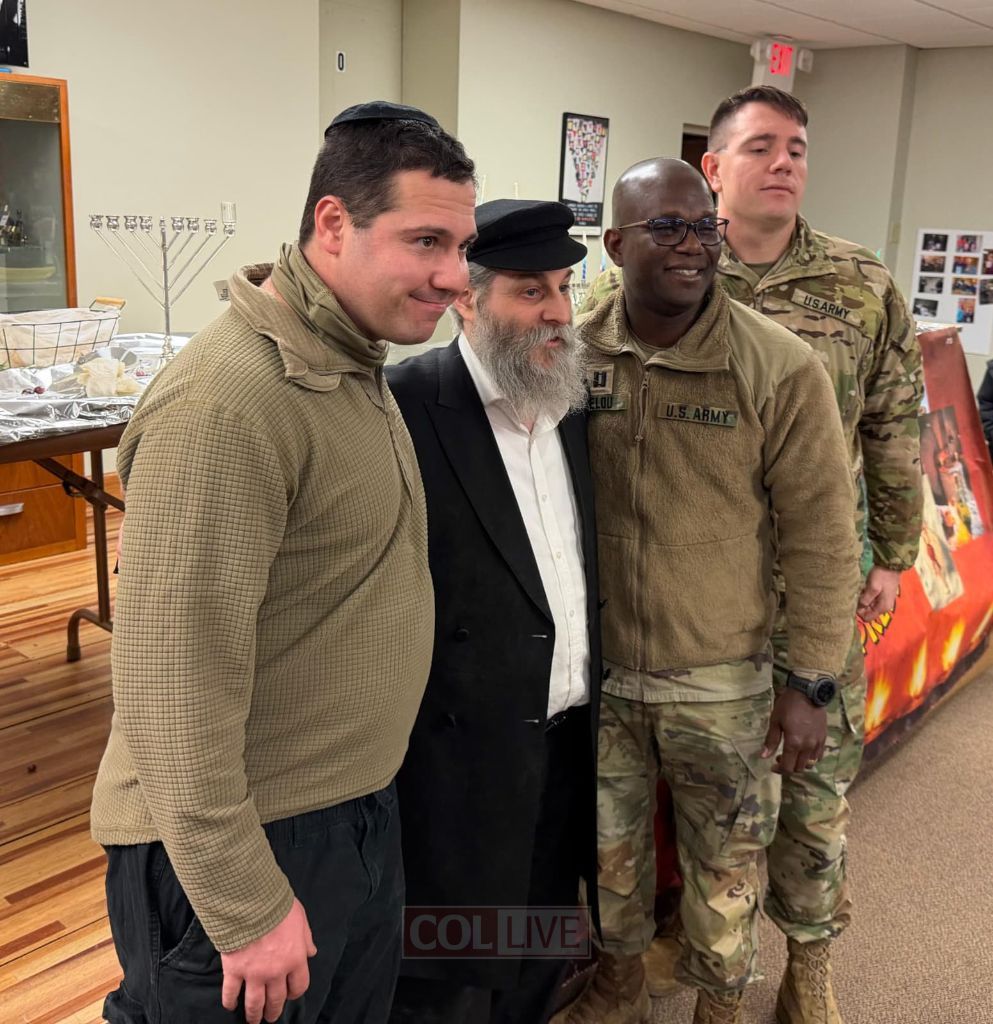
Rabbi Aron and Yehudit Schimmel, Chabad of Northeast Iowa, Postville, IA
By: Chaya Chazan
In the 1950’s and 60’s, Crown Heights was an enclave for chassidim from diverse backgrounds. One could daven Shacharis in a Karliner steibel, hop over to Vhitznitz for Mincha, and wrap up with Maariv in the Belzer shul.
My mother’s family lived in Crown Heights as proud Belzer chassidim. When my parents married, they settled nearby as well, continuing the Belzer tradition. Lubavitch was then gaining momentum, and my father’s interest was piqued by the earnestness of their baalei teshuva, their introspective farbrengens, and the astounding depth of the Rebbe’s Torah thoughts. He visited 770 often, even after he and my mother moved to Boro Park a few years later.
Although my family all follow Belzer chassidus, I was drawn to Lubavitch, due largely to my father’s influence. I attended a Lubavitcher yeshiva gedola in Israel and thought of myself as a Lubavitcher chossid.
My wife and I married in 1995 and stayed in Crown Heights while I completed a year in kollel. We were excited about shlichus, and began actively seeking possible positions. There were some promising leads, but nothing panned out. Then I heard Sholom Mordechai Rubashkin was looking for mashgichim for his meat processing plant in Postville, Iowa. My wife and I decided to take the offer, certain it would be a temporary stop on our way to finding our lifelong shlichus.
Pastoral Postville can be reached by flying to the nearest “big” airport – between three and four hours away in either direction – and driving past pristine corn fields, grazing cows, and miles of picturesque countryside. Postville itself is a small, quiet city, whose main attraction is its meat plant. Other mashgichim, like ourselves, moved to Postville for the job opportunity, bringing their families along. Slowly, a small community sprouted, its needs growing with its population.
I worked as a mashgiach and shochet in the plant for years, the realization gradually dawning that shlichus was needed here as much as anywhere else. As the Rebbe famously told Rabbi Moshe Feller, when he asked for guidance on his focus as a shliach, “Be flexible and fill the needs of the community as they arise.” I took that message to heart, and began looking around for ways we could aid and influence Jewish life around us.
There was the burgeoning Chabad community, where I helped arrange farbrengens, shiurim, and other touches that made us feel like a cohesive family. I turned an empty storefront into a cozy Jewish Welcome Center and library, so our children could have a space to learn, grow, and connect with each other. Postville also has a sizable chassidish community, and I taught a popular Tanya shiur for many years, as well as sharing sichos and maamarim whenever possible.
Of course, there are also many other Jews scattered throughout this remote countryside. We spend a lot of our time driving down bumpy dirt roads to meet with a single Jewish family living twenty miles from civilization, or spending two hours on the road to give a shiur to a couple of Jewish businessmen in the next city. On Chanukah, we celebrate in a different location each night, spreading the light across northeastern Iowa. Every person we’ve met receives a package of matza before Pesach, and we try to visit as much as possible, as well as host them in Postville.
One thing is for certain: although Postville may be a small, quiet city, there’s always work to be done!
——————
Every Shabbos morning, I offered a shiur on Chassidic insights into the parsha in the chassidishe shtiebel, home base for many of the shochtim who worked in the plant that weren’t Chabad chassidim. Many times, there were only one or two participants, and even then, I felt I wasn’t doing a good enough job of explaining the deep concepts of the sefer properly.
There’s barely an audience, and even the few who come aren’t understanding the sefer properly, I thought to myself. Maybe it’s time to stop.
That week, I randomly opened a volume of Igros Kodesh and came across a letter written to a chassid of the Rebbe Rashab. The Rebbe encouraged him to continue his shiur chassidus, even if there were only one or two participants, and even if the concept wasn’t fully understood. Discussing these holy concepts, the Rebbe explained, would sanctify the atmosphere, creating a net positive effect on everyone, whether or not they listened to – or fully understood – the shiur.
I was dumbfounded. The letter directly addressed the exact two concerns I’d had myself. With such clear direction, there was no way I could stop.
Interestingly, since then, I’ve always had at least one person learning with me. Sometimes, my usual listener will be running late, or will choose to learn something else at that time, but, without fail, someone else will come over and ask to learn Likutei Torah.
The Rebbe’s message is clear: the effect on even one person can never be understated.
————-
After almost three decades of shlichus, I’ve learned it’s possible to impact someone through the simplest of gestures, sometimes without even realizing it!
Kfir* was a kibbutznik who moved to Postville because the free range chickens and meadows full of grazing cows reminded him of his childhood. He’d received the typical kibbutznik Jewish education – that is to say, nothing more than the most basic sketches of Yiddishkeit.
He wasn’t interested in making mitzvos part of his life, but we invited Kfir and his family to join us for Shabbos meals often.
After a few years, Kfir and his family left Postville, but he wrote me a letter to tell me they’d started lighting Shabbos candles every week, a small commitment that showed how far some simple Shabbos meals could go.
—————-
Barak* was only around for a few months while he attended a semester of college. While he was in the area, I befriended him and invited him for Shabbos. He joined us every other week, until he completed his semester and moved to Miami.
Recently, friends from Postville that visit Miami often told me they’d met Barak, who was now a full-fledged baal teshuva.
When I called him to catch up, he confirmed his life-altering choice. “It’s all thanks to you and your influence,” he told me.
“But we barely interacted! It was just a few Shabbos meals; nothing more!” I protested.
“Your sincerity and passion came through just fine,” he teased. “I didn’t need to know you for very long to be indelibly impacted and know how I wanted to shape my future.”
—————
Not only is Postville a small city, but many of my shlichus efforts are directed towards the Jewish community who already know all about Torah and mitzvos. As much as we’ve accomplished over the last 28 years, every so often, a voice in my head asks, Is this really the best place for you? Wouldn’t you accomplish so much more elsewhere?
Whenever these doubts surface, I push them away, trying to remind myself of the good we’re doing, but the voice still remains, niggling in the back of my mind.
One time, as I prepared to visit the Ohel, as I do every year on Gimmel Tammuz, the doubts came back with a vengeance. I wrote to the Rebbe, explaining my concerns and asking for a clear sign and answer that my shlichus in Postville was where I was supposed to be.
I exited the cemetery and headed to the hospitality center, where I made myself a cup of steaming coffee, sat at a table, and pulled out my phone to check for updates.
I saw an email notification from a name that sounded only vaguely familiar. Upon opening it, I was even more confused when I read his request for me to review the article and send him my edits. What article? I questioned.
Finally, I remembered. A man from New Jersey had visited Postville on a business trip, and we’d struck up a conversation. I explained what I did, and he was so impressed, he asked if he could write an article about my “unique view on kiruv.”
I agreed, inwardly bemused, imagining how many shluchim lived within a 20 miles radius of his house, yet he had to travel to Postville to hear my “unique” take on kiruv.
As I read the article, I realized I’d received my answer. Was I “accomplishing” anything in Postville? Apparently, I was doing enough to impact at least one man, all the way in New Jersey, and hopefully, inspire his readers as well.
————-
We don’t often get visitors in Postville, so when a fancy car with Missouri license plates pulled up to our building, I was intrigued. I figured he was visiting the kosher grocery store, with which I shared my Chabad house space, and soon saw I was correct, as he began loading a shopping cart with kosher meat, chicken, and pantry staples.
I introduced myself to him and offered to help him put on tefillin.
“Oh, thanks,” he answered. “I have my own tefillin, and wear them every morning.”
Before he left, he gave me a couple hundred dollar bills as a donation.
“Thank you so much!” I said, accepting it gratefully. “What’s your name?”
He smiled enigmatically. “I’d rather remain anonymous,” he replied, before driving off.
The mystery Missouri man reappeared periodically to stock up on kosher supplies. Every time, he left me a donation, and maintained his preference for remaining nameless.
A year ago, the store moved locations. Just before Pesach, my anonymous benefactor visited again. He stopped short when he saw the empty shell where the grocery store had been.
“Don’t worry,” I assured him. “They’re still here! They’re just up the block.”
“Can I come in anyhow?” he asked. “I want to tell you something.”
“Of course,” I answered, leading the way to a comfortable chair.
“Rabbi, you changed my life,” he told me. I stared at him, disbelieving. I didn’t even know his name! How could I have possibly changed his life? “Don’t you remember what happened the last time I came here?” he asked.
I thought back to the last time I’d seen him, almost a year before.
“Yes,” I said, slowly. “I think I came to your car and asked for your Hebrew name.”
“Exactly.” He nodded. “I was hesitant at first, but you assured me that knowing my name was Yaakov ben Sara* wouldn’t diminish my anonymity in the slightest. You told me you just wanted to write to the Rebbe, asking for blessings on my behalf. Then you noticed my partner in the passenger’s seat and asked for her name, too. I told you she wasn’t Jewish, and we parted.”
“I remember now,” I said, stroking my beard. “I wanted to show my appreciation for your steady support, while still respecting your desire for anonymity. I did write to the Rebbe on your behalf.”
“I know!” he said, smiling. “I don’t mind telling you now that my name is Dr. Jake Bander*. I own a successful practice up in Missouri. I have a strong affinity to my Judaism, and keep some of the mitzvos as best as I can. When I met Mary*… I didn’t think it would be such a big deal.
“As our relationship grew more serious, there was a series of alarming events. Mary got into a bad car crash, and had a few other close calls. I invested heavily in the stock market, and suddenly, all my investments bottomed out in rapid succession. I’ve listened to enough shiurim from Rabbi Josh Gordon that I immediately made the connection – my and Mary’s relationship wasn’t good for either of us. We made the mutual decision to break up. In the next few days, the stock market recovered and I regained all I’d lost. Mary is recovering, too. I have no doubt it was all due to the brachos of the Rebbe that you requested for me.
“I probably won’t see you again. I’ve decided to move to Florida, where I can be closer to a Jewish community. I’m taking my Judaism more seriously, and am ready to learn more. Thank you for changing my life.”
*Names changed to protect privacy


Thank you for confirmation that Hahem appreciates what we do for Torah and mitzvosm bigger peulos and smaller. Everything we o is great but we have to be
reminded,