
By COLlive reporter
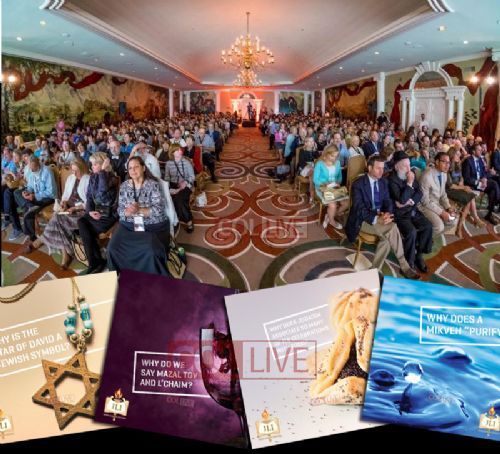
What happens when you survey 30,000 people, asking them to submit the questions about Judaism they are most curious about?
You get a course titled “The Jewish Course of Why?”
The Rohr Jewish Learning Institute (“JLI”), the acclaimed adult education arm of Chabad-Lubavitch, has conducted an unprecedented survey among past students who represent a cross-section of the Jewish community. In addition, several Shluchim ran focus groups in their communities. Both groups had similar questions.
To help with the direction of the research, the authors of the course interviewed veteran lecturers Rabbi Manis Friedman, Mrs. Rivkah Slonim and Rabbi YY Jacobson at the outset of the course development.
More than a dozen individuals sifted through the questions, researched and crafted relevant sources. Their work resulted in narrowing it down to the 50 most commonly asked about paradoxes in Jewish life with insights from some of the greatest minds in Jewish history.
Here are some of the questions in The Jewish Course of Why:
Why are there so many Jewish Nobel Prize winners? Why the Bible sanctions slavery and animal sacrifices? What is the cause of antisemitism? Why Jews eat gefilte fish and cholent? Why do Jews wish each other mazal tov and l’chaim? And what does Judaism say about Christianity? What is the role of women in Jewish life?
JLI’s Curriculum Development team was headed by lead editor Rabbi Mordechai Dinerman and Rabbi Naftali Silberberg who worked in collaboration with the writers and researchers, Rabbi Lazer Gurkow and Mrs. Chava Schapiro.
“The topics in this course span a diverse range, from fun, light, and off-the-beaten-track questions, to more complex and controversial issues. It will give insight into mysterious Jewish practices, strange biblical narratives, and enigmas of Jewish identity,” says Rabbi Dinerman.
VIDEO: Promo for the Jewish Course of Why
Research was provided by team members of JLI’s Machon Shmuel – the Sami Rohr Research Institute, among them Yaakov Gerson, Eli Raksin and Shmuel Super under the directorship of Rabbi Avraham Bergstein.
Rabbi Efraim Mintz said the course strives to share perspectives, spark curiosity, deepen the conversation. “The goal is for students to walk away dissatisfied—not with the course, surely, but with the paucity of what they learned in relation to the vastness of knowledge that awaits them, and with an awakened thirst to never stop asking “Why?” he said.
In just a few weeks, the course will be taught by 350 Shluchim across the globe. They will be using the intriguing branding and marketing items created by JLI’s Marketing Director Rabbi Zalman Abraham who charted the vision of the course launch.
Key leaders in the Jewish world have endorsed the Jewish Course of Why and commented on its relevance and importance in today’s world climate.
Professor Larry Schiffman, Director of the Global Network for Advanced Research in Jewish Studies at New York University, praised the depth with which each question was treated.
He wrote that the course, “will expose them to the rich literature that explains and clarifies these practices and their deep meaning. Participants will come to understand the complex processes that produced and encouraged so many of our beautiful customs. The deep understanding that they will acquire should greatly increase their appreciation for the unending intellectual quest that is a major part of Jewish life.”
Jonathan Greenblatt, CEO of the Anti-Defamation League said, “External challenges to core Jewish values and beliefs, including the concept of Jewish national identity and connection to the land of Israel are growing. The physical safety of Jews in parts of Europe and elsewhere is threatened. At the same time, levels of assimilation and ignorance within the Jewish community have never been higher….Initiatives to elevate Jewish literacy, like JLI’s The Jewish Course of Why, are vital, not only for personal spiritual growth, but to ensure that Jews have the knowledge and motivation to address today’s critical challenges.”
Malcom Hoenlein of the Conference of Presidents of Major American Jewish Organizations concurs, “To meet the multitude of external and international challenges facing Jews and Judaism in the 21st century, it is essential we are a knowledgeable, informed and committed community. The key to achieving this is meaningful education made accessible to the largest numbers possible. There is a growing desire on the part of younger Jews to know, to understand, our great heritage introduced in the Torah and sacred texts.”



Go Shevy Rivkin!!!!
We who know you from way back when KNOW your gorgeous work when we see it!!! Keep at it girl! Soon you will be a global brand!! (Remember us then:)
Publish the answers …the more the better
To #3 we in c.h. supposedly r learned enough to pick up a sefer “taaamey haminhagim”. U will find most answers there.
i disagree
jews are taught to ask questions and understand
the last time this was the lpoint of view was the times when zionism started and many jewgish people were entrapped because they didnt understand what they wehre doing as jews. they were doing it mindlessly we should be taught to ask and we sshould be taught the answer to these questions.
Very much disagree! We dont keep yiddishkeit because we necessarily understand the reasons. But to be robots and just do everything without understanding is not proper either. There is nothing wrong with trying to understand why we do certain things. However its important to realize that just because you dont understand, its not an excuse not to do it.
This course and all JLI courses should be offered in Crown Heights. Everyone can benefit.
wow! couldn’t have said it better. you are one smart guy! Or girl 🙂
Dear CH’er, While these questions are fascinating, and many in our own community, friends, neighbors, and ourselves, identify with so many of them, or simply want to gain some deeper insight or perspective, there is a reason why you weren’t taught the answers to some of these questions… There is a difference between having a question, and then being provided with the answer, and not having a question to begin with. The objective of the Chinuch we’ve received, or ought to have received, creates an environment and upbringing in which these questions do not arise, either because the answers were… Read more »
i hope one day they will post the answers online to make the basics of Judaism accessible to all
Will this be available for lubavitchers living in crown Heights too?