
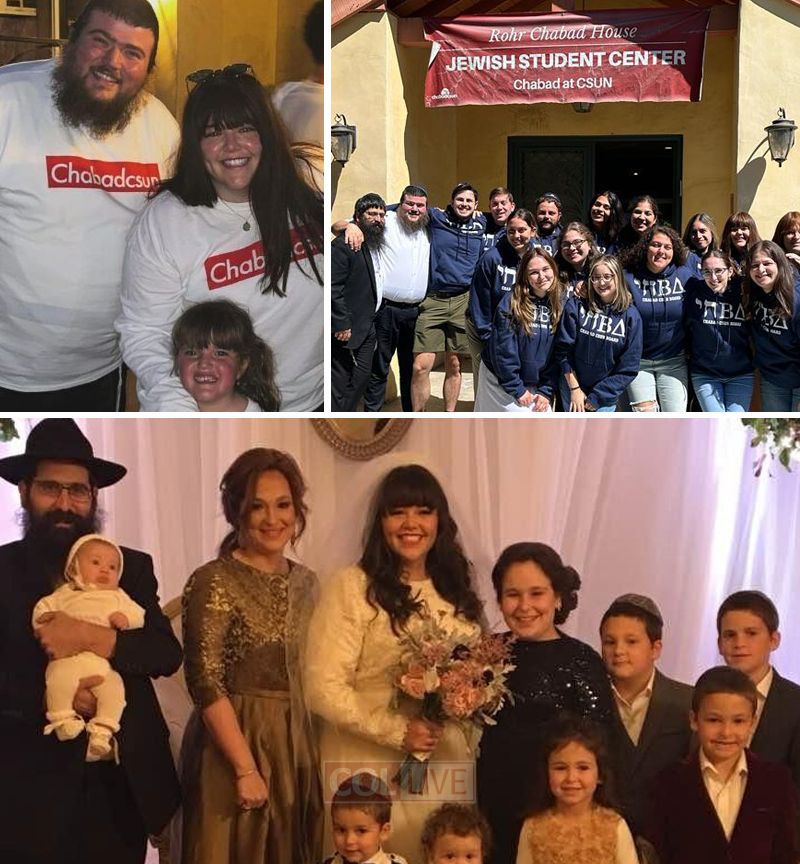
Rabbi Mendy and Sandra Paul, Chabad at CSUN, Northridge, CA
By: Chaya Chazan
Although I was born in Los Angeles, I spent the majority of my girlhood in the south of France. My mother was a fairly typical French-Algerian Jew, with a warm passion for Judaism, a deep and abiding respect for tzadikkim, and a strong sense of Jewish pride. She sent me to Sunday school and raised me to identify strongly with my Jewish faith. We were traditional, although not strictly Torah abiding. We never missed a Yom Kippur service, held a seder every year, and even celebrated the occasional Shabbat.
When I was a young teen, we moved back to Los Angeles. If anyone would’ve asked, I would’ve proudly declared my Jewishness, but not too many people asked, and that was fine with me.
I’d never enjoyed the academic side of school, so I breathed a sigh of relief when I graduated high school, happy to put classrooms, notes, and exams behind me. My mother was aghast when she heard of my plans.
“Everyone goes to college!” she told me. “What kind of future will you have without a degree?”
With deep misgivings, I enrolled in California State University, Northridge, most commonly called CSUN.
Why am I even here? I often wondered to myself.
In retrospect, it’s crystal clear. My mother may have sent me to college for an education and a degree, but Hashem sent me there to meet His shluchim, Rabbi Chaim Shaul and Raizel Brook.
As someone who identified deeply with my Judaism, I quickly became involved in more and more Chabad programs. I attended Rabbi Brook’s classes, ate Raizel’s delicious Shabbos food, enjoyed the New York Shabbaton, and eventually became president of Chabad’s student board.
—————–
I was interested in everything, but wary to take on commitments that would disrupt the comfortable routine of my life.
Friday nights at a college student were for partying and forgetting the stress of the week. I often made my first stop the Brook’s Chabad house. After a while, I knew how to time my visits perfectly. I’d learned that coming on time meant you’d watch Raizel struggle to serve so many guests at once, and you’d feel obliged to chip in and help. If you stayed until the end, you’d feel bad leaving the mess and would be commandeered into cleanup help. But if I arrived just after the first course and left before dessert, I got to fully enjoy the Shabbos meal – without having to lift a finger.
One autumn Friday evening, I arrived at my usual time. Instead of the unflappable, poised rebbetzin and spotless home I’d come to expect, chaos greeted me at the door. Her small children were running around, still finalizing their Shabbos preparations. The table was spread with a tablecloth, but the stacks of plates and cups remained in the center, waiting to be put out.
“Woah! I’m early!” I said, surveying the scene.
I was confused for a moment, but then I remembered. We’d just set the clocks back an hour. I’d meant to show up at 7:30, but it was only 6:30.
“I’m so sorry,” I apologized, awkwardly. “I’ll – I’ll leave and come back later.”
“No; don’t,” Raizel urged me. “Shabbos will start soon. Just stay until then.”
Almost magically, the room transformed into the serene tableau I’d come to expect.
“Licht bentchen!” Raizel called to her children. “Come light Shabbat candles,” she invited me.
“Oh. I – uh – I just want to be straight with you,” I stammered. “I’m not planning on keeping Shabbos. In fact, I have my car keys in my pocket right now, so I can go to the club later.”
“Right now, you’re connecting to Hashem. Nothing you do later can taint this special moment.”
Those words were transformative. I’d always thought of mitzvos as an all-or-nothing deal, of which I preferred to be on the more “nothing” end. Raizel showed me the value of a single mitzvah, making the idea of being Torah observant practical, realistic, and simple.
Now, as a shlucha, as I watch that same power cross my student’s faces, I feel honored and blessed to be in the presence of such potential and greatness. Their connection to Hashem is their truest essence. Their classes, jobs, hobbies, and foibles are simply the “side hustle” to their pure connection with Hashem.
———————-
Once I started keeping Shabbos, I stayed over at the Brooks. They kindly showed me to the guest room, where I’d have privacy. I was a little embarrassed to admit that I, nearly a fully grown adult, was scared of being alone. But my phobia won over my shame, and I asked if Mushka, their adorable eight-year-old daughter, could sleep in the other bed to keep me company.
As ridiculous as it was, the Brooks didn’t bat an eye. And neither did Mushka. She readily agreed to be my nighttime protector, and took the job very seriously. She would sing Chassidic niggunim and tell me Chassidic stories until she drifted off to sleep, leaving me to replay the melodies and envision the stories in my mind until my dreams took over.
I owe most of my niggunim knowledge to Mushka, and credit her wholehearted sincerity with my passion and chayus for Chabad chassidus.
I know firsthand how much influence junior shluchim can have, and I often reflect on that as my own daughter greets our Shabbos guests with the same innocent, pure love and acceptance Mushka gave me.
——————-
As Chabad’s student board president, I was particularly excited for Parent Shabbat, a yearly weekend where parents were invited to experience Shabbos at the Chabad house along with their children.
At one point during the meal, Rabbi Brook asked if anyone had anything they wanted to share. My mother raised her hand.
“It’s no surprise my daughter is here, at Chabad,” she began. “We always had a picture of the Rebbe in our living room, and a pushka in the shape of 770.”
I thought back to my childhood living room. I remembered which picture she was referring to, but I’d never known who it was. I’d assumed it was a long-lost great uncle from the shtetl. And the pushka? I’dd always liked the red brick, three pointed building, but I’d never known it had a name or significance.
“Years ago, a family member became very ill, and we didn’t know what to do.,” my mother continued. “At that time, my brother was studying with Rabbi Azimov, a Chabad rabbi in Paris, and learning about Judaism. He suggested that we visit the Rebbe and ask for a blessing.
“My ex-husband received a dollar, and I waited in line behind him. I too, received my dollar and continued towards the exit. Just then, I was called back. The Rebbe wants to see you again, I was told. The Rebbe gave me another dollar and blessing.
“A short while later, we found out I was pregnant with Sandra.”
I sat there, dumbstruck. I’d never heard the story before, and had been totally oblivious as to the Rebbe’s influence on my life. Hearing the story confirmed that I was being led by forces higher than myself, and that the journey I was just beginning was destined for me from the very start.
———————————-
Over the next few years, my life underwent a dramatic transition. After college, I attended Noanot in Israel for a few months, and then moved to Crown Heights. I studied in Machon L’yahadus while serving as a dorm counselor in Bais Rivka. A short while later, I met my husband, and we married a few months later. Our chuppah was held in the courtyard of 770. I wouldn’t have it any other way.
The Brooks had an indelible impression on me, and were still major influences in my life. Their absolute devotion to their mission and pure love and care for every Jew, no matter their circumstances, was an extension of the Rebbe’s unbridled ahavas Yisroel. I called them my “spiritual parents” and knew I wanted to replicate the shlichus they embodied.
I immediately thought of campus shlichus. As a recent grad, it was familiar to me, and I knew just how powerful the impact of a campus shlucha could be. That transient state of life, at once detached and independent from one’s parents, while also having a future open and undecided had such a pivotal and powerful potential.
Often, throughout my years in college and post graduating, the Brooks had joked, “You’ll come back to help us on shlichus!” Now, it seemed less of a joke and more of a very real possibility.
And so, a few years later, I found myself, once again, at the doors of CSUN; once again, beginning a brand new chapter of my life.
Tabling as a shlucha and a CSUN alum is exciting. I can offer the student spiritual guidance – pamphlets on kosher, Shabbos, invitations to classes and holiday events, Shabbos candles, kippot, and more – but I can also tell them the best shortcuts to Eucalyptus Hall, and which professors are more forgiving about lateness.
My husband jokingly calls himself a BBT – a ben baal teshuva. Both of his parents learned about Yiddishkeit through their shluchim in college. When our students connect with us, they can see their potential future, both immediate and long term. I am the model of college-student-turned-religious, and my husband is the “grown up product” of how their children might look 30 or 40 years down the line. We are living proofs that even while being religious, or raising one’s children religious, we can still be “normal.”
I constantly reflect on the incredible zechus and privilege I have to work with my role models and come full circle. I sometimes tell people, “I work for the Brooks.” Rabbi Brook always gently corrects me, “You work for the Rebbe and with us.”
——————–
Noa was deeply involved in a different student group, and rarely attended Chabad events. But I felt a certain kinship with her and just knew she was eventually going to be our next student board president. I made sure to befriend her and fostered the relationship.
I was right – beyond my wildest dreams!
Noa not only became our student board president, she internalized everything she’d learned and initiated truly incredible programs. In honor of the hakhel year, she created The Mitzv-azing Race, and gathered 120 mitzvah committments in honor of the Rebbe’s 120th birthday. We became close friends, and I admired her drive, integrity, and talent.
One of the hardest parts of being a campus shlucha is saying goodbye after four years. It’s always sad to wave a final goodbye to students we’ve shared hours and hours of deep discussion and friendships with, but it was especially hard to say goodbye to Noa.
Fortunately, all shluchim are one family, connected by a singular goal. She transferred to a nursing program in Baltimore, and I was able to introduce her to the shluchim there. They helped her kasher her kitchen, toivel all her dishes, and put up mezuzos. She spent many Shabbosim and yomim tovim with them. When she moved to Texas, I made sure she was in touch with the shluchim there as well, so she could continue her journey.
We are still good friends and maintain a regular study session over the phone, despite both our hectic schedules. Noa continues to grow in her commitment to Torah and mitzvos, thanks to the global family of shluchim.
————-
Every morning, as I battle my way through LA traffic, I think of the circuitous route my life took until I finally ended up as a shlucha in CSUN.
Then I pull up to the magnificent replica of 770 that houses Bais Chaya Mushka, my daughter’s school, and am overwhelmed.
“Do you know-” I tell her, but she always interrupts me.
“I know; I know. I’m so lucky to go to the Rebbe’s school,” she teases. She pulls the straps of her backpack over her shoulders and skips into the red bricked building for another day of learning what I’d only discovered as an adult.
————-
Rabbi Jonathon Saks summed it up nicely: The Rebbe empowered leaders, not followers.
We try to embody that in our shlichus as well. Our student board has 26 members, too many to make discussions practical, but we’re proud of our 26 leaders.
Like many campus shluchim, we offer JewishU classes, which allow students to earn credits while studying Jewish texts and Chassidic philosophy. Although Rabbi Brook, Raizel, my husband, and I myself all teach these courses, we wanted our students to take a more active, empowering role in their Jewish education.
“If you know alef, teach alef,” says the adage, and we encourage our students to follow it. Four of our students have become student teachers, studying the courses so well and internalizing it so deeply, they are then able to become the instructors of that course for their peers. The student-led classes are always popular and well attended – even more than the ones we teach! We already have a waiting list for student teachers for the upcoming semester.
It’s humbling to watch the Rebbe’s vision come to life in such a powerful, practical way.
—————–
Ethan didn’t mind putting on tefillin, but he never agreed to do so in public. In the privacy of his room or in shul – no problem! Out on the quad – no way!
After October 7th, there were some anti-Israel protests held on campus. Ethan borrowed some tefillin from Chabad, and wrapped them around his arms – right in front of the angry protestors.
His bravery and persistence were a testament to the pintele Yid’s eternal strength.
——————-
I couldn’t stay away from the Brooks for long and often returned for visits during the years I lived in Crown Heights. Of course, I was happy and excited to table on campus and meet students.
One day, a group of typical sorority girls passed by the table.
“Hey, good afternoon!” I called out to them. “Are any of you Jewish?”
To my surprise, one girl with distinctly Indian features, raised her hand.
“My father is Indian; my mother is Israeli,” she explained.
We struck up a quick friendship, and she grew more involved in Chabad activities. That summer, I led a Birthright group to Israel, and she signed up to join the tour. Her mother’s heritage came alive for her, and it proved to be a transformative experience for her.
———————
Rabbi Brook has a tradition that goes back years: Pizza Parsha. Every Thursday, he hosts a shiur on the weekly parsha, providing kosher pizza for the participants to enjoy.
On one of my visits to CSUN from Crown Heights, Rabbi Brook asked me to pick up the pizza for him. Of course, traffic was worse than I expected, and I was running late. Rabbi Brook texted me, asking for updates, and I drummed my fingers on the wheel nervously, itching to get there.
When I arrived, I was shocked to see that the entire group looked to be fully Torah observant Jews.
“I don’t think I needed to stress out so much about bringing them kosher pizza,” I mentioned to Rabbi Brook. “It’s not like they didn’t all bring their own bagged kosher lunches with them!”
“Learning Chassidus is for everyone,” Rabbi Brook answered. “It teaches us how to enhance our relationship with Hashem and work on ourselves. Learning Chassidus is equally valuable for every Jew, whether religious, not yet observant, Chassidish, Litvish, or anything else.




Very nice story
You sound sweet and genuine!
Next to the Palestinian flags is perfect!
Yaasher koach on your inspiring work:) I so enjoyed reading