

COLlive.com and Nissan Mindel Publications present “Archive Gems”, a periodical column sharing guidance from the Rebbe and unknown details of Chabad’s history in the United States.
The material is from the archives of Rabbi Dr. Nissan Mindel, the trusted personal secretary of the Frierdiker Rebbe and the Rebbe, and a renowned Chabad author of literature for young and old for close to 60 years.
Rabbi Shalom Ber Schapiro, Director of Nissan Mindel Publications, was entrusted with these treasured archives by his father-in-law, Rabbi Mindel and it is to his lasting credit that the dissemination of chassidus is thereby being strengthened.
Much of this material will be published in the forthcoming book “Chabad in America Through the Folders of Nissan Mindel,” covering Chabad’s activities in America from 1940 until 1994, as preserved by Rabbi Mindel in his folders.
*
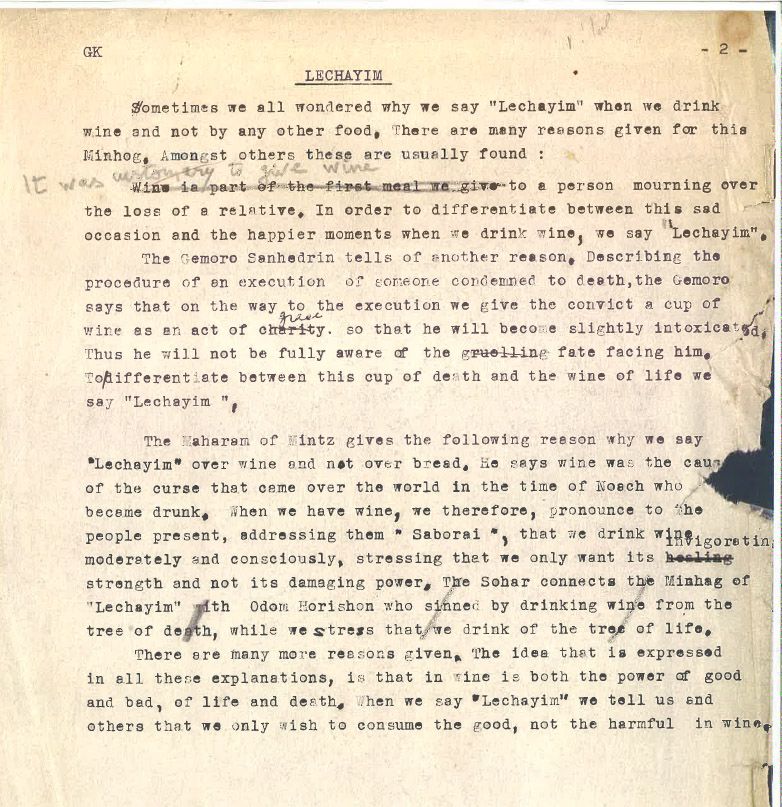
The following are 2 questions that the Rebbe himself took the time to answer. As far as we know, these answers were never published to date. We typed the Rebbe’s notations in the text but they can be seen in the original documents.
Question #1: Why l’chaim is said on a drink specifically?
The Rebbe’s answer:
Sometimes we all wondered why we say “Lechayim” when we drink wine and not by any other food. There are many reasons given for this minhog.
Among others, these are usually found:
It was customary to give wine to a person mourning over the loss of a relative. In order to differentiate between this sad occasion and the happier moments when we drink wine, we say “Lechayim.”
The Gemoro Sanhedrin tells of another reason. Describing the procedure of an execution of someone condemned to death, the Gemoro says that on the way to the execution we give the convict a cup of wine as an act of grace, so that he will become slightly intoxicated. Thus he will not be fully aware of the fate facing him. To differentiate between this cup of death and the wine of life we say “Lechayim.”
The Maharam of Mintz gives the following reason why we say “Lechayim” over wine and not over bread. He says wine was the cause of the curse that came over the world in the time of Noach who became drunk. When we have wine, we therefore pronounce to the people present, addressing them “Saborai”, that we drink wine moderately and consciously, stressing that we only want its strength and not its damaging power.
There are many more reasons given. The idea that is expressed in all these explanations is that in wine is both the power of good and bad, of life and death. When we say “Lechayim” we tell us and others that we only wish to consume the good, not the harmful in wine.
Question #2: There are those who ask – why did the Rebbe (ADMUR) send Benedictine in particular, that this liquor is produced, as is well known, by monks, and the recipe is a well-kept secret by them? And how are we to be sure that it is kosher?
The Rebbe’s answer:
It is already a custom of many years by kevod kedushas my father-in-law ADMUR, and also by his father (the Rebbe Rashab) to use Benedictine.
And they were a number of times in the country/location where this liquor is produced and they did not have any doubt as to it being mixed with wine; and it is also clear that the method of production has never been changed and furthermore and even more emphatically, there was an investigation in the matter again a few years ago and this was again confirmed to be so.
However, if not for the fact that this was the custom in my father’s house (Reb Levik) over the generations, for which there is a reason that I will not go into now, I would not have renewed this custom.
And I am happy that there are those who are careful in the performance of mitzvos, like the ones who are questioning this, if only they would be as careful in all the positive and negative mitzvos.







It is quite simple to understand that this whole issue of what the Rebbe consumed many years ago with regard to this mashke (or any other processed food,for that matter) has absolutely no bearing on us now.
Companies change, recipes change, and production methods and utensils (casks etc.) change.
@ Benedictine #14
Cholov yoroel , bishuel yosroel and pass yisroel can have leniences about them and that’s how the agencies certify certain products …. however if something is not kosher it’s not kosher … no 2 ways about it.
What are you guys all arguing about?! The Rebbe says clearly here & in another sicha as well that there never was a question about the kashrus of Benedictine… & We will use it as well when Moshiach comes…
It was known that even tough the Rebbe discontinued the use of Benedictine publically at the fahrbrengen, because some “smart fellahs” raised an issue. He however, used it it in his home personally. When “misnagdim” raise issues about mashke, that is a sign that you are “first” allowed to use it. Many of these “kashrut organizations’ are not stringent on major halachik issues, such as Cholov Yisroel, Bisuel Yisroel,, Pass Yisroel etc. (just to name a few). And all of the sudden they are “so” concerned about mashke. The Rebbe drank Benedictine and as Lubavitchers we don’t need a better… Read more »
What Minhag of Reb Levik is the Rebbe referring to?
The Rebbe is repeating the question as stated. What is your point. So, say the questioner got it wrong, the Rebbe addresses the real issue: Kashrus. As to your last sentence. Why don’t you read what the Rebbe wrote: And they were a number of times in the country/location where this liquor is produced and they did not have any doubt as to it being mixed with wine; and it is also clear that the method of production has never been changed and furthermore and even more emphatically, there was an investigation in the matter again a few years ago… Read more »
Dear Editor In the note you published, the Rebbe said there was never a cshash in Benedictine that wine was added and that our Rebbes had it investigated as to its kashrus. I would like to add that several years ago that I checked via correspondence and the company confirmed to me in writing there was no wine. Rabbi Motty HaSofer of Rabbi Landa’s office has subsequently told me that he actually has visited twice to the factory in recent years and confirmed in person there is no wine and that all the ingredients are kosher. There have been no… Read more »
THERE ARE THREE Benedictine:
Single cask liqueur is Kosher.
B&B is 100% NOT Kosher. (They add Brandy hence the B&B.)
The common one with the word DOM which is their regular liqueur is 100% Kosher.
BEWARE!
The most reputable Kashrus Agencies in the world, however, advised consumers that it was not to be used. In Melbourne, the Rabbi who is the Chief Posek for Kosher Australia is Mordechai Gutnick and he is a Lubavitcher. However, he pronounced that it was not recommended. The head chemist of Kosher Australia, Kasriel Oliver, also a Lubavitcher, said in no uncertain terms that it was not to be consumed irrespective of what the Lubavitcher Rebbe had done in days gone by. The Chicago Rabbinic Council do lots of investigating of spirits and liqueurs as does the London Beth Din. If… Read more »
Here are the opinions:
Star K – Not recommended;
London Beth Din – Dom is kosher;
NSW (Sydney) — Not acceptable;
MK (Montreal) – Not acceptable;
OU – Not recommended.
Chicago – Not Kosher
JSOR – nope
Seattle – not recommended
France – NK
Benedictine Liqueur Rabbi Dovid Cohen Administrative Rabbinic Coordinator of the cRc Centuries ago a monk created a flavored whisky (i.e. a liqueur) that contained a blend of 27 herbs and spices, and the beverage was produced by his successors for a few hundred years. Production was stopped around the time of the French Revolution, and it wasn’t until the late 19th century that a French wine merchant discovered the recipe and began manufacturing the drink once again. Although the merchant built a cathedral-like building to house his factory (which is still in use to this day) and named the beverage… Read more »
“As is well known” often means “I have no idea, I’m just guessing”. Benedictine has NEVER been produced by monks. It was invented in the 19th century and has always been a commercial product. There is no tradition, just a secret recipe that someone invented, just like Coca Cola. And since it’s secret, there’s no guarantee that they haven’t changed it many times.
I believe it was shabbos shabbos parshas noach 5727
it would be a great mitzva to clarify what happened with this. did the kosher one change to be in brown bottle and vice versa?as people are saying today.
can someone in the know please publisize the answer to above
I forget when exactly, but the Rebbe said that since questions were brought up about it by someone we will no longer Ben using it although when moshiach come it will be revealed that it was never a question it is ok.
Thanks for posting!
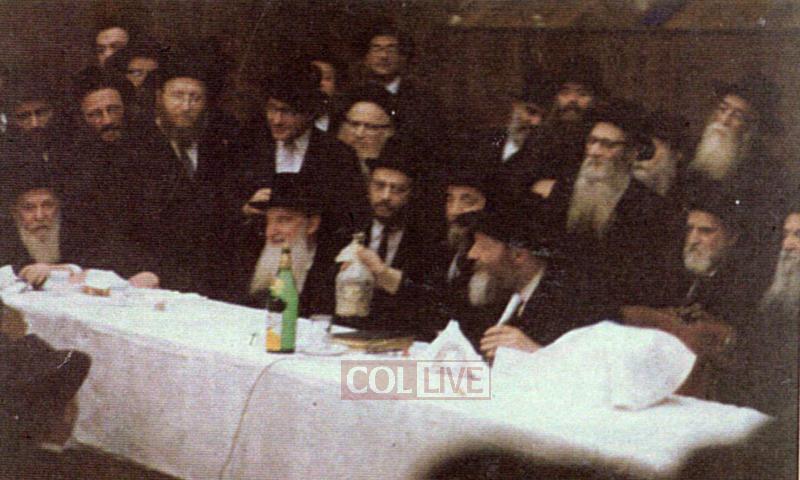
If I remember correctly the benedictine bottle was green and not brown
the green one is benedictine
an the brown one is benedictine liqueur