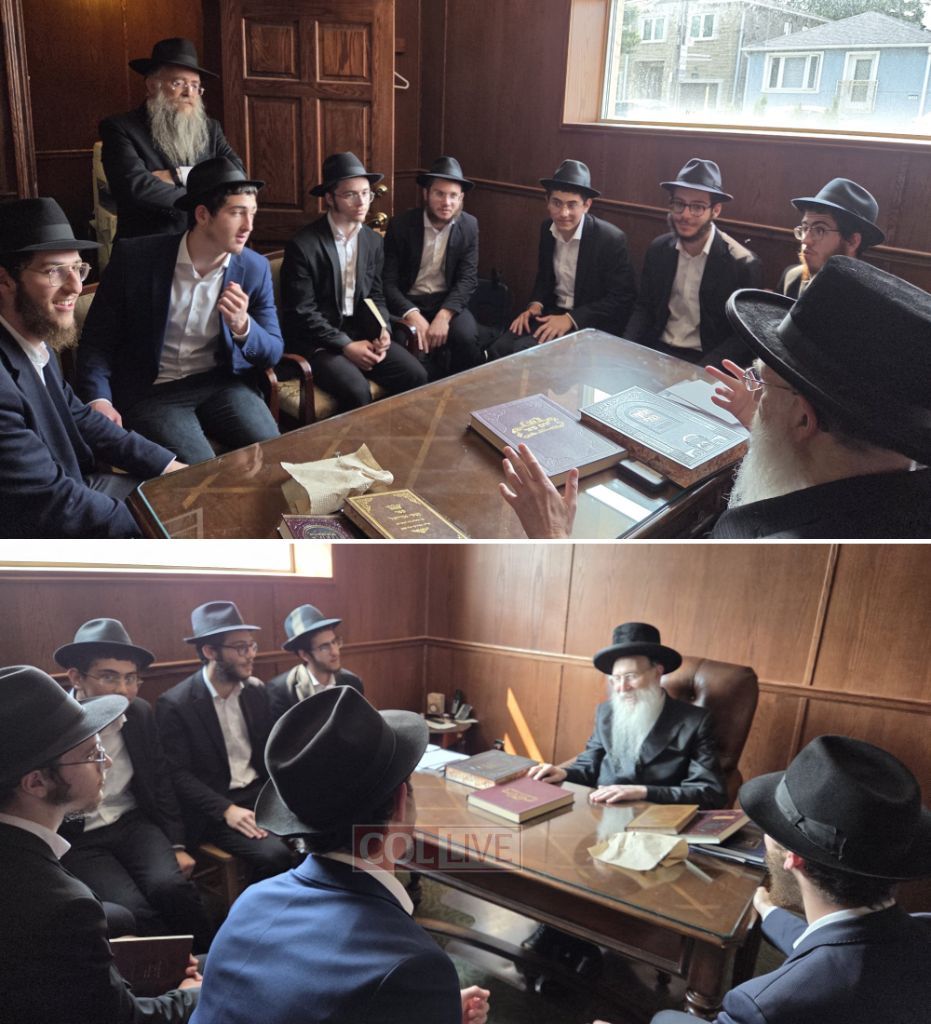
Rabbi Avremel and Mushky Zaltzman, Chabad of Smyrna Vinings, GA
By: Chaya Chazan
While Atlanta is a buzzing metropolis, many have never heard of Smyrna, in Cobb County. It recently began to develop into a rapidly expanding city center because the Atlanta Braves moved their stadium here, and restaurants, bars, clubs, and condos quickly sprung up around the arena.
One day Rabbi New, the head shliach of Georgia, received an email from Tom*. Tom lived in Savannah, where he loved attending his local Chabad house. He’d been to many Chabad houses all over the world and loved every one of them. His son had just moved to a place called Smyrna, but there was no Chabad house there. His son had many Jewish friends living in the area. Maybe it would be worthwhile to open a Chabad house there?
——————-
Our shlichus has proven to me, time and again, that Hashem is the true Master of the World, orchestrating every event down to the leaves fluttering to the ground.
I left home in the early afternoon on Rosh Hashanah after our yom tov seuda and began walking the streets, hoping to find Jews for whom I could blow shofar. I greeted everyone I saw with a hearty Shana tova. While I got many strange looks in response, those that recognized the phrase were easily identifiable as Jews.
I passed by a family with two boys, and smiled at them, greeting them with a Shana tova as I’d been doing all day. They glanced at me curiously and smiled back, but I saw no flash of recognition in their eyes. I was about to keep walking on, but something – an inner feeling I couldn’t explain – compelled me to stop and continue talking with them.
I introduced myself and explained, “I just wished you a happy new year!”
“Hi; I’m Isaiah*,” the father introduced himself. “This is my wife, Angelica*, and our children, Ezekiel* and Jedidiah*.”
“New year’s?” Angelica asked. “It’s September; not January!”
“True,” I smiled. “I was referring to the Jewish new year – Rosh Hashanah.”
“Oh yes! From the Bible!” Isaiah exclaimed. “We’re Christian and read the Bible often.”
I was disappointed, and again, began to walk away. That same indefinable instinct compelled me to continue talking with them.
“Do you by any chance have Jewish family members?” I asked.
“Oh yes! My mom,” Isaiah answered.
My heart soared, thinking I’d finally found the gold my inner mind had been seeking.
“She converted before I was born,” he continued.
My heart plummeted once more. I couldn’t hope that the mother of such a devout Christian had converted according to Halacha.
“Yup! She was born Jewish and converted to Christianity when she met my father,” Isaiah continued, blissfully unaware of the acrobatics my heart was doing at every sentence.
“According to Jewish tradition, the fact that your mother was Jewish – regardless of what happened later – means that you have a Jewish spark in you that can never be relinquished,” I told Isaiah excitedly. I pulled out my shofar. “Do you know what this is?”
“Oh! That must be a shofar, as described in the Bible!” Ezekiel burst out.
“You’re right!” I answered. “Can I blow it for you? You can recite the blessings by repeating after me.”
Isaiah recited the brachos, and listened carefully as I blew the shofar for him.
“Where do you live? I’d love to bring over a challah – Jewish bread,” I told him.
When he told me his address, my jaw dropped.
“We’re neighbors!” I yelped. “I live across the street, just a couple of houses down!”
When I went to visit him a few days later with the promised challah, I realized why I’d never thought to knock on their door. Their house was always festively bedecked for the holidays, so I’d assumed they weren’t Jewish.
Isaiah accepted the challah, and I quickly pulled out my tefillin as well. “These are also mentioned in the Bible,” I explained. “Can I help you put them on?”
Angelica watched with a proud smile as her husband put on tefillin for the first time in his life.
——————————
It had been a difficult few weeks. I couldn’t help feeling discouraged by the constant feeling that we were struggling to swim upstream. We knew shlichus would have its challenges, but there were moments when it all felt too overwhelming. It was an effort to stay motivated and the thought ran through my mind, over and over, Why are we even here?
But Rosh Hashanah was coming, and there were Jews who needed to hear the shofar. So, as stodgy as I felt, I had to press on. Previously, we’d help a shofar blowing in a nearby park. We decided to combine the shofar blowing with the tashlich ceremony. There was a park a little further that had a pond and would be perfect. I made a mental note to visit the park so I could figure out the exact layout and where to tell everyone to meet.
The days were filled with one busy task after another, and I didn’t make it to the park. Finally, I carved aside time one evening to check it out. I quickly found the perfect spot near the pond, and was about to head back to my car when the beauty of the park, the crisp autumn air, the inviting benches and gently swaying branches, and the soft, evening air compelled me to take a short turn around the park and relax on one of the benches for a few minutes.
I idly people-watched as I sat, when a very tall jogger caught my eye. His height was definitely eye-catching, but there was something else that made me notice him. Something I couldn’t explain was compelling me to go talk to him. As I fought the illogical impulse, he turned a corner and disappeared. The inner feeling was so strong, I got up and tried to trace his path. A short while later, he passed by me on his way back, and I quickly got his attention and introduced himself.
He told me his name was Robert*, and that, as a religious Christian who supported Israel and condemned the October 7th massacre, it was his privilege to meet a rabbi. We got to talking, and the inner voice urged me to question his lineage. As I dug deeper, I found out his mother was actually Jewish.
“That means you have an inherent G-dly soul within you,” I told him. “It’s a connection that can never be broken, no matter which religion you follow.”
I took his information and promised to be in touch. On my way back to my car, I couldn’t help marveling at the perfect hashgacha pratis I’d just experienced. Last minute emergencies had prevented me from going to the park before that day; I’d impulsively decided to sit on the bench; a mysterious inner voice had compelled me to talk to a stranger.
The malaise I’d felt had disappeared. I’d been told, clearly, exactly why I was on shlichus. My mission was to carry on, finding one more lost soul and teaching them about Yiddishkeit. The autumn breeze was my personal Elul shofar that evening.
———————–
Although we had just a short, one-hour davening for Rosh Hashanah, the rest of the day was extremely busy for me. I had to walk an hour to the park for our advertised shofar blowing, and I had a list of people on the way back I wanted to visit to blow shofar for them too.
So, after our seuda, I loaded up the basket of the stroller with everything I needed for Shofar in the Park, buckled my toddler in, and set off. I was proud of myself for remembering to take a watch. It was a long walk and I had a lot to get done, so it was important to set a steady pace.
After a bit of walking, I looked at my watch. Barely any time had passed. Strange. A few minutes later, when I glanced at it again, it showed the same time as before. Great. The watch was broken. I sighed and shrugged, figuring that my walk would become more interesting now that I’d have to stop a bunch of strangers to ask for the time.
Baruch Hashem, we made it to the park in time, and blew shofar for everyone. Then we set out on my planned mivtzoyim route, wishing everyone I passed a Shana Tova. Occasionally, I asked passersby for the time. It was nearing shkiyah and I still had one more home to visit. I wanted to know how much more time I had, and whether it made sense to continue on, but there was no one on the street I could ask for the time. I stayed on the lookout, but the next few blocks proceeded in silence and solitude. Finally, I noticed a middle-aged man walking towards me, engrossed in his phone. He had ear buds in, and I felt bad to bother him, but I just needed a short moment of his time. I waved my hands to grab his attention and asked for the time. He was confused – who wouldn’t be carrying around a phone in this day and age?
I told him it was Rosh Hashanah, and was about to explain what that was when he cut me off.
“Yeah, I know all about Rosh Hashanah,” he said. “I have lots of Christian friends and even go to church with them every so often, but my mother is Jewish.”
“She is?” I gasped. “I’ll need just one more minute of your time then. This is a shofar, and it’s a special mitzvah to hear its sounds today. Can I blow the shofar for you?”
He stayed to listen, and I memorized his address to keep in touch with him after yom tov.
I understood exactly why my watch had decided to stop working that day.
———————-
There were times when our finances were tight and the task of fundraising what we needed felt formidable. I quickly learned that the life of a shliach is l’maalah mi’derech hatevah – supernatural.
Keeping a balanced budget is very important, and a sure recipe for success, but I’ve found that keeping up with my shiurim, especially Rambam, has been the secret key all along. I increased my attention to learning Rambam properly, and somehow, something always came through that kept us out of the red at the very last moment.
When a shliach is carrying out the Rebbe’s shlichus, they’re on the Rebbe’s payroll. It almost doesn’t make sense to rely on conventional means of budgeting and salaries. Hashem foots the bill and the Rebbe makes sure his shluchim are provided for.
There were many times the help came in a miraculous blink of an eye, but perhaps the most interesting one was when a man from my grandfather’s community in Florida asked for my help to track down his stolen cars.
He’d shipped two luxury cars, filled with expensive wines and merchandise, through a company he thought was trustworthy. Unfortunately, they stole the shipment and disappeared into thin air. If not for the air tags his wife had placed in the back seats, he’d have no idea where to look. The air tags showed the cars in Atlanta, and he asked if I’d be able to drive over and have a look.
The neighborhood was shady, and the fancy car stood out like a sore thumb. I immediately contacted the police, but the criminals knew their work well. They’d replaced the VIN number and registered the car locally, so the police told me they couldn’t do anything. I convinced them to look for the air tags to prove the cars were stolen. Baruch Hashem, they listened to me and found the air tags exactly where I said they’d be. I was able to return the man’s car to him. He was so grateful, he wrote me a check that was sorely needed exactly at that moment.
Whether it be through small monthly donations, sudden windfalls, or chasing stolen cars, the Rebbe provides for his shluchim.
*Names changed to protect privacy