
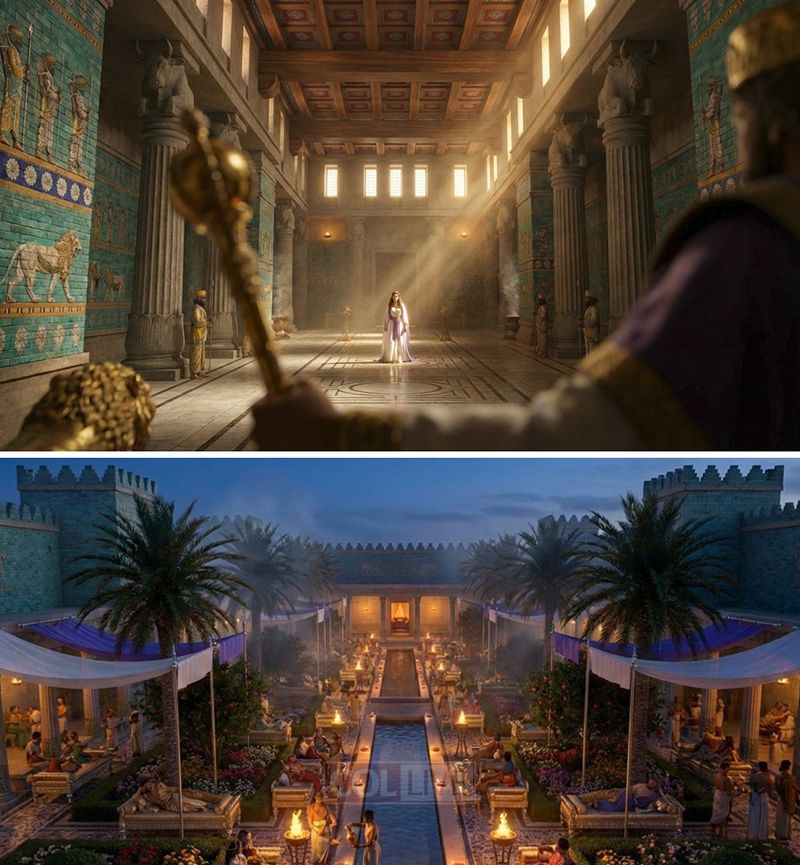
A new digital project is bringing the Megillah to life like never before, offering a fully immersive, three-dimensional reconstruction of Shushan Habirah and the palace of Achashverosh, created by Guilford, Connecticut Shliach Rabbi Yossi Yaffe.
The newly launched platform at learningtanach.org/esther features 119 detailed illustrations based on archaeological findings, excavations, historical descriptions, and material culture from the Persian Empire. At the center of the project is a complete 3D model of the palace compound, allowing users to rotate the structure, zoom in on individual buildings, and explore each area in depth.
Fifteen separate models recreate the entire complex, from the outer fortification walls to the women’s quarters, giving viewers a sense of the scale and grandeur described in Megillas Esther.
Visitors can virtually step through the King’s Gate, where Mordechai sat. The reconstruction presents a massive entry hall with polished stone benches, glazed brick panels depicting the king’s elite bodyguard, and an entrance tall enough for mounted horsemen. The original glazed brick figures, now housed in the Louvre, served as the visual inspiration for the renderings. The setting powerfully illustrates the pasuk that “one could not enter the King’s Gate dressed in sackcloth” (Esther 4:2).
The inner courtyard, where Esther stood in royal garments before approaching the king (Esther 5:1), has also been carefully reconstructed. Chazal discuss how Achashverosh was able to see her from his throne, explaining that the doorways were aligned to create a direct sightline from the throne room to the courtyard entrance. The model recreates that precise perspective. Commentaries such as the Manos HaLevi, Alshich, and Malbim are presented alongside the visual layout, each offering a distinct lens on the dramatic turning point.
The palace garden, “ginas bisan hamelech” (Esther 7:7), where Achashverosh walked after Esther’s plea and from where he returned to find Haman fallen on the couch, is also rendered in detail. Midrashim and classical mefarshim describing the king’s movements and emotional state are integrated into the experience.
The opening mishteh is depicted with “chur, karpas u’tcheiles” hangings stretched between marble pillars, reflecting the discussion in Megillah 12a between Rav and Shmuel about the materials used. The renderings portray fine linen and richly dyed textiles suspended on silver rings over multicolored marble flooring, echoing the grandeur of the Persian court.
In addition to the architectural reconstructions, the project catalogs more than 60 authentic artifacts from major museum collections, including gold vessels from the Oxus Treasure and Persian court jewelry held by the British Museum. Each item is cataloged with accession numbers and linked to relevant pesukim, providing historical context while emphasizing that the Megillah and its mefarshim stand independently. The archaeology serves only to enhance visualization, not to validate the text.
A central feature of the project is its integration of classical commentaries. Using AI tools, the Megillah text has been rendered in English in the style of a Kehot Chumash, shaped through the approaches of the Manos HaLevi, Alshich, and Malbim. These are not direct translations of the commentaries, but carefully crafted renderings of the pesukim through each commentator’s lens, presented alongside the original Hebrew for transparency and review.
Rabbi Yaffe describes the initiative as an ongoing experiment in harnessing modern AI tools for Torah learning. The project raises important questions about maintaining accuracy, preventing errors, and ensuring responsible use of emerging technology, while exploring how collaboration and careful editing can strengthen the final result.
For Shluchim, educators, and anyone learning Megillas Esther, the platform offers a powerful visual dimension that can be used during Megillah readings or as a study aid throughout the year.
The full experience is available at learningtanach.org/esther, with interactive models hosted on Sketchfab:
This is the full palace compound, rebuilt in 3D — you can spin it around, zoom in on any building, and click through to explore each space:
Fifteen separate models cover the entire complex, from the fortification wall to the women’s quarters:



This is magnificent, thank you for creating this!
This is incredible
Clear and appropriate graphics. Thank you – and for making it available to all at no cost!
Curious – why is Achashveirosh wearing a choshen style breastplate?
You never watched the queen of persia🫢?!
The big party was celebrated 70 years since the BHMK had been destroyed and since it was not rebuilt after 70 years (as the prophecy had it, just they calculated wrong), Achashverosh was celebrating.
To mock the Jews, the party had keilim from the BHMK and Achashverosh wore the Kohen Gadols clothing
Because he was wearing the priestly garments stolen from the holy temple
While it doesn’t say specifically the Choshen The Gemara in Megilah (12a) says on the Pasuk (Esther Perek 1 pasuk 4) “When he showed him the riches of the glory of his kingdom,” Rabbi Yossi bar Chaninah says, we learn from here that he (Achasveirosh) wore Bigdei Kehun (and Rashi interpreted that he had the garments of the Kohen Gadol that Nevuchadnetzar had brought from Yerushaleim), and they learned this from what is written (there) “The glory of his greatness is precious,” and the same word for “glory” (Tiferes) is also used regarding the garments of the Kohen Gadol (Shemos… Read more »
Truly amazing what you have done B”H
Beautiful resource
Thank you
😊
This is such an incredible resource for all ages! Thank you Rabbi Yaffe!
check out this picture for example learningtanach.org/art/09A5 There are midrashim and aggados hidden in the pictures some come out better than others. This one is a mix of the actual imagery that was at the palace in that basic time period and one of the reasons given for why we write the sons of haman they way we do, in the bavli and yerushalmi Bavli megillah 16B: The next line of the song inverts the sequence. This is the principle for all songs in the Bible except for this song, referring to the list of Haman’s sons, and the song… Read more »
Yasher Koach to the Rabbis and illustrators who spent time creating this. I am really excited by this and yes it really brings the Megillah to life in as new way! Very well done!