
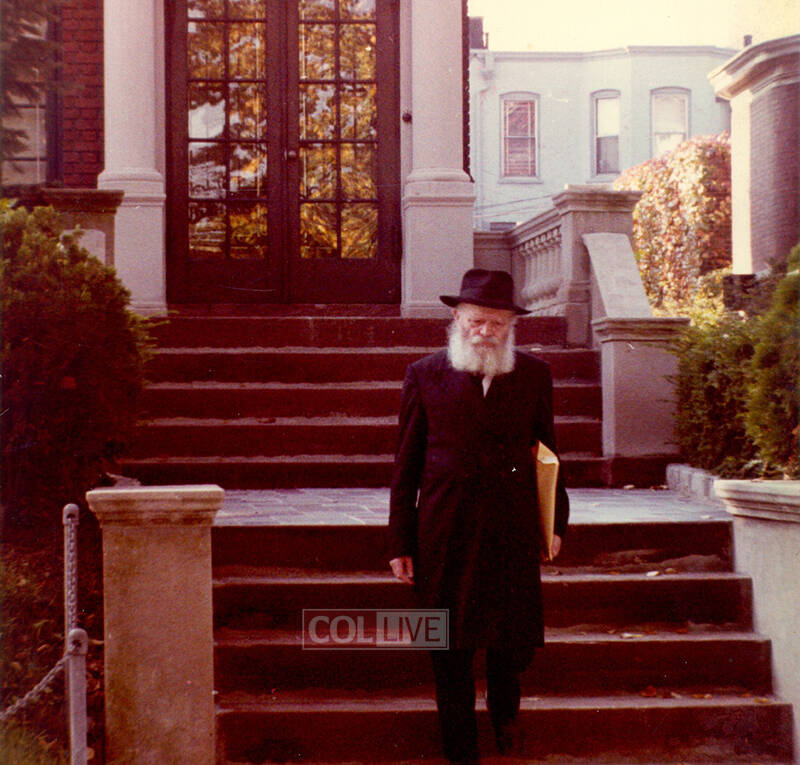
From the Front Lines
How did the Rebbe comfort a war widow and her now fatherless children? How did the Rebbe’s mitzvah campaigns, manned by his loyal troop of Chassidim, provide aid to the IDF – both in the battlefield and in the hospital? The Avner Institute presents a collection of powerful and moving anecdotes, showing the Rebbe’s unfailing attention to their fighting force.
With special thanks to Rabbi Nosson Wolf.
“Why Doesn’t Moshiach Come Now?”
To Rabbi Menachem Mendel Schneerson, shlita:
G-d was with us during this very difficult time, and we succeeded in standing strong against all the nations. Nevertheless, every single victory needs commitment and sacrifice, and there is no greater sacrifice than giving up a life.
Because I remain a widow, with no father for my children, it is hard for me to educate them and to bring them up in the best and proper way. It is hard for me to stand alone against such a large world with all the adversity out there. Because my children have a proud Jewish heritage, Rebbe, I have questions that I would like to ask.
I have one daughter who is seven years old, and one boy who is five. How do I explain that their father’s death came through self-sacrifice to G-d’s will?
My son is asking me, “Mother, when Moshiach comes, the dead will return, and then Tatty will come back. So why doesn’t Moshiach come now?”
How do I answer these questions? In my eyes these questions, which are so fundamental, may have an effect on my children’s beliefs and thoughts.
It will be a tremendous honor for me if the Rebbe can answer.
The Rebbe’s reply:
In regards to the questions the children are asking which you are writing to me about:
Explain to them the way it is in truth: There are souls that are so pure and holy that G-d wants them to be in the heavens, after they have completed their mission in this world and guarded over all the sons of Israel who live in Eretz Yisroel.
In the heavens they intercede for all their relatives and loved ones, and especially for their children, and they ask from G-d that their children succeed in studies and conduct. When their children conduct themselves properly, that is the biggest pleasure that the soul can have – that it remains alive and existing.
Bringing Joy in the Battlefield
It was the eve of the Six Day War, forty-seven years ago, when the Rebbe began the Tefillin Campaign and saw the heart of his nation open wide. It was a Biblical moment, an opportunity of cosmic proportions, and the Rebbe urged Jewish leaders to don tefillin and speak to the public about return to Jewish traditions.
The following is a passage adapted from the diary of a Chabad yeshiva student, one of the Rebbe’s soldiers, who, armed with prayer and tefillin, went to visit a military base during the war.
It was ten a.m. I had left my apartment, and traveled in an armored car. As we approached the base, I began to recite tefilat haderech, the special traveler’s prayer.
I must be honest. I have said tefilat haderech many times before. But the feeling I had on this trip, seeing around me buildings blown up, deserted streets, etc., especially reading the words may I be saved from my enemies, may I return in peace – I just could not help but pray with so much fervor as ever before!
So why did I decide to undertake such a risky trip? Because that is what the Rebbe wants from us – to lay tefillin on the soldiers at the front lines.
Deep Connection
After several hours of driving, we finally got to the base. As we left the car, I clutched my tefillin and sefer Tehillim [Book of Psalms] when I cheerfully announced, “Who would like to put on tefillin?”
Within minutes, soldiers lined up and patiently awaited their turns. Each one had his sleeve rolled up, ready to perform this beautiful mitzvah. And each one, as he approached us, had a great smile on his face and thanked us for giving them the merit of such a great opportunity.
Words can’t describe the power of the words Hear O Israel for each soldier. I truly witnessed, for the first time in my life, the deep connection of all Jews, from all walks of life, to G-d. The tears of joy streaming down every soldier’s face as he recited the Shema was utterly moving!
What really touched me the most from this whole experience? They performed such a beautiful mitzvah in such a natural, spontaneous way!
A few soldiers, however, told us, “We heard that the Lubavitcher Rebbe said that every Jew, especially those serving in the IDF, should lay tefillin and that in the merit of doing so, it will guard us and help us succeed in destroying our enemies.”
Then they concluded, “Did you even have a doubt that we would not do so – lay tefillin?”
Among the Wounded
Soldiers who were wounded in battle gained the special interest and sympathy of the Rebbe, who always made sure to bring them joy, by sending them letters and having his Chassidim visit the hospitals as the soldiers recovered.
One soldier writes:
I am severely wounded. The pains in my foot are terrible. Yesterday, Chabad came and visited and brought mashke [liquor] from the Rebbe’s kos shel bracha [cup of blessing], and they gave out coins to keep and for tzedakah [charity].
I did not drink immediately. I left the mashke for the next day. This morning, I awoke and put on tefillin, as the Chabadnikim suggested. I gave the coin to tzedakah and drank l’chaim from the Rebbe’s mashke.
What can I tell you? It’s unbelievable. The pain in my foot went away, and I have already asked the nurse to try and get me out of bed. I am sure that I will be able to walk on my two feet.
Please, write thanks to the Rebbe . . . . he is amazing! He not only cheered me up – he healed my foot!
To receive letters and inspiring stories from the Avner Institute about the Rebbe, email [email protected]