The Avner Institute presents four insightful anecdotes on the special, intense bond between the current Rebbe and his saintly father-in-law – the latter’s continual, guiding influence over the new Rebbe, whose early signs of leadership included total reverence and humility toward his predecessor.
In loving memory of Hadassah Lebovic A”h
“Teeth problems”
As official reviewer (chozer), Rabbi Yoel Kahan faithfully attended every farbrengren to hear the current Rebbe’s discourses, which he would memorize and disseminate afterwards. He remembers those dramatic days of 5710 (1950), when the saintly presence of the Previous Rebbe lingered in everyone’s minds and hearts while the rising influence of his successor was being revealed.
During the initial period following the passing of the Previous Rebbe Yosef Yitzchak Schneersohn – the “Rayatz” — many of us witnessed many miracles under the leadership of the new Rebbe, Menachem Mendel Schneerson. Yet as far as the “Ramash” was concerned, these miracles occurred solely in the merit of his father-in-law, so great was the new Rebbe’s humility and submission to the saintly Rayatz’s authority.
One miracle stood out which I have remembered vividly ever since – one that was obvious to all, yet one that the Ramash firmly attributed to his predecessor.
Tzvi Zahler, then a student at the Chabad yeshiva, was friendly with a young man who had once learned there but subsequently went a bit “off the derech,” as we say today, abandoning Torah observance. Now this man looked down upon those still in yeshiva, considering himself the enlightened one.
It was summer of 5710 (1950), and the Korean War was in the horizon. This young man became concerned that he might be drafted, since he lacked means of military exemption. So he approached Tzvi and asked what to do.
Tzvi asked casually, “Why don’t you go to the new Rebbe and ask for a blessing?”
The man spat, “Are you joking? What can he do?” He quickly added, “I’m not just referring to him. I thought the same thing about his father-in-law.”
Nevertheless, Tzvi persisted, so the man finally gave in and went.
At this time, there wasn’t yet any formal arrangement for yechidus, a private audience. Whoever wanted to speak with the new Rebbe could simply knock on the door and walk in.
So the young man knocked and entered. Shortly later he emerged with the smirk of someone who’d been proven right.
“You see?” he told Tzvi, who was standing among the man’s friends. “I knew in advance he couldn’t help me.”
Tzvi, bothered at the man’s derisiveness, asked him, “Were you in the mikvah today?” Chassidic men traditionally immerse themselves every morning – especially before meeting their Rebbe – in a ritual pool.
The man shrugged. “No.”
Tzvi scolded him. “Is that the way to go in to see the Rebbe?”
The young man, taken aback, followed the ritualistic instructions Tzvi proceeded to give him, along with other preparations before undertaking such an audience.
Yoke of Torah
After all the preparations, the young man again went to the Rebbe. This time he emerged in quite a different fashion. Outside his friends, including Tzvi, waited.
“Before anything else,” the man gasped, “the Rebbe told me, ‘It says (Avos 3:5): One who accepts upon himself the yoke of Torah is exempt from the yoke of government duties and the yoke of worldly cares. Therefore, you must take upon yourself to learn a page of Talmud each day.’”
The man continued his story. When asked by the Rebbe what he had in mind to say during the medical exam at the draft office, the man answered, “I told him I had heard once from my parents that I suffered from heart problems following my birth, so I’m thinking of complaining about heart pain.”
The Rebbe frowned. “That is not a good idea.”
The young man groped for another ailment. “Both my parents had eye problems. Maybe there is something hereditary?”
But the Rebbe nixed that idea also.
And so it went. No matter what the young man suggested, the Rebbe answered in the negative.
Finally the Rebbe asked him, “Did you ever have problems with your teeth?”
“No,” the man answered.
“What about your parents? Grandparents? Did any of them ever have teeth problems?”
The man shook his head.
“In that case,” the Rebbe said, “you should complain about teeth problems.”
The man was dumbfounded. Nevertheless, at the draft office he complained about teeth pain – and received a full military exemption!
A few days later I heard from Rabbi Nissan Mindel what the Rebbe told him:
“We literally see how the Rebbe the shver [father-in-law] is with us in a manner that’s greater than during his lifetime. And we are witnessing open miracles on his part – much greater than what we witnessed before his passing.
“Here, for example, was a young man who requested an exemption from the military, and he complained there about tooth pain – something totally irrelevant to him. Nevertheless he received a full exemption.”
“The heavens are waiting for you”
Rabbi Kahan also relates:
There is another story I remember well. It also took place a few months after the passing of the Rayatz – the summer of 1950 — but before the Ramash formally accepted the Chabad leadership.
There was an irreligious Jew, very distant from Torah observance, who lived in Williamsburg. He found himself in great trouble: his daughter, who fell critically ill, was rushed to the hospital. The Jew’s wife, who had distant Chassidic relatives, told him, “There’s such a thing as a tsaddik, a holy man, who can give blessings, and his blessings are fulfilled.”
She pressed her husband, “Maybe you can go to a tsaddik and ask for a blessing. Maybe that will help?
The man, with his limited understanding, equated a tsaddik with some kind of magician. Nevertheless, he traveled to a number of Chassidic Rebbes, many of them Holocaust survivors now living in New York, and offered them ten thousand dollars – a great sum at that time – if they clearly promised that his daughter would recover. These Rebbes, though impressed at the sum, hesitated to make such a promise.
In desperation, on a Motzei Shabbos, the man arrived at 770 Eastern Parkway, Chabad headquarters. Inside the congregation was completing the evening prayer to big farewell to the Sabbath Queen.
The man wanted to enter immediately, but someone clutched his sleeve. “You must speak first with the secretary,” the stranger said, pointing to Chaim Mordechai Eizik Hodakov.
The man spoke to the secretary who, after hearing the urgent message, promised to approach the Rebbe after Havdalah and ask if it were possible to let the man speak to the Rebbe then and there.
Following Havdalah, Rabbi Hodakov approached the Rebbe, who had gone into his office. When the secretary re-emerged, he told the man, “You cannot go in now. You should come tomorrow morning.”
The man’s eyes welled with tears. “What do you mean, wait until the morning? My daughter is dangerously ill! By tomorrow morning it might all be over, G-d forbid!”
But Rabbi Hodakov replied, “Either way – if you believe in the Rebbe, you can rely on what he says. If you don’t believe . . . then what are you doing here altogether?”
Something Unusual
In the morning the man phoned the hospital and asked to speak to the doctors.
One of them got on the phone. “Something unusual has taken place!”
“What is it?”
“Normally this kind of illness doesn’t remain static. Either things worsen or they improve. But in the case of your daughter . . . it has already been over twelve hours and her condition has remained exactly the same.”
The father made a mental calculation. It was precisely since the time he had been at 770!
He hurried to 770. The Rebbe announced, “The heavens are waiting for you, sir. It all depends on you.
“If you wish for your daughter to recover, you must accept three things upon yourself: Shabbos, tefillin, and kashruth.”
The man stammered, “I don’t think it is possible. It’s an awful lot to accept.” Then he lowered his voice. “Can I give more money instead?”
The Rebbe firmly shook his head. “This isn’t a negotiation with me. I am simply telling you the reality.”
Finally the man acquiesced. However, he said, “I don’t know how to put on tefillin.”
The Rebbe smiled. “The yeshiva students will show you.”
Sure enough, the man arrived every day at 770, where Berel Junik lay tefillin on him until he learned to do it himself. Meanwhile, the Rebbe warned the Chabad administration not to take even one dollar from this man! He did not want the man to equate his daughter’s recovery with any money – rather as a result of the three things the father accepted upon himself.
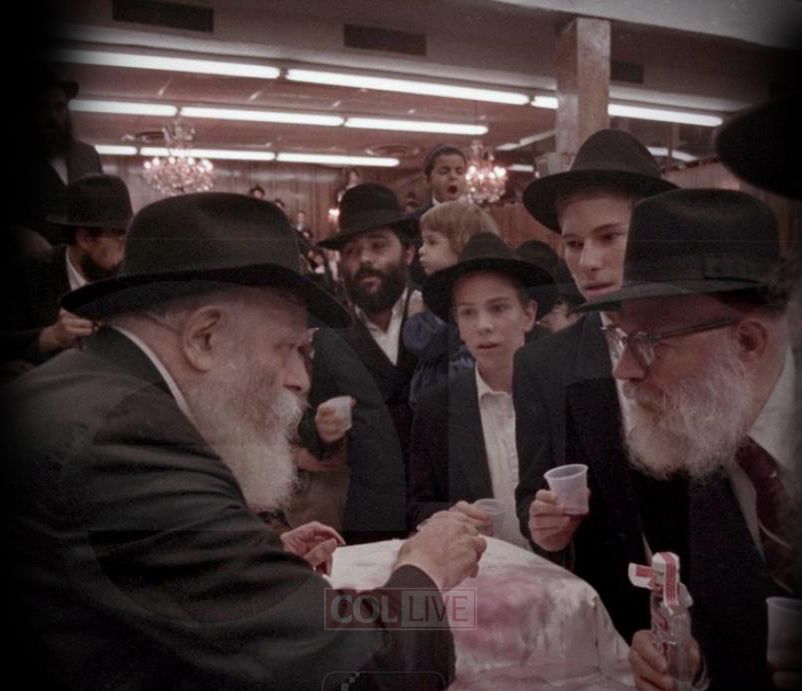
In the autumn, during Shabbos Vayigash, the man hosted a Kiddush at 770 as a thanksgiving meal in honor of his daughter’s recovery. The Rebbe participated.
The man’s Jewish name was Yehuda Leib, so I remember that the Rebbe turned to him at the beginning of the farbrengen and recited the first verse of the Torah portion, “Vayigash eilav Yehuda – then Yehuda approached him.”
To receive to your inbox email: [email protected]