
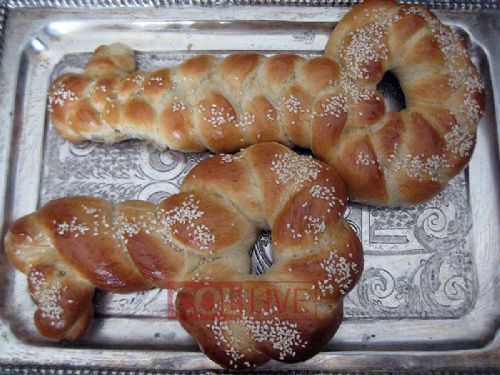
There is a custom in Jewish communities to bake a Shlissel Challah (Yiddish for key) for the Shabbos after Pesach. These Challos are best known as a segula for parnasa and livelihood, though there are other reasons for it.
There is a minhag to bake shlissel challah (shlissel means key in Yiddish) for the Shabbos after Pesach. Shlisel challos are best known as a segula for parnasa, though there are other reasons for it, as we will soon see. Some bake the challah with an actual key inside, some make the challah in the shape of a key and some put sesame seeds on top in the form of a key. There are those who make the challah flat to look like matzos. We will discuss this later on. The Ohev Yisroel says about shlisel challah that “the minhagim of our fathers are most definitely Torah”. There are many reasons given for this minhag of baking shlissel challah; we will go through some of them. (Some of the items written below can also be found in Taamei Minhagim, Nitei Gavriel, Sefer Hatoda’a and Minhag Yisroel Torah)
First of all, the second mishna in Rosh Hashanah says on Pesach we are judged on the grains, parnasa. Rabbeinu Nissim asks if we are judged on Rosh Hashana then how are we judged on Pesach? He answers that on Pesach it is determined how much grain there will be in the coming year for the world, but on Rosh Hashana it is decided how much of that grain each individual receives. The Meiri, however, says that on Rosh Hashana it is decided if one will live or die, suffer or not and other such things, but on Pesach is when we are judged on the grains. Based on this there are customs in Sephardic communities to do things Motzei Pesach as a sign that we want Hashem to give us livelihood. In Aram Soba (Syria) and Turkey they put wheat kernels in all four corners of the house on Motzei Pesach as a sign of prosperity for the coming year. (Moed L’kol Chai -R’ Chaim Palagi, Beis Habichira). From a mishna we already see that there is a connection between Pesach and parnasa.
Different ways of making Shlissel Challah
As mentioned above (reasons 8 and 9) there are those that make the challah round and flattish for this Shabbos, in the image of matza.
Some make the challah in the shape of a key.
Some attach a piece of dough in the shape of a key. Breslov Customs for Pesach (page 57) says this is the minhag of the family of Reb Elazar Kenig shlita and of Manistritch.
Sefer Hatoda’ah mentions making the image of a key with sesame seeds on top of the challah. These first three customs can, perhaps, be seen from the wording of the Ohev Yisroel in one place where he says we put the image of a key on the challah.
Some place an actual key in the challah. Perhaps this is done because of the wording in many places of indenting the challah with a key.
Either way it is done the key or image of the key is usually on top. An interesting observation about this. The Gemara quoted by the Yismach Yisroel (reason 6), about the key, is at the top of daf 31b. At the bottom of the daf is the mishna mentioning the women’s mitzvah of challah. Here too, the key is on top and the challah on the bottom.
More on this custom here.



I saw it in the Rebbe’s Reshimos that the Chabad minhag is not to make the shlisel challa.
In our home we wrap the key in aluminum foil (because it is not clean) and stick it to the bottom. No “mixture,” no borer.
thanks a lot!
well done, sgulos and yeshuos is what we need now ikvese demoshiach, right you are #19
Do you do all that the Rebbe demands? If you dont then what business do you have dragging our Rebbe into your insults against yidden?
I think one needs to truly ask themselves if they are Yiddin who pick and chose the Minhugim they see fit, thereby creating their own unique family traditions etc. they choose to adopt based on what see feel is nice to do.
Our have you chosen to go in the ways of a specific form of Chasidim, which would then mean you trust its Rebbe or Manhig Rochni (Spiritual Leader), that he will tell you the important Minhugim which are meant for his Chassidim yourself among them.
It’s not a game of convenience.
1).In Shir Hashirim (which we read on Pesach) it says פִּתְחִי-לִי אֲחֹתִי רַעְיָתִי – “Open for Me, My sister, My beloved”. Chazal say that Hashem asks us to open up for Him a small whole like the tip of a needle and He will open up a huge hole for us. Also, Klal Yisroel is called a bride and they are called the bechina (aspect) of bread. During Pesach all the upper gates and minds are open and after Pesach they close and we need to open them. Therefore, we put a key in the challah after Pesach to hint… Read more »
don’t put down people’s Minhagim, especially not in the name of the Rebbe!!
if you want to be a millionaire, you should bake the shlissel challah
if you just want ruchnius, don’t do it
Oh well. Everyone, #2 said that its not Chabad minhag. Our family however, does not literally put a key INSIDE, (a bit gross) but takes a chunk and shapes it.
i grew up with my mother making shlishel challah. If chabad would have the minhag not to do it, we would of known about it. This is a yiddishe costum that most follow. You dont haveto make challah if you dont want to. But do not say, chabad does not do it, bec. a lot of us DO IT!
hatzlacha
I, along with many other lubavitchers, have this custom! just because it’s not specific to chabad doesn’t mean people can’t adopt as their own custom if they want…
Good news, my friends!
it really works!!!!!!!!!!!!!!!!!!!!!
what’s your source?
this custom “not to make a key”- is not found anywhere in the Rebbe’s teachings at all!
every year the same thing happens… someone and i predict many more ppl commenting that it is not chabads minhag….
Its a minhag yisroel which either you adopt or not.
But in any event i don’t think its chabads minhag not to do it but rather we don’t have a minhag either way about it.
The Rebbe specifically mentioned by a farbrengan that it’s not minhag Chabad. By Chabad we know ‘ain lonu ela divrai Ben Amrom’ If anyone remembers which farbrengan please post.
give me a source
cool
FYI – chabad’s minhag is not to make shlissel challah.
there is definitely a chance of falling into the boirer prohibition