
By Yaakov Ort – Chabad.org & COLlive.com
For most of his life, Rabbi Chaim Kanievsky OBM declined to take on a public leadership role in the community, devoting himself instead to studying and writing on a wide range of often theoretical Talmudic topics of Torah scholarship.
Rabbi Kanievsky’s study regimen was very rare, as he reportedly spent up to 17 hours each day in study. He completed an incomprehensible amount of material each year, including the entire Tanach, the Babylonian Talmud, the Jerusalem Talmud, the Rambam’s Mishneh Torah, the Code of Jewish Law, Midrash, Zohar, Tosefta, and the writings of Rabbi Isaac Luria, known as the Ari.
This panoramic view of the fundamental works of halacha and kabbalah, some of which were significantly beyond the ‘curriculum’ of most heads of yeshivahs, granted him expertise in large swaths of the Torah’s corpus. His written works reflect this breadth of knowledge and cover some of the more obscure areas of Jewish law, such as laws particular to the Land of Israel, the Temple, and the sacrifices.
Studying these areas also brought him face to face with some of the themes that the Rebbe, Rabbi Menachem M. Schneerson, of righteous memory, had delved into years earlier. In this vein, he weighed into the debate regarding the shape of the branches of the Menorah in the Temple. In line with the Rebbe’s deductions from Rashi’s commentary and the Rambam’s famous illustration, he, too, concluded that the branches of the Temple Menorah were straight rather than curved.
He similarly researched and came to agree with the Rebbe’s approach to matters like the superiority of wigs vs. kerchiefs as head-coverings for married women; and the centrality of the Rambam’s code, known as Mishneh Torah, to the entirety of Judaism.
Unlike the Shulchan Aruch of Rabbi Yosef Karo which does not codify laws that are inapplicable today, the Rambam covers the entirety of Jewish Law. Rabbi Kanievsky wrote an extensive commentary on the various sections of Mishneh Torah which pertain to areas of Jewish law not covered by the Shulchan Aruch and its commentaries.
Rabbi Kanievsky would actively support the daily study of Rambam as per the Rebbe’s guidance. He also deeply appreciated the work of Chabad scholars who had expanded on the Biblical and Talmudic sources for all of the laws cited by the Rambam. He similarly called for the public to learn the Shulchan Aruch Harav of the Alter Rebbe, Rabbi Shneur Zalman of Liadi.
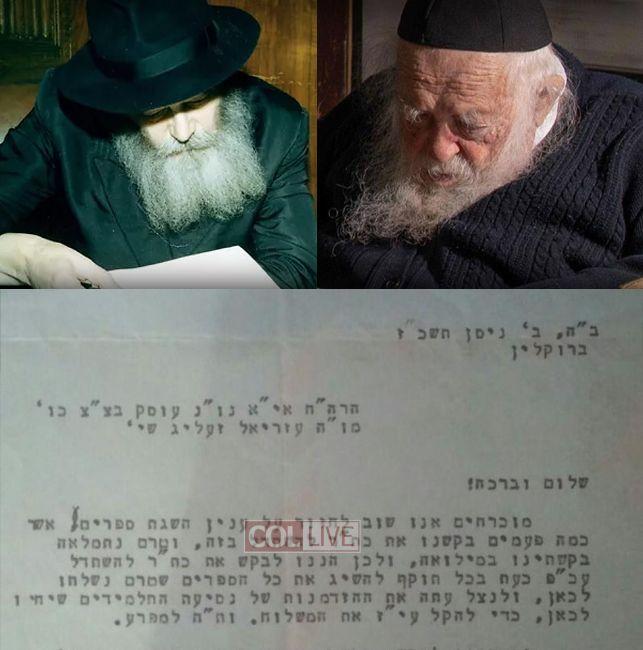
Perhaps most attesting to his proficiency in Rambam is a 1967 letter from the Rebbe’s secretariat to Rabbi Azriel Zelig Slonim in Jerusalem asking him to obtain a number of works for the Rebbe’s library, including Rabbi Kanievsky’s Kiryat Melech on Mishneh Torah published in 1928.
“We heard that the son of the Steipler Harav Kanievsky sheyichye (may he live) published a safer of marei mekomos and sources on the Rambam,” wrote Rabbi Chaim Mordechai Hodakov, the Rebbe’s chief of staff. Rabbi Kanievsky’s sefer is indeed mentioned as a reference in at least one of the Rebbe’s letters in the volumes of Igros Kodesh.
Rabbi Yosef Tzvi Segal, Rosh Kollel Tzemach Tzedek in Jerusalem, related how a group of yungeleit were publishing an elucidated version of the Noam Elimelech nd were searching a reference which the author R’ Elimelech of Lizhensk made to the Rambam.
Not successful in finding the source, they reached out to many known Talmidei Chachamim yet haven’t received an answer. When they turned to Rabbi Kanievsky, he thought for a moment. “It’s certainly not in Mishneh Torah,” he said and added, “also not in Pirus Hamishnayos, and also not in Moreh Nevuchim.” But he couldn’t cite the source.
After the sefer was published in 2 volumes, it was brought to the Rebbe. The compilers spoke about their work and how one source was not found. The Rebbe immediately responded that the Rambam wrote it in his introduction to Pirus Hamishnayos. When Rabbi Kanievsky was told about the encounter, he said he know the Rebbe was “an outstanding genius” (א געוואלדיקער גאון) but not to this extent.





Correction: קרית מלך was written in 1958 – תשח”י
He was born in 1928…
Thank you for sharing the connection to Lubavitch of this gaon. Important for the next generation to know and respect other true leaders.
I thought they may have confused 1928 with תשכ”ח (5728). Thanks for clarifying.
…of Gadlus appreciating Gadlus!
We all has the huge zchus to have our Rebbe!!!! A Rebbe for all!!!!
What is the mareh makom for saying that Rabbi Kanievsky would actively support the daily study of Rambam? Thanks.