

By Bentzion Pearson
Each year, as the season of “Yud Shvat” arrives, the thoughts of a chossid naturally turn to that extraordinary and formative period, the profound months between the Frierdiker Rebbe’s histalkus and the Rebbe’s acceptance of the nesius as Nossi of Chabad, and, by extension, leader of World Jewry—a period of time that would forever shape the course of Jewish history.
To properly chronicle that entire era would require several volumes to encompass the full depth and scope of those pivotal months. What follows, then, is but a single episode from that early spring.
It was Beis Nissan, 5710 (March 1950)—just under two months after the sudden and devastating histalkus of the Frierdiker Rebbe—when an idea took root in the minds of two senior bochurim studying at “770.”
These two bochurim were my grandfather, Rabbi Dovid Raskin, and his colleague, Rabbi Gedalia Korf, aleihem hasholom.
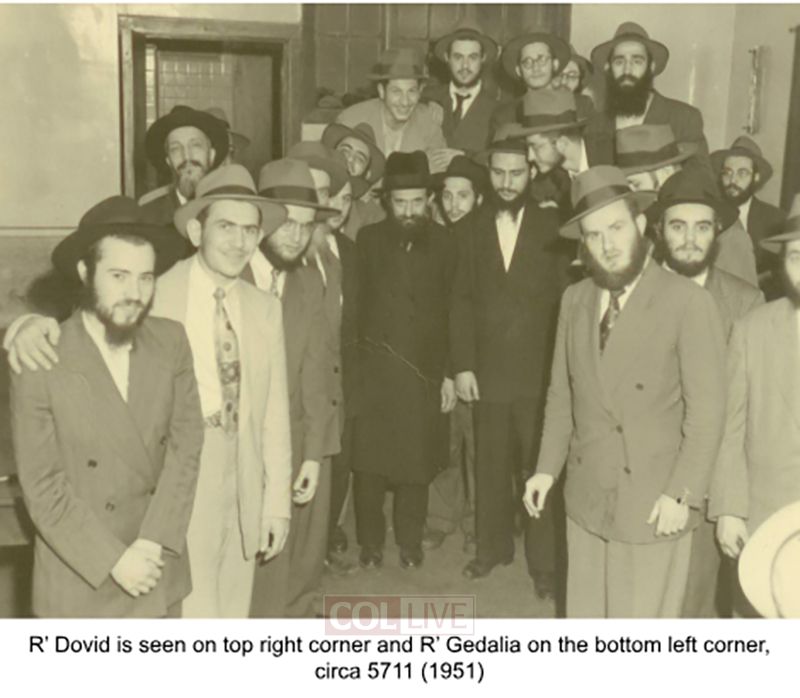
Both Russian-born, they had grown up under the harsh realities of the communist regime and eventually reached France in 5708 (1948) to continue their studies at the Yeshivas Tomchei Tmimim branch in Brunoy. Together with three other bochurim, they had arrived in the United States shortly before the Frierdiker Rebbe’s histalkus. Among their American peers, they were collectively known as “the Russian bochurim”—or, more precisely in Yiddish, “di rusisher bochurim”.
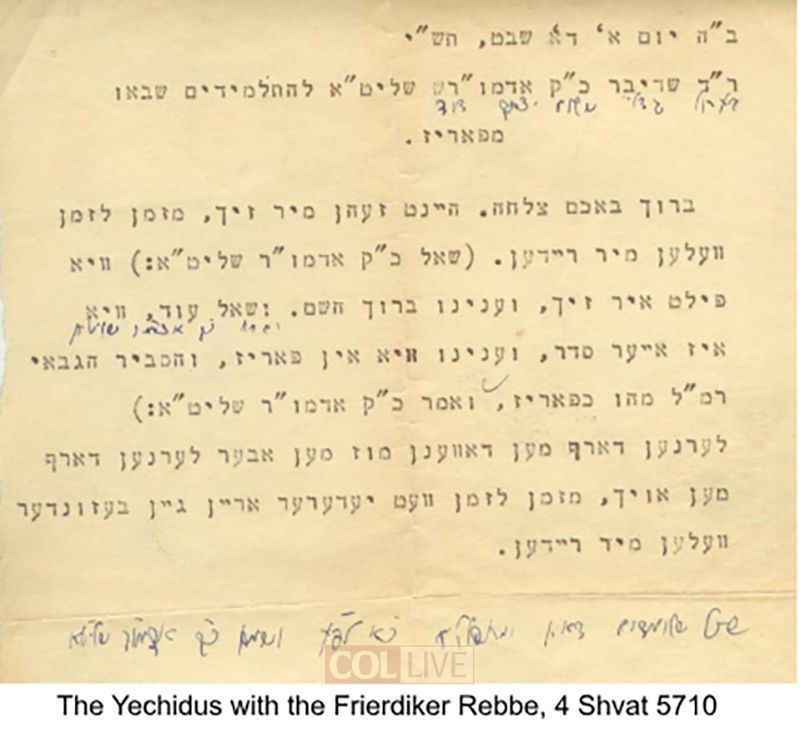
Under the guidance of our Rebbe (then referred to by the acronym of his holy initials), they had been carefully prepared for a Yechidus with the Frierdiker Rebbe on Sunday, 4 Shvat 5710—mere days before the Frierdiker Rebbe’s histalkus, which occurred that Shabbos,10 Shvat 5710.
At that time, aside from Shabbos Mevorchim, the Rebbe had not yet conducted Farbrengens. But these two bochurim, sensing a deep need for inspiration and connection, approached the Rebbe’s office. With quiet determination, they asked him if he would hold a Farbrengen that night in honor of the yartzeit of the Rebbe Rashab, founder of the Yeshiva.
The Rebbe asked why they had not approached Rabbi Shmuel Levitin or Rabbi Yisroel Jacobson, the mashpi’im of the yeshiva. To which they replied that they had already farbrenged the previous night, and that they wished for “the Rebbe” to farbreng.
During the course of the conversation, the Rebbe inquired whether their request was made on behalf of the entire body of bochurim in the yeshiva or only the senior bochurim, and they replied that it was for everyone.
According to their account, the Rebbe took a small calendar from his desk drawer, checked it, and then told them that, bli neder, he would farbreng in one month, on Beis Iyar (the birthday of the Rebbe Maharash).
[During Chol Hamoed Pesach, the Rebbe encountered Sholom Morosow, one of the “russian bochurim,” and asked him to verify with his colleagues who had requested for the farbrengen, whether they intended it only for the Russian bochurim or for everyone. Understandably, their response was that the farbrengen was intended for all.]
On the morning of Rosh Chodesh Iyar, following Shacharis, the Rebbe called my grandfather over and handed him five dollars [equivalent to about $70 in 2026] as his personal contribution toward the farbrengen scheduled for that evening.
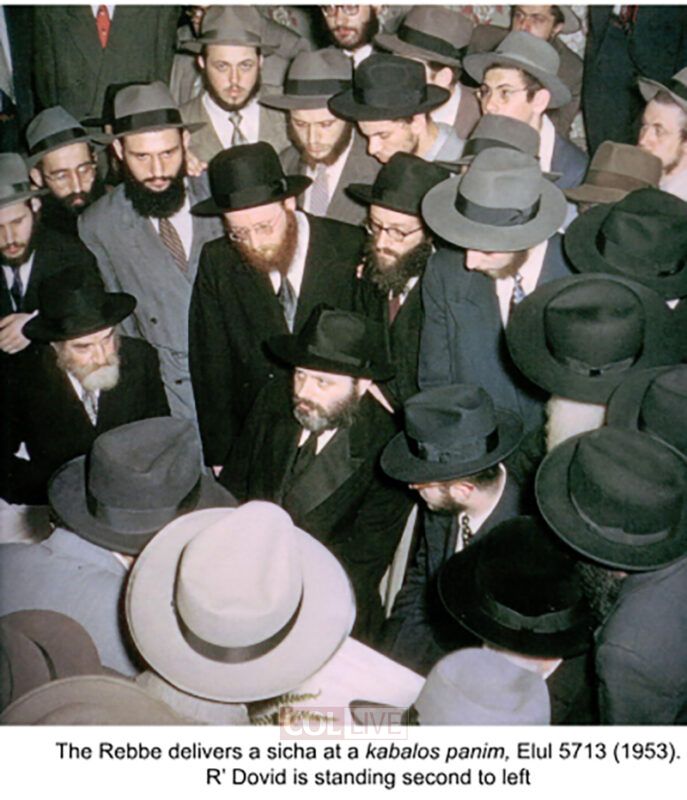
At around 9:00 p.m., the Rebbe entered the ‘zal’, where a gathering of yeshiva bochurim—accompanied by a small group of yungerleit—had assembled in eager anticipation of this special occasion.
What followed was a unique and remarkable farbrengen, lasting two and a half hours and filled with inspiration and guidance, shaping the hearts and minds of a new generation of Chassidim. The farbrengen was transcribed by Rabbi Yoel Kahn, then a bochur who had only recently arrived in the United States from Israel, and after submitting the transcript to the Rebbe for review, he merited having selections edited to the benefit of the public.
(The farbrengen is recorded in Toras Menachem, Vol. 1, p. 37-45. 14 משיחת ליל ב’ אייר – תפארת שבתפארת – ה’שית.pdf
Sections of it were later published in Likutei Sichos, Volume 2, pp. 508-509, and an image of the Rebbe’s handwritten edits appears at the beginning of Toras Menachem, Vol. 1.)
Following the farbrengen of Beis Iyar, a series of farbrengens took place, including those on Pesach Sheini and Lag B’Omer, many of whose sichos were directed specifically to the bochurim.
One month after the farbrengen of Beis Iyar, on Beis Sivan 5710, my grandfather merited a Yechidus with the Rebbe, in which he received personal guidance. The content of that Yechidus makes evident that during the month between the farbrengen and the Yechidus, he had devoted himself earnestly to carrying out all that had been demanded at the farbrengen.
Specifically, this included the foundational principles of a Rebbe’s role and the manner in which a chossid binds himself to the Rebbe; the obligation of yeshiva bochurim to step beyond their comfort zones and devote themselves heart and soul to the Rebbe’s causes; the pursuit of diligent study in both Nigleh and Chassidus; and the responsibility to actively influence bochurim from other yeshivos and draw them closer to Chassidus, primarily through establishing regular times to study together.
A month later, on Rosh Chodesh Tammuz 5710, he again merited to enter the Rebbe’s office for further guidance, covering topics from the previous Yechidus.
By way of preface to the two Yechidus’n presented below:
After the group of “russian bochurim” had their earlier Yechidus with the Frierdiker Rebbe on 4 Shvat, my grandfather went downstairs to our Rebbe’s office and relayed to him what the Frierdiker Rebbe had instructed them regarding their seder in Yeshiva. The Rebbe then directed him to prepare a transcript of the Yechidus. When he returned with the typed transcript, the Rebbe asked if he had kept a copy for himself. After my grandfather confirmed that he had, the Rebbe offered to bring it into the Frierdiker Rebbe for review at an appropriate time. (For more details, see Yemei Breishis, pp. 55–57.)
Unfortunately, this never occurred, as the Frierdiker Rebbe’s histalkus took place just days later, as mentioned above.
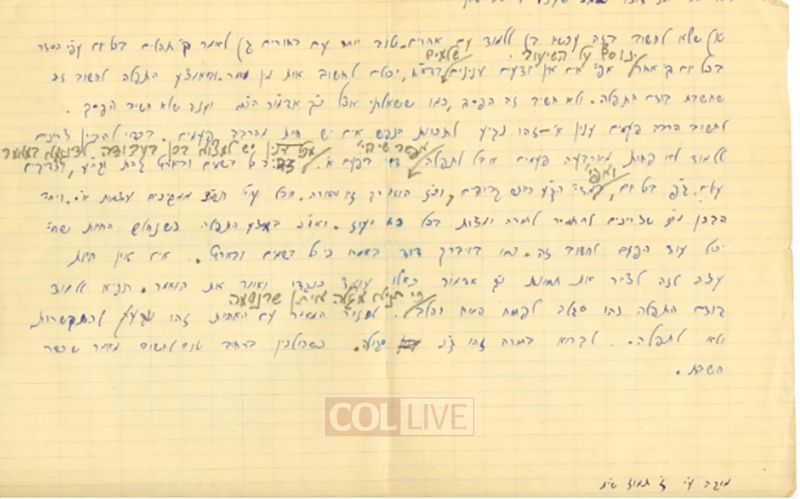
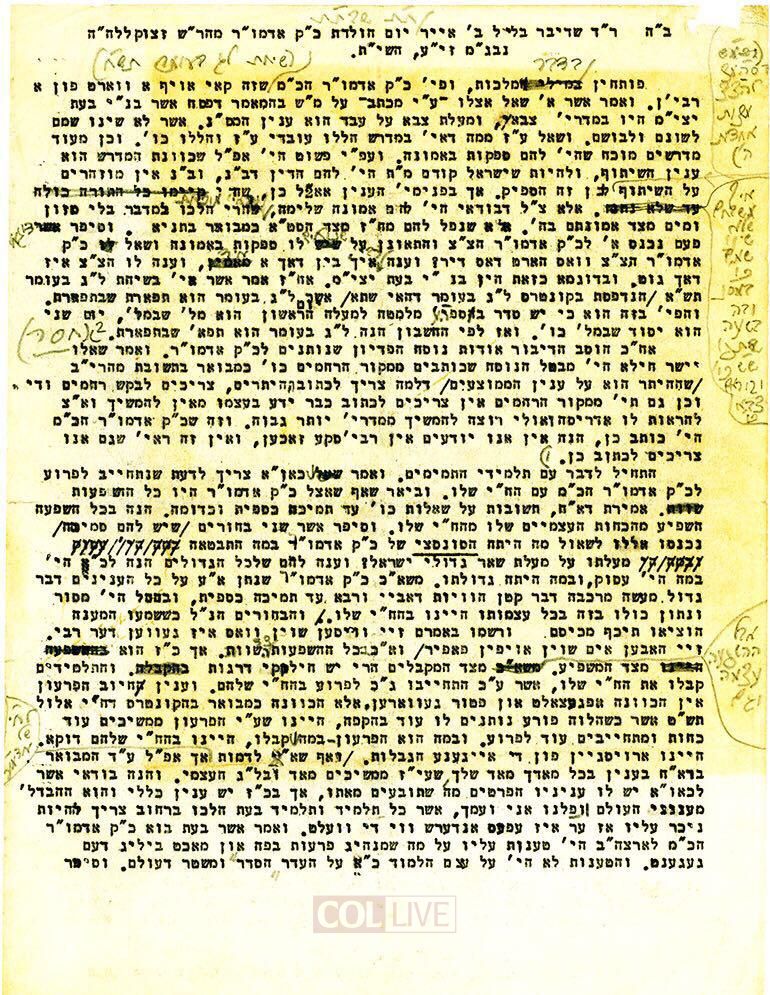
In accordance with this guidance, my grandfather adopted the same practice after meriting Yechidus with the Rebbe himself. Accordingly, following each of these two Yechidus’n, he prepared a transcript and submitted it to the Rebbe for review.
On 7 Tammuz, one week after his second Yechidus, the Rebbe returned the notes from both Yechidus’n, fully edited. As my grandfather later recalled:
“During that period, the Rebbe would usually arrive at 770 at 8:00 in the morning, and at times also in the evenings, during seder Chassidus. On the eve of 7 Tammuz, as the Rebbe came from his home, he entered the zal and made his way toward my place. With a gesture, the Rebbe invited me forward and handed me the two Yechidus’n—now fully edited.”
Presented below are the transcripts of those Yechidus’n, translated from Hebrew, offering timeless guidance on the foundational path of Chabad Chassidus. They cover key concepts such as hisbonenus before and during davening, how to properly study a maamar Chassidus, the application and integration of the Chassidus we learn into daily life, positively influencing one’s surroundings, and being joyous.
— • —
The Yechidus from 2 Sivan 5710, with the Rebbe’s edits incorporated:
[The first three points are responses on various personal matters.]
1) It’s not necessary to think about that now.
2) Learn with others, even better, with other bochurim.
3) Say one chapter (kapital) of Tehillim each day in order (I.e. a different chapter each day), in addition to the daily Tehillim shiur [of “Chitas”].
Even if you don’t know full concepts in Chassidus, you could still contemplate on a section (an “אות”) from a maamar, and in the middle of davening continue contemplating on that topic [of what you learned before davening]. As I once asked the Rebbe, my father-in-law [the Frieirdiker Rebbe], and he responded that it is not considered an interruption in davening.
To contemplate a single concept multiple times depends on one’s personal abilities (״תכונות הנפש״), particularly on one’s energy (״חיות״) to do so [i.e. the patience to engage deeply and review the content multiple times].
In general, to thoroughly comprehend a concept, one should study it at least four times. However, for the purpose of davening with the maamar, a single study is sufficient.
From every concept that we study, there must be a practical outcome in our service to Hashem. For example, in the ‘maamar’: ״וַיְבָרֶך דָוִיד״, [the tefilla recited during p’sukei d’zimra], we say: ״כִּי כֹל בַּשָּׁמִים וּבָאָרָץ״.
The explanation offered*:
This refers to Gan Eden ha’elyon and Gan Eden ha’tachton, as well as to the daily threefold ascent of tzaddikim. Even the loftiest levels of Gan Eden ha’elyon are considered merely a “radiance and illumination” (״זיו והארה״). However, through [our avodah of] learning Torah and fulfilling mitzvos, we are able to draw down עצמות א״ס. [Elevating and actualizing the Divine potential that exists, even above the highest spiritual realms.]
[* For a more elaborate explanation, see the Lag B’omer maamar of 5710—published by the Rebbe two weeks prior to this Yechidus.]
The practical takeaway from all of this is that we must dedicate ourselves fully to studying Torah and performing mitzvos, using all of our energy and strengths [or abilities] (״בכל כח ועוז״).
Afterwards, in the middle of davening, when the enthusiasm you had at the beginning begins to weaken, you may again contemplate on that [i.e. the chassidus you learned]. Like when you reach ״וַיְבָרֶך דָוִיד״, you should contemplate the meaning of ״כִּי כֹל בַּשָּׁמִים [as explained earlier].
If you find yourself lacking enthusiasm [or interest], the solution for this is to envision the image of the Rebbe, my father-in-law, as though he is standing before you and reciting the maamar.
Learning Tanya before davening is a segulah for opening [expanding] the mind and heart [enabling one to intellectually and emotionally absorb and internalize ideas]. Tanya reveals the inner powers and strength of a Jew’s neshamah [for the word “Tanya” (תּנְיָא) shares the same letters as “Eisan” (אֵיתָן), meaning strength].
Regarding reviewing a maamar using its actual wording, this is relevant for the purpose of hiskashrus, but it is not necessary for davening.
Reading from the Torah can also serve as a segulah (fostering both emotional and intellectual expansiveness). [In Yemei Breishis, for the entry of Rosh Chodesh Iyar 5710, it’s noted that he was already serving as the baal koreh on weekdays at that time.]
When walking in the street, it is advisable to review and think over a maamar that you have learned.
— • —
The Yechidus from Rosh Chodesh Tammuz 5710, with the Rebbe’s edits incorporated:
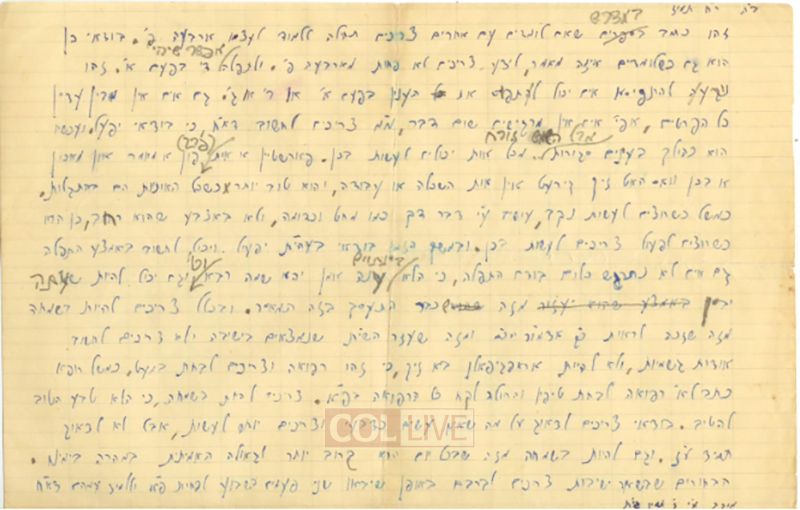
Regarding what is brought in Midrash [Avos d’Rabbi Nasan; see also Eruvin 64b]: in order to study with others, we must first study for ourselves four times—
This is certainly the case. Similarly, when studying any maamar, one should review it at least four times in order to thoroughly grasp its ideas. When it comes to davening with the maamar, however, studying it once may suffice.
These repetitions serve to ensure a proper understanding of the maamar’s concepts. Even if you grasp the ideas fully by the second or third review—or even if you do not yet feel [or perceive anything]—you must still continue to contemplate Chassidus, for the teachings will ultimately penetrate within you. In the present moment, it may feel as if you are walking blindly, yet the sun is shining.
From every section (אות) of a maamar, one must derive a practical lesson. Strive to understand a section (or chapter) of a maamar, whether its content is ‘intellectual’ or ‘spiritual’ (‘haskala’ or ‘avoda’) in nature, and then contemplate its meaning, actively seeking ways to apply it in your life. The practical application of the teachings is greater than merely knowing all the revealed letters of the maamar. [I.e., internalizing and living the lessons carries more significance than intellectual knowledge alone.]
To illustrate, consider the analogy of a needle: if one wishes to pierce a small hole, a thin, precise tool, like a needle, is required, unlike a finger which is wide. Similarly, in working on ourselves, we must apply what we study in practical, focused ways [integrating the teachings into our daily life]. With Hashem’s assistance, such dedicated effort will surely have its effect.
One can contemplate during davening even if no feeling is sensed beforehand, for in the meantime one has already answered “Amen, y’hei shmei raba,” and the like. It may also be that at this point you are already beginning to gain a subtle understanding of the maamar studied before davening.
In general, you need to be happy. Firstly, because you were zoche to see the [Frierdiker] Rebbe, and secondly, because you are, with Hashem’s help, in Yeshiva and are not preoccupied with material concerns. Therefore, there is no need to feel dejected.
This is metaphorically compared to medicine, which must be taken in small, measured doses. Imagine a doctor who prescribes a specific dosage, and the patient instead takes all the pills at once [it would be both ineffective and potentially harmful. Likewise, spiritual growth must be approached gradually and in measured steps].
[Again,] you need to be happy. For the nature of Good [i.e.Hashem] is to produce good.
Of course, we must remain aware of the areas in our lives that need repair and continuously need to improve, but this should not be a source of constant concern.
Another motivating factor for happiness is that each day brings us closer to the true and complete Geulah—may it be speedily, in our days.
Regarding working with bochurim from other yeshivos, one should make an effort to draw them closer through regular learning of Chassidus—ideally twice weekly, and at least once a week.






This is so inspirational! Thank you for sharing this priceless information!
R. bentche had already arrived in 5711?