
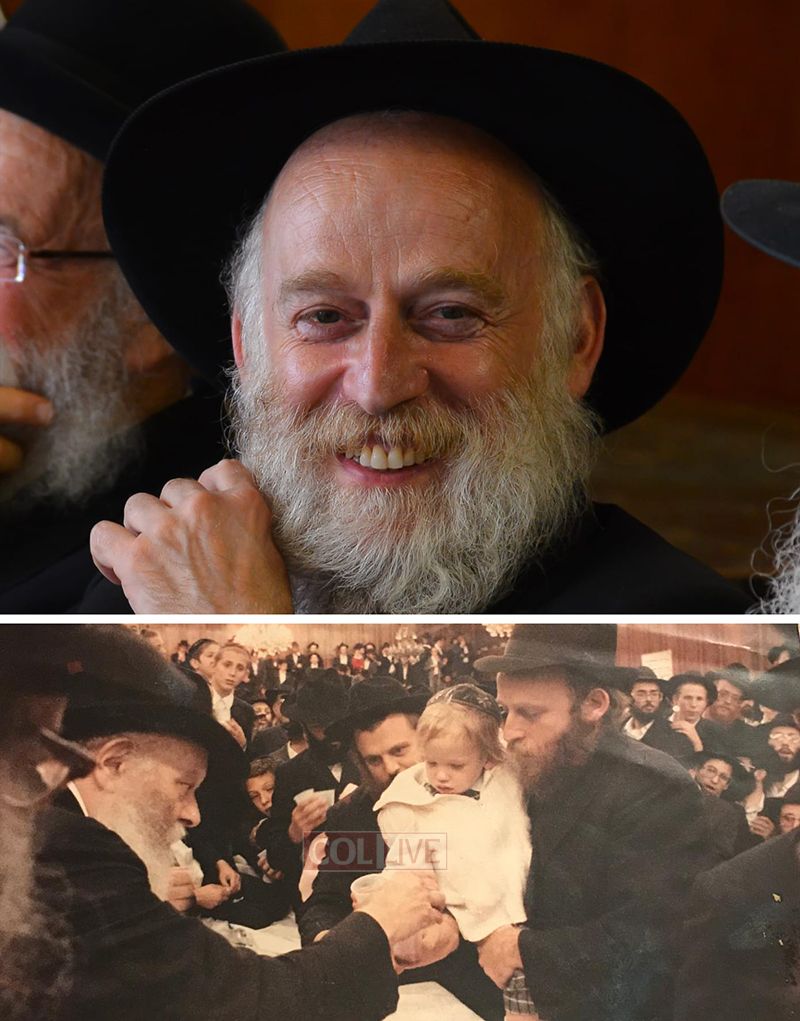
By Rabbi Mendel Kalmenson – rabbi of Beit Baruch and executive director of Chabad of Belgravia in London, England
“Loves known not its own depth until the hour of separation.”
Sometimes one only fully recognises the true greatness of what’s in front of their eyes, when forced to step back and see it from a distance.
That was my excruciating experience just one short-yet-very long month ago, when my dear and saintly father, Olav Hashalom, suddenly passed away on the first morning of Rosh Hashana.
Having been suddenly forced to “step back” from the enveloping embrace of my father’s physical presence, the towering peaks and majestic contours of my father’s humble greatness have emerged in stark relief, accompanied by a newly crystallised debt of gratitude to Hashem for the blessing of having been born to such a unique father.
It is the way of the world for people to lose parents at different stages of their life, but it is not the way of the world to have had a father like ours in the first place.
How many people can say that in over 41 years of knowing someone intimately they never once heard them utter even one negative word about another?
And my father did more than never speak Lashon Harah, when he sensed that a conversation was heading in that direction, he would do everything in his power to gently redirect it, and, if all was lost, he’d make a quiet exit.
And if, c’v, unexpectedly, a negative word was said about another in his presence, he would recoil, and his face would blanch, so allergic was he to the denigration of another human being.
Despite his vast and far-reaching intellectual accomplishments, including 15 critically acclaimed (published) Sefarim, (and approximately another 10 sefarim yet to be published), all held in high esteem by the greatest Roshei Yeshivos of the Yeshiva world, my father lacked even a modicum of self-importance and in my entire life I never once saw him condescend to anyone C’V, or saw him demonstrate even a hint of ego or pride.
To the contrary, he greeted and treated every person he encountered with a deep respect that bordered on reverence, and with his trademark radiant smile and infectious warmth, he made everyone he encountered feel seen, heard, and valued.
One incredible feature of his profound sensitivity to the feelings of others, was his uncanny ability to act surprised and delighted when someone shared an anecdote or story with him that he already knew.
In fact, on numerous occasions I personally witnessed someone telling my father the same story my father had shared with them previously, only to see my father’s face light up with pleasure upon hearing the punchline, as if hearing it for the first time.
You see, my father wasn’t just a Gaon in Torah, he was a Gaon in Kavod Habriyos, in bestowing dignity, honour, and empowerment upon everyone he met.
His extraordinary sensitivity to others was second only to his patience, kindness, and caring for others, especially those whom others overlooked.
In this, my father emulated the Rebbe’s words to Reb Yossel Weinberg when he apologised to the rebbe for unwittingly making the Rebbe bend down to pick up a fallen note he had placed in the Rebbe’s door:
The Rebbe responded: “הרי כל עניני הוא אופהויבן, ובפרט דאס וואס אנדערע פארזען – my entire raison d’être is to uplift — especially those whom others overlook.”
No matter how important what he was doing was or with whom he was doing it he would always jump up to take a call from individuals who struggled with physical or mental health challenges, who saw him as their lifeline.
One example among countless others, is of an individual affected by a bed bug infestation and needed to be taken to a doctor’s appointment.
My father gently wrapped the man in a blanket and personally drove him to the appointment.
As a true Eved Hashem, no task was beneath him and no duty ever grew old for him.
This was my father’s true Gadlus, his Baal Shem’ske tmimus and pashtus, a rare blend of sincerity and simplicity which saw him translate every word of Torah he learned into the realm of Pshat and Masseh Bpoel – the literal and applicable.
To my father, “Hevei Mekabel Es Kol Adam Bsever Panim Yafos,” wasn’t poetic but literal.
“Vohavta Leracha Kamocha”, wasn’t a platitude, it was literal.
“Vohavta Es hashem elokecha” and “Pekudei yesharim Mesamchei lev” wasn’t theoretical, it was visceral.
“Netzor Leshoncha Merah”, wasn’t figurative, it was literal.
“Ki Hem Chayenu Vorech Yamenu Uvahem Nehgeh Yomam Valayla,” wasn’t lyrical, it was life itself.
“Talmidei Chachamin Marbim Shalom B’olam” wasn’t conceptual, it was literal.
[During Shiva, a man shared that my father helped broker a peaceful resolution between his father and his business partner who had had a terrible falling out and were suing each other in court for years. “I can’t bear to see two Jewish people fighting with each other,” he explained, when asked why a Torah scholar of his stature would got involved in the business dispute of two acquaintances.]
“Hatzea Leches Im Hashem Elokecha” wasn’t aspirational, it infused every aspect of his Avodas Hashem.
“Kol Yisroel Arevim Zeh Bazeh” – just one extraordinary expression of his all-consuming sense of achrayus for another Yid was his near-daily minhag to wake up bachurim for Sof Zman K’S and bring Neggel Vasser to their beds.
“|Vayaminu Bhashem Uvmoshe Avdo”, wasn’t a Drush, it was Pashute P’shat.
The Rebbe’s Inyonim and Mivtzaim weren’t recommendations, Hiskashrus was the life blood of his existence.
This is how you get one of the great Roshei Yeshivos of our generation, devoting hours each day, and literally organising his life around opportunities to help others put on tefillin, including on his last day b’alma dein.
I am not exaggerating when I say that not once in over 41 years did I see even a hint of dissonance between my father’s values and his Machshova, Dibbur, and Maaseh.
Not once, not even a hint, literally, he served Hashem al Derech Hapshat.
I cannot stress how unique this is for someone whose primary occupation, preoccupation, and life’s work involved Lomdus, that subtle and sophisticated intellectual artform built upon abstraction, conceptualisation, and theoretical analysis.
Notably, in all of the above, my father was lovingly supported by my dear mother, may she live and be well, whose devotion to his life’s work was beyond measure, and whose unwavering dedication and presence in his life allowed him to accomplish as much as he did, spiritually, intellectually, and communally.
But in truth, if you really want to understand my father, you must understand the following.
My father was more than a collection of diverse virtues, however unique in quantity and quality.
Every branch of his character and personality grew out of the very same root.
There’s an ancient saying that “the fox knows many things, but the hedgehog knows one big thing.”
My father knew one big thing, which he internalized and embodied to such a degree that it became his essence.
Notably, this past summer at a family reunion celebrating his 70th birthday my father shared what to my mind was that big idea.
It was during Seudas Shabbos when I asked him, “Tatty, you merited to spend so much time at the Rebbe’s Farbrengens. Which one teaching left the deepest impression upon you?”
This is what he answered:
The rebbe was discussing two versions of the Mishnaic teaching describing the very mission statement of humankind.
The first iteration is: Ani Nivreisi L’shamesh Es Koni. I was created to serve my maker.
The second version is: Ani Lo Nivreisi Ela Lshamesh Es Koni, I wasn’t created except in order to serve my maker.
The Rebbe explained that that the difference between the two Nuschaos was not a matter of semantics but substance, each version describing an entirely different way of serving Hashem.
The difference can be readily understood if you remove the second part of the statement: “Lshamesh Es Koni.” To serve my maker.
In the first version, we are left with Ani Nivreisi, I was created.
In the second, we are left with Ani Lo Nivreisi, I was not created.
In the former, the person’s existence and sense of selfhood is primary, it’s just that he’s come to recognise the life enhancing beauty in serving something beyond himself.
And so his foundation and the prism through which he sees the world, is Ani Nivreisi, Ich Bin Da.
My I, my ego, my selfhood, is the premise of my existence and consciousness.
But then there are those special souls, very few and very far in between, for whom their very essence is L’shamesh es Koni, and as for their own existence, well, Ani Lo Nivreisi Ela, I don’t exist but for.
I am only the means, Hashem’s Will is the end, not the other way around.
These elevated souls have no self-image or personal agenda, in the language of chasidus, they exist on the frequency of Hanachas Atzmuso, they are imageless and egoless because they are or become whatever they are needed to be at any given moment, in order to fulfil the Ratzon Haboreh.
And in them one sees that rare light, a ray and reflection of Koran Or Panav, the unique radiance reserved for those who have made themselves completely transparent to their purpose in the world.
Call me positively biased, but it was that refined light and luminescence that graced my father’s countenance, and whose energy touched so many a soul.
Ultimately, the teaching of the Rebbe that touched my father more deeply than any other was not a vort in Nigleh or Chasidus, but a vort in Avoda, and that was the one big idea that was the cornerstone of his existence – Vidach Pirusha.
And to the extent that we can emulate my father’s example, each of us in our own way, whether speaking one negative word less, or one empowering word more, whether adding in Limud Hatorah, Shkidah Vhasmadaha, Avodas Hatfilah, in the Rebbe’s Mivtzoim, and especially Mivtza Tefilin, whether being more patient and caring with those in need, especially those whom others overlook, to that extent will my father’s presence live on in us and through us, bringing Aliyah and nachas to his holy soul.
Allow me to conclude with a final anecdote.
There were times when a Friday night meal had gone quite late, and there was no sign that the guests were anywhere near ready for bentching, when my father in his gentle way would delicately try to communicate that Hegiah Zman Kriyas Shema Shel Shacharis.
It was then that he would say with a warm smile: “Di Kinder Zeinen Farmatert.”
“The children are tired.”
And with that, the Bentching would commence.
Well, Tatty, now it’s our turn to say to you, please storm the heavens, and let der Aibeshter know, Az di kinder zeinen Oisgemutchet un Farmatert.”
Your children are exhausted beyond measure by this drawn out Galus, and it’s time to make a siyum on this bitter exile once and for all, when Vhekitzu Vranenu Shochnei Afar, we will be reunited with our loved ones in person, once again, Amen Ken Yehi Ratzon.


Wow Mendy
Your father is truly a person to learn from.
r mendel, i didn’t merit to properly know your father. we only spoke when i confused for my rosh yeshiva, his twin.
but reading these words after knowing your uncle and you.
makes me think Ani lo….
So beautiful. I want to read this a few times to internalize
What a beautiful tribute!
Where did he learn in Yeshiva?
Brunoy, where he grew up, near Reb Nissen nemenow and where his father was a teacher
This is article is so so beautiful!
Thank you so much for sharing!
As someone who spent two years in NH I can definitely see how you everything you say is so true.
And like you said, hopefully this can have even a small effect on everyone.
My mind honestly cannot wrap itself around how much of a beyond great person he was.
May his memory be a blessing.
To the Kalmenson family,
Beautiful article. My husband Reb Yitzchok Michael learned many years with your dad Oleh Hashalom. My husband knew you your father for many years bh. He would tell me that Rabbi Kalmenson is giving a
Shiur and I don’t want to miss it. Your father was an absolute gem along with your mother. unfortunate right now my husband has yene machla. My husband is mamash a trooper and a fighter. May your father be Gute better.
Heard this in real time as I watched the shloshim live. All the speeches were phenomenal- would love to see them written up as well.
This article- speech bears reading and rereading to the point of inspiring the reader.
Rabbi Kalmanson was a remarkable human being and Chossid. Thank you for letting us get to be inspired up close and to encourage positive change within each of us
Thanks for sharing so beautifully about your righteous father z’l. Your words truly resonate. Amen to Moshiach now!
loshon hora is something we need to constantly remind ourselves to stay away from. its very seductive. over time, every time you HOLD THOSE WORDS IN, you build that muscle of self control, and it really gets easier over time, and its very satisfying. try it! hold in the urge!
Rabbi Kalmanson was a true tzaddik gamor.
Our world is left without a tzaddik and neshama, being so unique — so pure, always embodying what it means to be a chossid, humble beyond description.