
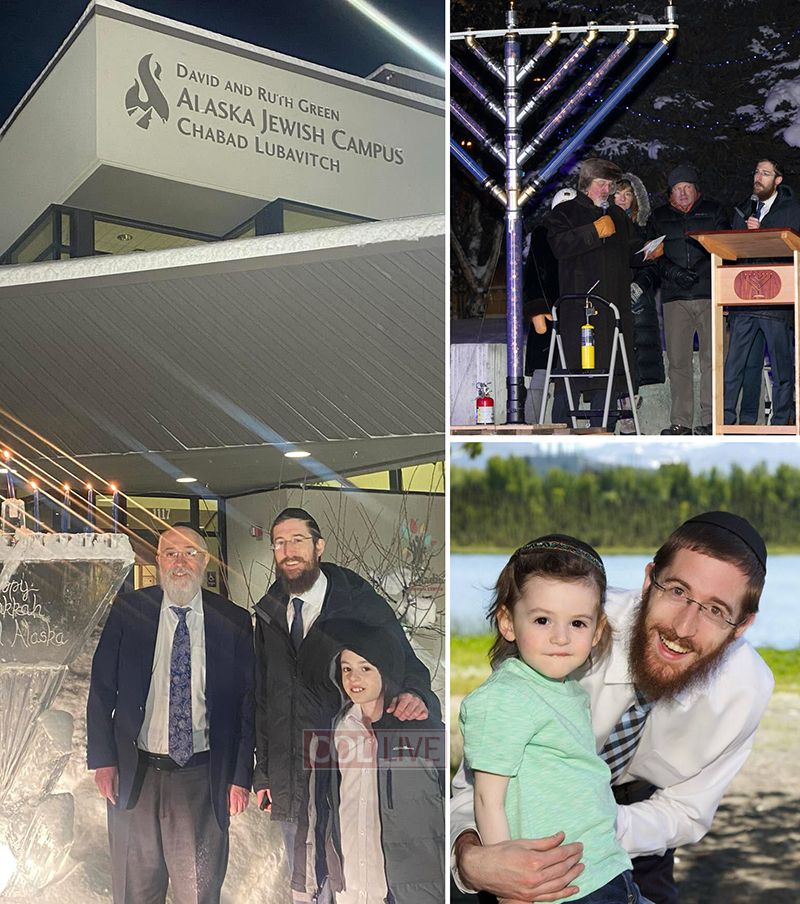
Rabbi Levi and Mushky Glitsenstein, Alaska Jewish Campus – Chabad Lubavitch, Anchorage, Alaska
By: Chaya Chazan
The Rebbe paid special attention to far places, where the work of Chabad is needed the most for the local communities. These small, far out, yet vibrant Jewish communities serve as an inspiration for Jews around the world to strengthen their commitment to their Judaism.
I was born in Eilat, Israel. My father was one of the only shluchim to be personally chosen and sent by the Rebbe before he was even married as a pioneer to establish Chabad in Eilat. In 1975, Eilat was considered a small and faraway city, and the Rebbe was involved in every step of the development of Chabad’s work there, giving many specific directives and blessings throughout the years, from small details like editing Chabad flyers to larger projects like choosing the specific property to build the Chabad house.
My wife grew up in a location as opposite to Eilat as could possibly be. My in-laws, Rabbi Yosef and Esty Greenberg, arrived in Alaska in 1991 with Rebbe’s blessings to establish Chabad in the state of Alaska. Baruch Hashem, they were very successful in building a thriving Jewish community at the Alaska Jewish Campus – Chabad Lubavitch. Their vision and work is truly incredible and unmatched for a city and location of this kind. My wife and I were honored to join their team as shluchim in 2013, dedicating ourselves to outreach, programs, classes and activities, building and supporting a thriving Jewish life in Alaska.
In 1992, my in-laws came to the Rebbe for the Kinus Hashluchos, when my wife was three months old. The Rebbe gave them the blessing before going back to Alaska, “You should make it warm there!” This is our mission and calling until the coming of Moshiach: to “warm up” Alaska.
———————–
As can be easily imagined, life in Anchorage comes with a specific set of special challenges and opportunities. The closest Jewish community in Seattle, Washington is more than a three hours’ plane ride away. That means that there’s a constant need to provide any and every Jewish service imaginable, no matter when or where. Whether it’s flying in a mohel for a new baby boy, coordinating kosher food orders for the local community, or arranging a Jewish burial, we are there. Every aspect of Jewish life for all ages and stages, locals and visitors, is our honor to help and facilitate.
—————–
It was the highlight of the Gan Israel Teen Camp: an overnight in beautiful, scenic Seward, Alaska. I supervised the unpacking and barbeque, singing campfire songs and telling stories which continued into the midnight sun, since it doesn’t really get dark in the summer months.
Early in the morning, I headed back to Anchorage. Alaska is filled with magnificent scenery stretching over every horizon. It was a silent drive, and I immersed myself in Hashem’s majestic artwork. From time to time, I glanced at the fuel gauge, although I knew the needle would never waver from empty. It had been broken for some time, and insisted the tank was empty even when freshly filled. Making sure I didn’t end up stuck on the side of the road was more a lucky guess or careful estimate than anything else.
I passed a gas station and looked again at the gauge. Was it time to fill up? I decided to keep going. A while later, I passed by another gas station, and decided to continue. When sighting the third one, something compelled me to stop and refill. As I waited for the pump and relaxed against my car, breathing in the clean, early morning air, I heard a voice from the other end of the gas station calling, “Sholom aleichem!”
I was surprised. The roads were deserted at this early hour of the morning. What were the chances of meeting another person, let alone a fellow Jew at this random gas station? I figured it was one of the many thousands of tourists who come to enjoy Alaska in the summer.
I turned and saw a man approaching, smiling widely and waving his hand in excited greeting.
“Sholom aleichem!” he said again, as he approached. “What are the chances of meeting a rabbi around here? It’s been years since the last time I met a rabbi!”
David had grown up in a traditional home in Rhode Island, and was now living in Anchorage. He knew about Chabad in the city, but it had never meant enough to him to seek it out. He was on his way to a fishing trip when he stopped for gas. He was so flabbergasted to see a real, live rabbi out in the middle of nowhere, he couldn’t help but say hello.
We exchanged numbers, and I wished him luck on his fishing expedition before getting back in the car and continuing the long drive. I tried calling him a few times after camp, but the excitement that had gripped him so strongly in the gas station seemed to have all but dissipated.
One wintery Friday afternoon, when Shabbos comes in very early, he finally texted back. “I can come to the synagogue in the next few minutes.” Even though it was nearly Shabbos, I knew I couldn’t let this opportunity pass. I met up with him and renewed our acquaintance.
From there, our connection grew, bit by bit. He started to get involved, coming to shul to meet and put on tefillin, and sometimes for Shabbos and holiday services. We had many conversations about Judaism, tefillin, Chabad, and, of course, the Rebbe, and his mission to change the world. I gifted him with Joseph Telushkin’s book, Rebbe, and he couldn’t get enough. He read the entire thing cover to cover multiple times, and quotes from it constantly. He tells everyone how much it inspires him, and how he learns something new on every re-read.
Recently, at a Shabbos lunch with the community, he shared his reflections on the Rebbe.
“I’m fascinated. Every time I think about the Rebbe, I’m smiling; he affects me that way. The Rebbe had the ability to go to the root of all problems. Just about every time, he had the answer for people and they walked away with a sigh of relief and understanding how to proceed. I’m not a practicing Jew, yet I’m so attached to this man and it’s a blessing for me. I never met the Rebbe but I know the Rebbe. He is everything to me.”
—————–
I’d driven down the street leading to the Chabad house hundreds of times. I’d walked that block every Shabbos week after week and was familiar with the homes and community members. In the winter months, I wasn’t able to pay much attention, since I needed to keep my eyes on the ground to make sure I didn’t slip on the icy snow, but in the summer, I had the leisure to look around and notice all the small changes. I was surprised when I saw one home with a mezuzah.
How have I never noticed this before? I wondered. If a Jewish family lives so close to Chabad, wouldn’t I know them?
A few days later I returned to visit and rang the doorbell, but no one seemed to be home. The next few times I went, I met with similar disappointment. I left flyers and cards on the porch, but never heard from the mysterious owner.
One Shabbos morning as I passed by, I saw a man exiting the home. I went over and greeted him and introduced myself.
When I told him who I was and why I was so excited to meet him, his face relaxed into a smile.
“Oh! Yes, that makes sense. My name is Nate. I’m a doctor and a surgeon with a demanding schedule, so I’m rarely home. It’s nice to meet you!”
I shared my interest in his mezuzah and asked him about it.
“Oh, that? It’s not mine,” he answered. “I bought this house from a Jewish lady 15 years ago, and she had it up on the door.
“I decided to leave it. I myself also have some Jewish background, although I don’t know much. My grandmother, on her deathbed, told my mother she was Jewish. She survived the Holocaust and was too afraid to ever let anyone know after that. With my grandmother’s revelation in my mind, I decided to honor this Jewish relic by leaving it where it was.”
Nate promised to come by the Chabad house. That was the beginning of a long and fruitful friendship. Together, we learned Torah, put on tefillin, and Nate got more involved with his Judaism. Recently, he built a new home on the other side of town, and this time he made sure to call and ask me to come and put up mezuzahs in the new house.
______________________________
Alaska is the largest state in the country, but its population is spread thinly throughout hundreds of small towns and villages. Throughout these exist a sprinkle of Jews. As Chabad of Alaska, it’s up to us to help every Jew in the state, even though many of them live hours away from us.
One summer morning, I got a call from an elderly man in Soldotna, a small city about 3 hours drive from Anchorage. His voice was tremulous, and I had to listen carefully to make sure I caught every word.
He told me his name was Jules – although he was proud to tell me his Hebrew name, Yosef ben Eliezer HaKohen, as well – and that he now splits his time between Soldotna and Florida. His doctors had just given him a grim prognosis: his days were numbered.
“They gave me three weeks,” he explained, stumbling over the difficult words. “In the short time I have left on this earth, there is only one thing I care about. For most of my life, I wasn’t involved in my Judaism, although I have fond memories of accompanying my grandfather to shul in Connecticut as a boy. Now, as I look death in the face, I know with certainty: I want to be buried with my people!” His voice grew stronger. “Please help me!”
“Of course!” I assured him. “We have a Jewish cemetery here in Anchorage, and it would be our honor to reserve a spot for you!”
He gave his credit card information right away to cover all the costs involved in the taharah, funeral, and burial.
“I’m very serious about this, and will do anything to ensure I will receive a proper Jewish burial,” he explained.
I was impressed with his sincerity and passion, and promised to start the arrangements right away. Jules called me every other day to get status updates, making sure I was giving his funeral arrangements top priority. Although we only spoke on the phone, I could hear the rapid deterioration of his health in his voice. When he called me one morning, his voice had faded to a raspy whisper, and I knew his time was approaching.
Knowing that the end was near, we video chatted and I helped him say the final confessional prayer. We ended with Shema, which I began to coach him through, just as I had for the rest of Viduy. Jules didn’t need my help. He said the entire Shema fluently, and sighed deeply when he finished.
The next morning, his neighbor called to tell me that Jules had passed away.
I immediately called the funeral home and arranged for his body to be transferred to Anchorage. Jules had no family and knew not a soul in Anchorage. Who would be our minyan? I emailed our community the information for the burial of this meis mitzvah, and hoped people would come through. I made a few phone calls and texts to ensure that Jules would be properly respected on his final journey and that Kaddish would be said.
When I got to the cemetery, I was surprised to see over 100 people gathered to see him off on his final journey. The crowd included our local community members, tourists and even the students of a traveling yeshivah camp.
Jews from every walk of life had come to pay their respects to this stranger that none of them knew, from the middle of nowhere, Alaska. Just a day before, we’d commemorated the destruction of the Beis Hamikdash, reminding ourselves that every Jew is a mini-mikdash. As long as the Jewish nation lives, the Beis Hamikdash can never be destroyed.
————————-
Ari travels far and wide for his business. He was one of the dozens present at Jules’ funeral. The scene of so many Jews coming together to perform this unique mitzvah for someone they didn’t know was so deeply moving, he volunteered to recite Kaddish for Jules the entire year.
For the next eleven months, Ari never missed a Shacharis, Mincha, or Maariv minyan. He called me on the last day, reflecting on the incredible opportunity he’d experienced.
“I’ve said kaddish for him in France, Iceland, Morocco, Canada, Israel and more! May his neshama have an aliyah.”
—————————
I’d known David for a long time. He’d been coming to Chabad for a while, and was a beloved member of our community.
When we celebrated the birth of our daughter, David called to congratulate us, offering his most sincere and joyous Mazal tovs.
“I have a baby gift for you,” he told me. “Can I come over now to show it to you?”
David arrived about twenty minutes later, radiating barely contained emotion. He held a brown folder tightly against his chest, smoothing its cover every so often with unconscious strokes.
“I didn’t have it easy growing up,” he began, once he’d sat at the table with a cup of coffee. “My parents attended a synagogue at one point, but they moved to another part of town and never bothered finding a replacement. So I grew up knowing next to nothing about my Judaism.
“My parents both died when I was a teen, leaving me to patch up the broken pieces of my future. I felt lost and rudderless, so when I saw an ad asking for volunteers in Israel to replace workers who’d been called to serve in the Gulf War, I thought it was the perfect solution to all my problems.
“I joined a kibbutz and soon settled into my new routine. I made friends and was starting to envision a future, when tragedy struck. I was working in the fields with a group of friends, when terrorists opened fire on us. A few friends from my group died, and I was injured badly.
“The next few weeks were devastating. I mourned the loss of my friends and felt stifled by my immobility. I was an athlete who loved running around and being active, and I was going out of my mind confined to a wheelchair that relentlessly taunted me with the reality of my blighted future. When I finally recovered enough to hobble back on my feet, I flew back to America.
“I was extremely depressed and lost. I was coming out of the train station in Chicago one day, engrossed in thought, when a New York Times article caught my eye.”
David pulled a yellowed newspaper from the brown folder with deferential care. It was dated July 8, 1994, just a few weeks after the Rebbe passed away. It was a full page ad with the catchy title, Turn pain into action; tears into growth. A large picture of the Rebbe beamed up from the page.
“I didn’t know who the Rabbi in the newspaper was, but I was immediately drawn to his kind, compassionate face. Just looking at his picture brought me a measure of comfort. The words on the top of the page seemed written expressly for me, and I bought a copy of the paper on the spot. I hung up the ad on my wall, and every time I looked at it, it brought me a renewed sense of peace and purpose. I slowly began to rebuild my life. Whenever I moved, this newspaper moved along with me, and it was the first thing I hung on the walls of my new home.”
David paused for a moment, breathing deeply and gathering his thoughts.
“At some point, I realized there were some other words written on the side. See? Mah zar’o b’chayim, af hu b’chayim – as his children are alive, he is alive. Now that you’ve had another child, I thought it would be a fitting gift for you. This newspaper is my most treasured item and it changed my life. Now that I know so much about the Rebbe’s work all over the world and I see your family growing, it deserves to be with you – a child of the Rebbe who is keeping the Rebbe’s legacy alive by being here in Alaska, continuing to change the lives of countless Jews.”
I accepted the gift with humble appreciation, and it now occupies a prominent spot in my office.



🆒
Thankyou for publishing these I am so inspired:)