

By Tzemach Feller –Chabad.org

Now, six of Sacks’s peers—chief rabbis in countries around the world—are paying tribute to his life of leadership. Sacks’ first work was Torah Studies, eloquent adaptations of parshah essays by the Rebbe, Rabbi Menachem M. Schneerson, of righteous memory, and published by Kehot Publication Society in 1986. For the Torah-portion of Vayechi, the week of Dec. 27-Jan. 2, the six rabbis have recorded classes using Sacks’ beautiful rendition as their source text.
Rabbi Max Godet, the Chief Rabbi of Uruguay, teaches his class in Spanish; Rabbi Warren Goldstein, the Chief Rabbi of South Africa, in English; Rabbi Michel Guggenheim, the Chief Rabbi of Paris, gives a class in French; Rabbi Binyomin Jacobs, Chief Rabbi in the Netherlands, in Dutch; Rabbi Dovid Lau, Chief Rabbi of Israel, teaches in Hebrew; and Rabbi Berel Lazar, Chief Rabbi of Russia, in Russian.

Sacks (front row, second from right, with his hand on his chin) attending a lecture for students by Rabbi Zalman Posner, celebrating the opening of Lubavitch House in London in March 1968.
“Rabbi Sacks’s first visit with the Rebbe had a profound effect on him,” Rabbi Shmuel Lew, today a senior Chabad emissary in London and the director of the Lubavitch Senior Girls School, tells Chabad.org. That summer of `68 the Rebbe suggested Sacks remain in New York for a bit longer, until after Rosh Hashanah. “Much to Sacks’ amazement, the Rebbe knew that the term in Cambridge began weeks later than most of the other college terms did,” says Lew.
With Cambridge’s early October start date that year falling out after Rosh Hashanah, Sacks indeed stayed. “The experience moved him so profoundly that on Rosh Hashanah in 2019, he expressed that for the past 50 years, the sounding of the shofar to him has meant the inspiration, depth and joy he experienced at the Rebbe’s shofar sounding that year,” Lew recalls.
During that initial meeting, the Rebbe pressed Sacks on what he was doing for Jewish life on campus, and so when Sacks returned to Cambridge he began hosting a Torah class in his dormitory room. That class continued— albeit hosted in different venues—through Chabad on Campus’ arrival at Cambridge in 2003, to this very day.

Rabbi Lord Jonathan Sacks
“Very often before the class began I would share with Sacks a sichah — talk — that the Rebbe had recently taught,” says Lew. “He was fascinated, and his interest only grew.”
In response to the Rebbe’s 1971 call to increase in Torah study, Vogel suggested that Sacks—with whom by then he enjoyed a long and deep relationship—begin rendering the Rebbe’s most intricate weekly teachings on the writings of Rashi into English. “Studying the Rebbe’s talks weekly together with him was one of the highlights of my life,” says Vogel.
These pamphlets were distributed to Jewish community members, and Sacks’ lucid and contemporary style proved popular. In 1986 these pamphlets were collected and, with the Rebbe’s blessing, published as Torah Studies.
“That was his very first publication and was followed by some thirty books which have received universal acclaim and adulation amongst religious leaders, political leaders, academics and the populace of wide and varying nations,” says Vogel. But, “the underpinning of all his moral philosophy lies within his very first book.”

Students at the University of Central Florida with Rabbi Chaim Lipskier, left, take part in the weekly study of the Rebbe’s Likkutei Sichot, part of a worldwide effort to study the entire 39 volumes over eight years.
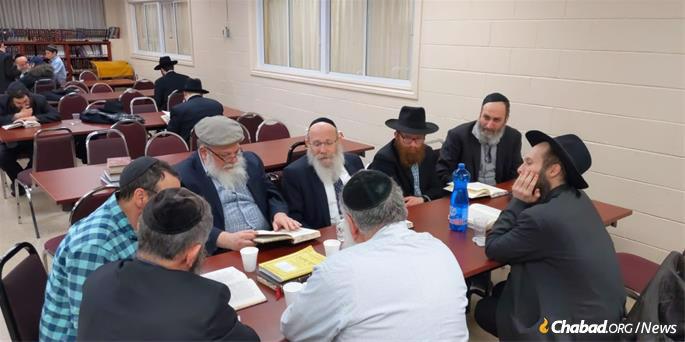

Students at the Bnos Chomesh High School in Toronto have made the weekly study project part of their lunch-time activity.
“The sichos adapted by Rabbi Sacks in Torah Studies convey the Rebbe’s thoughts with a unique clarity and succinctness,” says Rabbi Yossi Friedman, who directs the Kehot Publication Society, which published Torah Studies and made it available online at Chabad.org. “In his foreword to the latest edition, Rabbi Sacks wrote: ‘Great spiritual teachings do not die. It is my hope that this brief selection taken from the Rebbe’s words will serve as a living reminder that the Torah continues to be our Tree of Life.’ These are appropriate words for the translator—Lord Rabbi Sacks himself—as well.”
Vogel relates how following the Rebbe’s passing in 1994, Sacks delivered an hour-long memorial lecture. At the conclusion of his talk that in many ways captured and distilled the quintessence of the Rebbe, Sacks said, “I have tried to pay tribute this evening, not only to one of the great leaders of Jewish history, but also one of the great ideas of the Jewish spirit. I can think of no more visible proof of an invisible force—the force of the mystical Ahavat Yisroel—the love for every Jew—which the Lubavitcher Rebbe so loved and lived and taught.”
“Indeed, he mirrored the Rebbe in his aspirations,” says Vogel. “This must be his ultimate accolade.”
VIDEO: