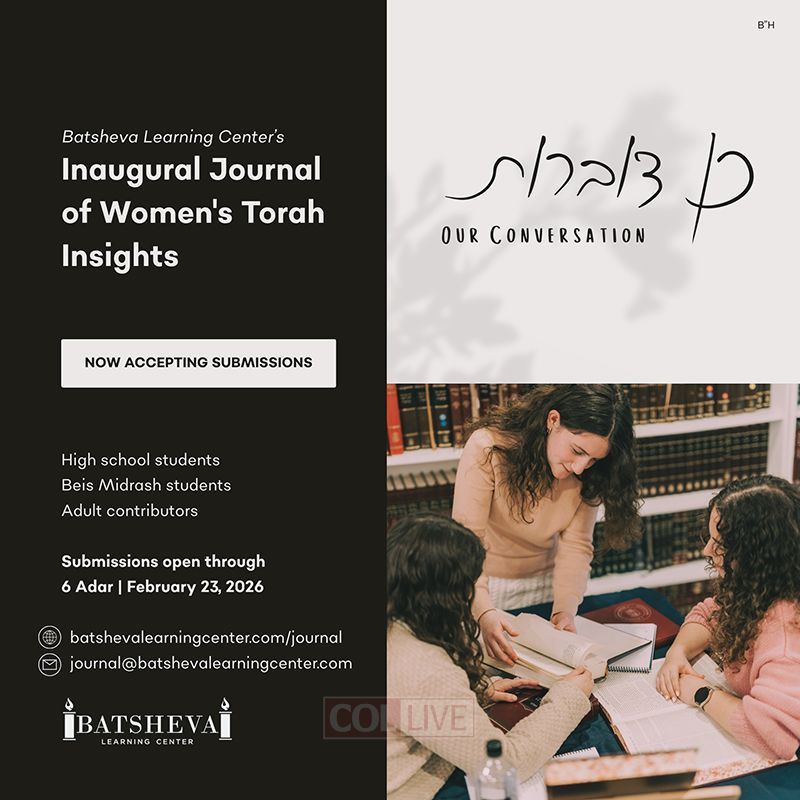
This spring, Batsheva Learning Center will, G-d willing, publish its first annual journal of women’s Torah insights—and we’re inviting YOU to be part of this groundbreaking project!
כן דוברות-Our Conversation: A Journal of Women’s Torah Insights, will give a unique opportunity to high school students, Beis Midrash students and adult contributors to submit original essays for consideration. Essays for our inaugural journal are based on the process outlined in the Rebbe’s קונטרס ענינה של תורת החסידות. Each author will pick a topic in Torah and trace its development through the structure of Pardes (Pshat, Remez, Drash, and Sod) culminating in the illuminating insights of Chassidus. Developing your own insights into Torah is not just an academic exercise.
It is part of our inheritance and mission as Chabad Chasidim.
We are all familiar with the structure of the Rebbe’s Rashi sichos: a number of questions on Rashi’s commentary are posed and then the Rebbe brilliantly resolves every difficulty. However, what if the sicha ended with the questions and you had to come up with the answers? On Shabbos Parsha Vayeishev תשמ״ד, the Rebbe asked a number of questions on a Rashi at the farbrengen, but he gave no answers. When no one sent in any answers the following week, he made an announcement that the weekly Shabbos farbrengens would pause for three weeks until Shabbos Mevorchim Parshas Va’eira when he repeated the questions again. That week, hundreds of people submitted answers: men, women and children.
The Rebbe’s intention was clear. When you are responsible to uncover something new in Torah it is the most powerful motivation to learn– and it makes it your own. As Chassidim of the Rebbe, we were not meant to be passive recipients of his Torah, but rather to learn from the Rebbe to see the Torah the way he does. The inclusion of women in this process was initiated already by the Frierdiker Rebbe in his instruction to the Riga women’s group, Achos Hatemimim, that they should develop Torah essays reflecting on their learning in their own voice with their own thoughts. Thus, when establishing Neshei Bnos Chabad, the Rebbe noted that the women should produce publications on Torah topics to inspire fellow Chabad women, their own sons and daughters, and the broader Jewish People.
Alongside the practical motivation and excitement of developing your own exposition of ideas in Chassidus, there is a spiritual significance to this process. Revealing something new in Torah through your own efforts reveals the “בלי גבול” nature of the Torah– that it can be unfolded infinitely. In addition, when a person innovates something new, this is a revelation of their own unique essence. It allows a person to reach beyond their conscious powers and tap into a deeper, more essential connection to the neshama. Chassidus teaches that this process itself is a taste of geulah, a step toward the fulfillment of “ומלאה הארץ דעה את ה׳.” For this reason, the Rebbe taught that in the time leading up to the geulah, every Yid has a responsibility to produce chiddushei Torah.
Under the guidance of an experienced editorial team, contributors to כן דוברות will be supported through multiple stages of development and refinement, ensuring that each essay reflects both clarity of thought and depth of insight. The result will be a beautifully produced journal that serves not only as a record of learning, but as a lasting resource, one that can be studied, taught, and returned to again and again.
High school submissions are now closed but Beis Midrash and adult contributors are still welcome to submit an essay by Feb 23rd. Some exceptions may be made for high school students who still wish to submit for this year. Essay length is 1,000-3,000 words.
To learn more or submit an article to the journal, visit https://www.batshevalearningcenter.com/journal or contact [email protected]