
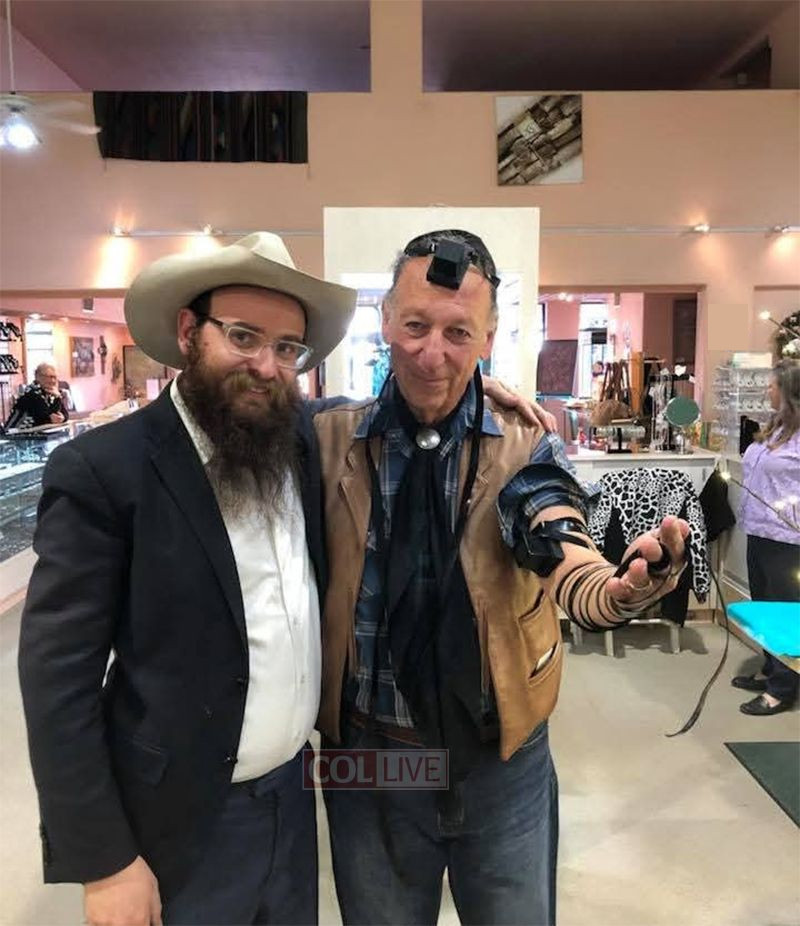
Rabbi Benzion and Chaya Shemtov, Chabad of Cochise County, Sierra Vista, AZ
By: Chaya Chazan
My parents were the major inspiration for our shlichus. Watching them throughout my childhood as they served the Tucson community and created thriving, Jewish life made me want to do the same. My wife and I found a small city about an hour and a half southeast of Tucson where we felt we could make a difference.
Nestled in the desert, almost directly on the border of Mexico, is Sierra Vista. There is an army training base nearby, Fort Huachuca, and almost everyone in the city is active military, retired military, or working for the army.
When we first moved, I presented myself to the army base commander and offered my services. After organizing holiday events and services for soldiers on base, the army offered me an official position thanks to an endorsement from the Aleph Institute. As such, I’m able to visit the base weekly, offering Torah classes for soldiers and officers.
While our local community is settled, the soldiers on base are constantly revolving. An average training lasts between three and six weeks. Sometimes it feels like soldiers leave before we’ve even had a chance to meet them properly! While it can be challenging to form lasting relationships in such transient settings, there are some who stay in Fort Huachuca for a couple of years, and we’re able to build strong friendships with them.
We arrived in Sierra Vista just before Rosh Hashanah of 2016, settling in a hotel room until our house was ready. We hosted services for Rosh Hashanah and Yom Kippur, and by Sukkos, we were able to invite people to our home to join us for Yom Tov meals.
“Rabbi, aren’t you afraid you’ll burn out?” a Jewish soldier once asked me. “You’re the only religious Jew for miles! How will you maintain your fire for Yiddishkeit?”
“You’ve got it the wrong way, my friend,” I told him. “As a rabbi and representative of Judaism, I know I always need to be prepared. I have a more vigorous learning schedule here than I did living in Crown Heights! I’m always aware that as a lamplighter, my first priority is to never let my own flame die out.”
*****
One of our biggest concerns when deciding whether or not to move to Sierra Vista was financial viability. With such a small Jewish community of approximately 500 Jews, we’d have an extremely limited pool of donors. Would we be able to support ourselves and a Chabad house?
I reached out to a few shluchim in similar situations and asked for their experienced guidance.
“How do you manage financially?” I asked each one.
“It’s hard,” one shliach admitted. “But I know I’m here because the Rebbe asked me to be here. As the Rebbe’s messenger, my shlichus is blessed with the power and energy of the Rebbe.”
“And mine will be as well,” I responded.
*****
While we were still researching the viability of opening a Chabad house in Sierra Vista, I visited for three weeks in the summer. My best friend was the list curated by Merkos Shlichus bochurim – young men that visit small communities throughout the world during the summer months. The bochurim who’d been to Sierra Vista had indicated exactly who they visited and all their contact information. I spent those three weeks visiting every person on the list and forging a personal connection.
When I called David Greenberg*, I told him I’d noticed he’d been marked down as a “tefillin wearer.”
He chuckled. “I wouldn’t say that, exactly, Rabbi. I don’t mind doing it once a year or so.”
“Can I come over and help you put them on?” I asked.
“Sure,” he answered. “This will be my once-yearly tefillin.”
I returned to Sierra Vista a few months later for Chanukah, and called David Greenberg again.
“Well, it hasn’t been a year yet…” he hesitated. “Aw well. What’s the harm? Sure. Let’s do it.”
That summer, we officially moved to town, and I called David to let him know. Of course, I asked if he wanted to put on tefillin again.
“Fine,” he agreed, reluctantly. “But this is becoming too often for my taste!”
“David,” I laughed. “I think we have different definitions of ‘often.’ What would you say about committing to put on tefillin once a month?”
Eventually, David agreed, and he became the first to commit to a monthly goal. After I met a few more “Davids” and worked out similar deals with them, I decided to establish a Tefillin Club. We met once a month, and everyone put on tefillin together.
Seven members of the Tefillin Club bought their own pairs of tefillin within the first year!
****
When Covid hit, everyone withdrew to their homes, so it was difficult to keep the Tefillin Club going. Of all the regulars, there was only one member, Sammy*, who wanted to continue.
“We can’t hold Tefillin Club meetings at my house as usual,” I regretfully informed him. “But that doesn’t mean you can’t still take strides in your Judaism! What would you say about starting a weekly study session together? I know you have a store to run, and I don’t want to inconvenience you, so I’ll come to your store and we’ll study together for just half an hour.”
“But I don’t even read Hebrew!” Sammy replied.
“That’s okay! There are many things we can learn – in English!” I told him.
That week, I visited his store and we began learning Pirkei Avos together. I kept to my time limit and left promptly every week, even if we were in the middle of a mishna.
“Come on, Rabbi,” Sammy said one week as I was about to leave in the middle of our discussion. “Let’s at least finish this topic before you go!”
From then on, we aimed to complete one mishna each week – even though it often took longer than half an hour.
When we finally completed all six chapters, Sammy asked, “What’s next?”
“There’s actually a book I’ve been wanting to study myself,” I said. “I’d be honored if you joined me to learn it together. It’s called Shaar Habitachon.”
As we read through and discussed the text describing how to maintain faith and trust in G-d, I could see the effect it was having on Sammy. Whenever a customer walked out the door without having made a purchase, he used to get upset. After learning Shaar Habitachon, he remained calm and tranquil. He also showed more patience and understanding to his staff, even when they made mistakes.
After completing Shaar Habitachon, Sammy was ready for the next challenge. “But choose something short, Rabbi,” he told me. “I’m an old man already, and I don’t know how much longer I have.”
“Let’s not think that way!” I answered. The next week, we began with the first volume of Lessons in Tanya. It’s been two years, and we’re halfway through the first section!
****
– Every Rosh Hashanah, I walk to the army base – about a five mile walk – to blow shofar. The army offers me an escort, so I’m accompanied by a group of soldiers every year.
At first, I thought it was for my safety and protection, but I soon realized the army’s true intentions. The soldiers selected to form my escort were always ones who had questions about Judaism – questions that we’d never have time to discuss. The two hour walk was the perfect setting for all these discussions and questions – to our mutual benefit.
******
My brother-in-law, Rabbi Kushi Schusterman, has a Chabad house in Maryland. One of his community members moved to Tucson, so he gave me her email and told me to be in touch with her.
When I emailed her, she told me she knew my parents, but attended a different synagogue. Nevertheless, she remained on our mailing list and received all our fliers for upcoming events, including Rosh Hashanah services and shofar blowing.
On Rosh Hashanah, a family I’d never met before came for the shofar blowing. They introduced themselves as Jeff and Marcia Smith*, and their adorable toddler, Liam*. Marcia told me she was expecting, and asked if I could arrange a bris.
“I’m not certified to do a bris myself, but I’d be happy to facilitate it when the time comes,” I told her.
A few months later, Marcia called to tell me she’d had a beautiful baby boy, and to remind me about the bris. I found a mohel, and arranged everything. The bris was held in the Smith’s home, and they invited all their friends and family. One woman looked familiar, and when she introduced herself, I realized she was the woman from Tucson my brother-in-law had asked me to contact.
“What are you doing here?” I asked her.
“The Smiths are family friends!” she explained. “Every time I get an email from you about an upcoming event, I forward it to them! That’s how they knew about the shofar blowing!”
The Smiths became close friends, and continued coming to all events. The next year, Liam and his siblings were our first Hebrew school students. He’s almost bar mitzvah now, and about to graduate!
A few years ago, I was in Florida visiting family, and I had the opportunity to meet Marcia’s grandparents who lived there as well.
“I remember Rabbi Posner, the Chabad rabbi in Nashville, from many years ago,” Marcia’s grandfather told me. “He was the rabbi of our shul for a while, and he even gifted my wife with a Hebrew-English siddur that we still use!” He showed me the siddur, its pages frayed from 50 years of constant use. “I haven’t had any contact with Chabad since Rabbi Posner, but I’m delighted that my great-grandson had a bris because of you, and that Liam is learning all about Judaism. It’s incredible to see Judaism passing onto the next generation! I think I’m going to call my local Chabad rabbi and meet with him.”
The Smiths’ involvement has impacted their extended family as well. Marcia told me her mother, aunts, and uncles have all joined their local Chabad houses!
The Rebbe’s network of shluchim are one family, united on one mission – to teach every Jew about Yiddishkeit. That is how a shliach in Maryland effectuated a baby’s bris in Arizona, and a family in Florida and Tennessee to reconnect to their roots.
****
After October 7th, the local hospital asked me to speak to their staff about the tragedy. I was happy to oblige and showed up with plenty of time. When I entered the conference room, it was empty. I was disappointed and confused, but the hospital director passed by, saw me, and asked why I was there.
“I’m here for the meeting,” I explained.
“That’s next Thursday,” he told me. “I’m so sorry you wasted your time and came all this way.”
“I don’t believe in ‘wastes of time,’” I answered. “G-d wanted me here today for a specific reason. And I think I just might know what it is. I’ve visited Jewish patients here before, but you have doctors, nurses, and staff that are also Jewish, and they aren’t getting access to our services.”
The director mulled it over for a couple of minutes. “You’re right, Rabbi. Just be in touch the next time something comes up and I’ll see what I can do.”
A few months later, I saw the perfect opportunity. I emailed the hospital director, explaining that I had shmurah matzah packages, and he could help me greatly by distributing them to his Jewish staff.
“I’ll do what I can,” he told me.
On erev Pesach, our cleaning lady, who also worked in the hospital, told us she’d received a staff-wide email from the director, in which he’d invited all Jewish staff members to visit his office to receive their shmurah matzah package.
“Thank you!” I said to her. “I’m happy to hear the matzah actually went somewhere!”
At our communal seder that night, I shared the story. One woman raised her hand. “I’m a nurse at that hospital,” she said. “I found out about tonight’s seder because of that matzah email!”
I thanked the hospital director for his attention to the matter, and asked if I’d be able to give a class on Jewish end-of-life protocols. He agreed, and I was able to explain the Halachic process and Jewish perspective on end-of-life care. I also offered a series of lectures on medical ethics – some of which were attended by the hospital director himself!
*Names changed to protect privacy