
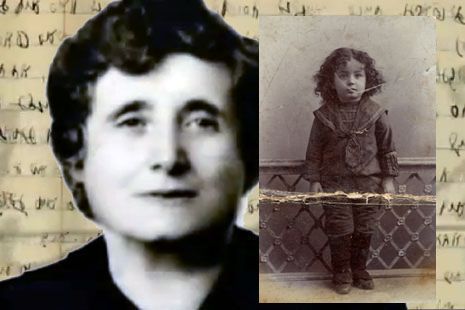
From the diary of Rebbetzin Chana Schneerson – Chabad.org
I would like to record several of the episodes that I remember. There are many other and greater episodes, yet according to my understanding it is the small incidents that reveal the greatness and the loftiness of his soul.
I recall that when my son [the Rebbe, Rabbi Menachem Mendel Schneerson] was two years old, he recited the Four Questions on Passover. He memorized them on the eve of the holiday and understood them like an adult.
In 1905, when there were pogroms in Russia, my children and I, together with other mothers and children, hid in a pharmacy. As is normal during chaotic times the children cried a lot. The pharmacist was fearful that the noise would expose him for sheltering Jews, placing his own life in danger.
My then three-year-old son would walk around the room and quiet all the children. This was a remarkable scene. We could not talk because voices could be heard outside, so he silently motioned to them and gestured with his hands to keep quiet, calming each child in a different manner.
The pharmacist kept returning to see how my son was performing, and how [my son] cleverly affected the small children.
I would like to record several of the episodes that I remember. There are many other and greater episodes, yet according to my understanding it is the small incidents that reveal the greatness and the loftiness of his soul. In 1911, my son accompanied me to a health clinic in Balaclava, [Crimea]. There was a cave that led to the sea. The narrow stream of water flowed between the two walls [of the cave] and rolled into the sea. The place where the stream and the sea met was very dangerous, even experienced swimmers were cautious.
One time I was at the shore where we gathered to spend time. I heard that a boy was drowning and went to see what was happening. I heard from others and saw for myself that a small child had rowed out in a single-person boat with one oar [a “kayak”]. As I said before that [the place where the stream and the sea met] was a very dangerous place. The boat began to sink with the child inside.
When my son noticed this, he swam out to the boat, climbed inside, and took the oar from the exhausted, barely conscious boy. Taking control, he steered it out of the danger zone and brought it to the shore, saving the passenger.
But after this difficult, extraordinary, I would say, rescue, my son was physically and emotionally strained. With no warning or forethought he had to create a strategy to determine in which direction he could safely steer to a less dangerous area. My son therefore became very weak, and he himself began to [struggle from] drown[ing] close to the bank. When I saw him, he was exhausted and pale, and his clothes were drenched.
Thank G‑d, we had brought him [to the shore that day].


how much longer…
Thank you for this important clarification. Is there any way we can ascertain what you’ve said to move it from “apparently” to “factually?” Thanks COL for posting this.
apparently, this diary was once given to print by Rebbetzin Chana and then she took back the manuscripts. it was recently found with changes to the original part and a whole new section. that might be why it was previously published differently
These stories are in Aim B’Yisroel (MOTHER IN ISRAEL)and were not elaborated like this. how comes we have different versions now? There the Rebbetzin said she was not aware that the Rebbe had saved a boy but that he went missing for a short while and only later discovered he dived into the Black Sea.
I really appreciate seeing these segments of Rebbitzen Chana’s life, her husband, the Rebbe, etc.
I think it is really nice that these articles can be shared on a site which so many Lubavitchers see daily.
Please continue, thank you!
bh we have such a special rebbe
Thank you everyone for these wonderful stories of ‘Melech HaMoshiach.’
The ‘Rebbe’ cared about all of G-d’s creations with a great and profound love.
“Butzin Butzin Mekatfey Yediah”, in relatio to the story of abyeh on ravah when they where asked, where is hahsem one pointed to the ceiling and one went outside and pointed to the sky, the gemarah finishes off saying, “hinu deamry inshy, butzin butzin etc.” loosley transelated is, “that from their littile you could know what they will be, as Rashi explain it being like a plant that from when it starts groeing you can see in the long run how it will be,