Chaya Shuchat – N’shei Chabad Newsletter
It’s about fifteen years now that I have been learning Hilchos Bais Habechirah, the laws in the Rambam about building the Bais Hamikdosh, during the Three Weeks.
Some years I attended the shiurim in Bais Midrash l’Noshim in 770, where Rabbi Yossi Paltiel and Rabbi Yossi Keller made the Bais Hamikdosh come alive with their clear elucidations.
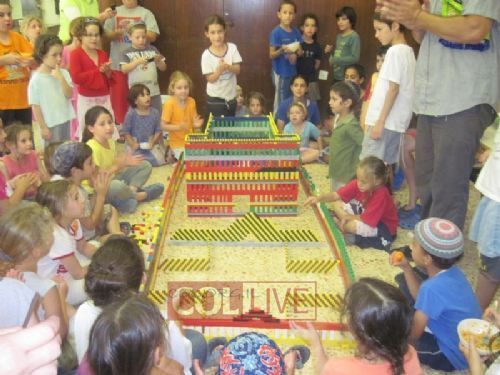
Some years I learned in a group of women, sometimes on my own, or around the supper table with the family. Some years my learning was embellished with charts, diagrams and even videos, while other years I sufficed with a brief reading of the passages. Sometimes I also studied a few pesukim from Yechezkel, or some passages from Mesechta Middos, the tractate of Mishnayos on this theme. Each year according to my schedule and ability at the time.
Studying Hilchos Bais Habechirah during the Three Weeks is, of course, a custom instituted by the Rebbe, based on this Midrash:
When G‑d revealed the structural details of the future Bais Hamikdosh to the prophet Yechezkel, He told him, “Tell the people of Israel of the House… and measure its design.”
Yechezkel, as our Sages relate, replied:
“Master of the Universe! Why are You telling me to tell Israel of the form of the House?… They are now in exile in the land of our enemies. Is there anything they can do? Let them be until they return from exile. Then I will go and inform them.”
G‑d answered: “Should the construction of My House be ignored because My children are in exile?… The study of the Torah’s [description of the Bais Hamikdosh] is deemed equal to its [actual] construction. Go, tell them to study the form of the Bais Hamikdosh. And, as a reward for their study…, I will consider it as if they had actually built the Bais Hamikdosh!”
The Rebbe emphasizes in a sichah (Likutei Sichos vol. 18) that when we study Hilchos Bais Habechirah, it is not as a commemoration of the Bais Hamikdosh as it stood long ago. Rather, it is to prepare ourselves to fulfill the obligation of building the Bais Hamikdosh, much as a bar mitzvah boy studies Hilchos Tefillin.
Over the years I have realized how much the study of Hilchos Bais Habechirah has transformed the experience of the Three Weeks. From a time of mourning, or a time to kvetch about the various discomforts and restrictions, it has become a time of hope and anticipation. Maybe the fact that my birthday is on Tishah b’Av adds to the celebratory mood. Without really trying I have become comfortable, familiar with the various nooks and crannies of the Bais Hamikdosh as it once stood, and how it will stand very soon, G-d willing.
This transformation of the Three Weeks is part of a gradual process orchestrated by the Rebbe throughout his leadership, of pushing aside the negative aspects pertaining to golus and retaining only the positive. I remember that on Tishah b’Av of 5751 (1991) the Rebbe encouraged the singing for the first time ever on Tishah b’Av after minchah, and said a sichah. True, the fast of Av was actually on Sunday that year, a nidcheh, when some of the restrictions are slightly relaxed. However, it was a groundbreaking moment nevertheless. In the sichah of Shabbos Tishah b’Av that year, the Rebbe said:
The imminence of Moshiach’s coming should not cause us to slacken any of our efforts to spread positive activities at present. Indeed, even after Moshiach’s coming, the positive effect of one’s activities and resolutions will continue. In regard to the revelations of Gan Eden, our sages declared, “Happy is he who comes here having acquired.” Similarly, in regard to the Era of Redemption, our efforts in Torah and mitzvos at present will expand our capacity to appreciate the revelations which will become manifest in that era.
Whether you have never studied Hilchos Bais Habechirah before, or are a seasoned veteran, make this a part of your summer! If you are worried that the subject is too detailed, too tedious, or too technical, I can assure you, first of all, that the Rambam’s language is extremely clear and accessible, especially if you use a good translation. Also, don’t feel that you have to finish the whole thing. Even reading a passage or two a day can set you in the right spirit. Feel free to browse and to focus on the parts that interest you the most. There is also a website, thetempleinstitute.org, that has stunning drawings and models of the Bais Hamikdosh. Make it a family project, or grab a few friends and learn together with them. Everyone, young and old, can contribute something to the study of Hilchos Bais Habechirah and will benefit from it.
And this summer, when we’re all standing around in Yerushalayim in the rebuilt Bais Hamikdosh, you will have the pleasure of pointing out the various features to your family and friends.
Recommended books in English for studying the Bais Hamikdosh:
Hilchos Bais Habechirah in English, translated by Rabbi Eliyahu Touger. Moznayim publications, 5753.
Seek Out the Welfare of Jerusalem: Analytical studies by the Lubavitcher Rebbe of the Rambam’s rulings concerning the construction and design of the Bais Hamikdosh. Rabbi Eliyahu Touger, Sichos in English, 5754.
The Third Bais Hamikdash by Rabbi Shalom Dov Steinberg, translated by Rabbi Moshe Leib Miller. Moznayim publications, 5753.
—–
All Woman and Girls are invited to a
Guided Tour of the Second Bais HaMikdash
with the world renowned Rebbetzin Malka Touger from Yerushalayim
Wednesday, July 25 – 8:00 PM
605 Ocean Parkway (near 18 Ave.)
Suggested donation $5:00
For more info: 347-489-9358