
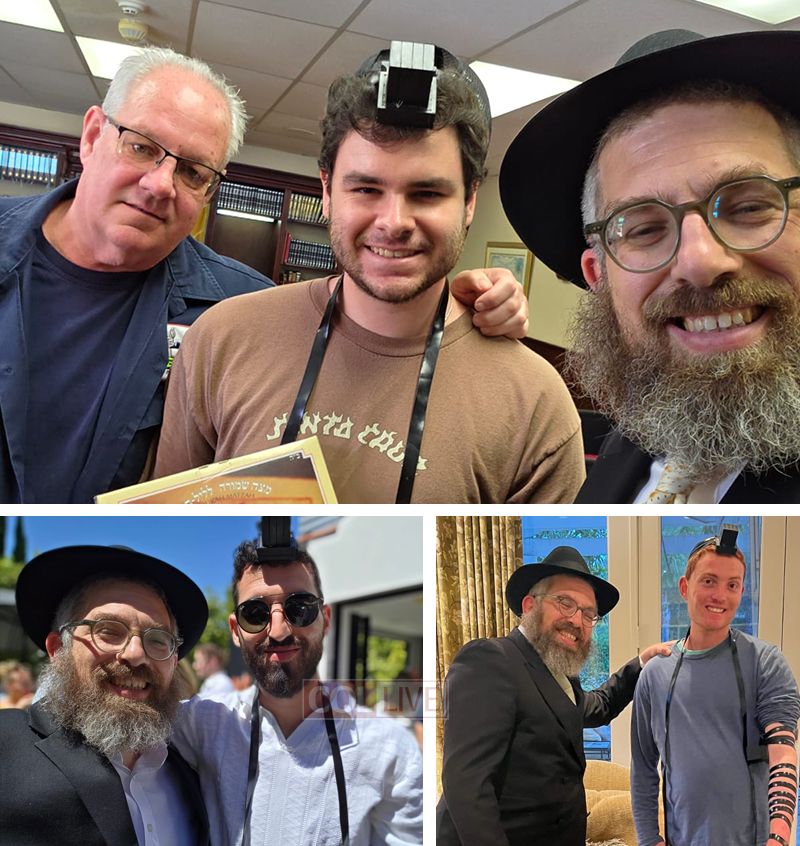
Rabbi Aryeh and Leah Lang, Chabad of Camarillo, Camarillo, CA
By: Chaya Chazan
If parents of three-year olds make birthday parties more for themselves than for their toddlers, who barely understand what a birthday is, then I definitely attended those parties more for the parents I’d meet, rather than for my son to celebrate his friend.
It was another one of those pizza-in-a-playplace three-year-old birthday parties, and I kept a close eye on my son while introducing myself to any parents I hadn’t met before.
Brad* was the proud father of two little twins, and, as they jumped around him, we managed to talk a bit.
“I’d love to support you,” he told me, frankly. “But our finances don’t give us much flexibility. I’ve got to introduce you to my father though. I’m sure he’d be interested in supporting such a wonderful institution!”
I thanked him and told him I’d be happy to meet his father anyday. The party concluded, and we all took our tired, but happy children back home.
A few weeks later, on motzei Shabbos, I sat at the table in my customary pose, ready to write my weekly duch to the Rebbe, detailing what I’d accomplished that week. These weekly reports are important, as they remind me that, ultimately, I’m merely a representative, responsible to answer to my boss, the Rebbe. As always, I had a volume of the Igros on my table, ready to receive my duch after I completed it.
I’d been writing weekly duchos for years, always placing it in a randomly selected volume of Igros Kodesh, but recently, there hadn’t been answers on the pages facing me.
Now, as I folded my letter and placed it inside the sefer, I asked for a sign; an answer of some kind. I was standing in my kitchen, open Igros in hand, when there was a knock at my door.
I glanced at the clock. Almost 10:00 PM. It might as well have been 3 in the morning in Camarillo, where everything went silent at 8:00. What could’ve happened? I wondered, as I unlocked the door.
It was Brad. “My father gave me this envelope for you.” He handed it to me and waved goodbye as he walked to his car.
In the envelope was a generous check – the first of many, as it turned out.
I walked back to the table and looked at the open volume of Igros. I’d gotten my answer.
—————–
Moshe* had been a long-time member of our community. He helped read the Torah, and served as an impromptu gabbai.
One night, Moshe unburdened himself to me.
“I don’t know what to do!” he said. “I’ve been feeling unwell for some time now, and the doctors say I have a tumor on my lung. They don’t know exactly what it is, but they suspect it’s cancer and say if I ignore it, it’ll soon become fatal. But I don’t have health insurance! I’m stuck!”
“Don’t worry,” I told him. “I’ll help you. Everything will be well.” I comforted him with sage Chassidic advice, reminding him that Hashem runs the world, not doctors or health insurance. Moshe calmed down, his breathing evening out, and color returning to his face.
As soon as he left, I called a friend, an influential physician in one of the local hospitals, and asked for his help. He directed me to a Jewish pulmonologist, who was moved when he heard my story.
“Tell Moshe to ask for me at my hospital’s ER,” he said. “I’ll take care of everything.”
Moshe was grateful and headed to the ER immediately. He was whisked away for one test after another, but they all seemed to point to the same awful reality: it was malignant.
Moshe, of course, was terrified. Shortly before Purim, the doctors scheduled an emergency operation where they’d remove part of the cancerous lobe. While Moshe was in the hospital, preparing for surgery, I had a sofer check his tefillin and mezuzos. The sofer told me that, while the parchments themselves were kosher, they’d been placed upside down inside the tefillin, rendering them pasul.
“It’s v’nahapoch hu!” I told Moshe, jovially. “Just as the entire Purim story turned around, now that your tefillin have been repaired, your situation will also turn around!”
Moshe was heartened to hear what had happened, and went into surgery with so much optimism and joy, the doctors and nurses must’ve thought he’d lost his mind. I asked to be updated on Moshe’s condition, as I had to run home for Shabbos.
When I listened to my voice mail on motzei Shabbos, there was confusion and wonder in their voices.
“Before removing part of the cancerous lobe, we decided to biopsy a small piece of the tumor,” they explained. “Tests revealed absolutely nothing. Just a harmless, benign tumor. Instead of the massive resection we’d planned, we just closed him back up and wheeled him to recovery. It was a complete turnaround!”
Moshe continued to read the Torah in our shul for many more years after that.
———————–
When Covid first hit and we were all quarantined at home, I knew it would be a great test for many, in regards to maintaining their Yiddishkeit with no support system whatsoever.
I sent out a message, encouraging everyone to keep “Shabbat at home,” and quoting some resources that could help.
Simon*, whose work as a doctor had always made keeping Shabbos seem like an impossibility, was struck by my message.
“The rabbi is asking each of us, personally, to take ownership of our own Shabbat observance,” he mused.
He immediately put his phone away, and kept it off until Shabbos was over.
Since then, Simon has been keeping Shabbos faithfully, week after week.
———————-
Chanan* was a born-and-bred Israeli, and even served in the IDF during the Six Day War, but, having been raised on a secular kibbutz, he had limited knowledge about Yiddishkeit. We wouldn’t necessarily see him in shul on Rosh Hashanah and Yom Kippur.
One day, he asked me for a favor. “I want to grow an etrog tree,” he said. “Can you please save your seeds for me?”
I promised him I would. Of course, all the heartbreak, tragedy, and chaos of October 7 wiped nearly everything else from my mind. But, as I was about to dispose of my esrog, I remembered Chanan. I carefully preserved the seeds and phoned him up.
When Chanan arrived, I asked him if he’d be willing to put tefillin on in honor of the soldiers and hostages. Chanan agreed. The proud sabra was strangely moved by the experience, although he didn’t say much.
Fast forward to the present day. Chanan bought himself a pair of tefillin which he wears daily, joining us in shul each morning. He is actively involved in the community and loves learning the daily Chitas. He also volunteers for many things, including as a security guard for the preschool, which, with his military background, we are very grateful for.
Hamas set out to destroy as many Jews as they could. They didn’t know their monstrous barbarity would strike the hearts of many more Jews all over the world.
——————–
With all the negativity in the media and on college campuses throughout the country, it’s important to recognize those that reach out in friendship and support. Baruch Hashem, the community in Camarillo has been incredibly considerate. We’ve received an outpouring of love and support, with many of our non-Jewish neighbors asking if they can volunteer to stand guard outside our Chabad house, or even simply stand silently in solidarity.
Our 6-foot-tall menorah on the Chanukah that followed October 7 was covered from top to bottom with letters of encouragement, support, and care from the entire Camarillo community.
——————
Jeremy* attends a Christian private school, but he’s been working hard lately to prepare for his bar mitzvah, which we celebrated in our Chabad house a year and a half ago.
Jeremy is an earnest kid; sincere and hardworking. His parents offered to buy him a set of tefillin, even though his father didn’t wear them! Jeremy really wanted to own the mitzvah, and decided to use his bar mitzvah money to purchase his own set.
At his bar mitzvah, Jeremy’s father spoke about how he feels watching his son rise early to put on tefillin every day.
“I’ve learned from the best,” he said, his voice thick with emotion. “After Jeremy puts them on each day, I follow his example and wrap tefillin myself.”
—————
We needed to build a mikvah, but it was a costly endeavor. We knew it would be difficult to raise funds from our community, who had a limited understanding of a mikvah’s importance and significance. We decided to fundraise outside the community as well.
I was in a Chabad shul in LA, speaking to someone about the mikvah we wanted to build. When we’d finished our conversation, I was stopped by a man who’d overheard our conversation.
“I’d like to help you build your mikvah,” he said.
“Thank you!” I answered. “Can I ask what your inspiration is?”
“My wife and I have been married for years without children,” he explained. “Recently, we became involved in building a mikvah, and my wife is now expecting. It’s clear that this is a direct way to channel Hashem’s brachos for children. I want to gather a few couples who are suffering from infertility and give them the chance to donate.”
The man was clearly right. People from our own community were on the mikvah committee, and it was clear to see how being involved in this holy project brought bracha to their lives. A while after beginning the project, one of the families celebrated the engagement of their daughter, just one day before another family married off their daughter!
—————
George* showed up at our Chabad house one day and continued coming regularly after that. He even joined our small, cozy Chassidus shiur on Shabbos mornings.
At that time, we were in the final stages of building our mikvah. We’d already raised most of the sum, and construction was well underway. But, like many other ambitious projects, it ran out of steam before everything was finalized. I still needed a lump sum to complete the work, but it felt like every avenue I could try had already been used up.
At the Chassidus shiur that Shabbos, I shared the power that comes from being involved with this holy mitzvah, and told them the story of the man in LA that was expecting after years of childlessness, due to his involvement in mikvah.
“Enough talking about the mikvah,” George said, in his signature booming tone. “How much is needed, Rabbi?”
I named the amount, quite a large sum.
“I will give you half,” he said. “If I can help my fellow Jews have children, I’m in!”
The following week, George texted me to meet him at a gas station. He handed me a very generous check, waved, and left before I could even process what had happened.
A short while later, I called George, who told me he was in Sun Valley, Idaho. It was a city name I recognized.
“I was there over twenty years ago, as a Merkos bochur!” I told him.
After a bit of calculation, we realized that George and I had already met, many years ago!
“I remember!” he laughed. “Two nerdy young rabbis knocked on my door and asked if I wanted to put on tefillin!”
I didn’t remember the encounter too well, which meant that I’d probably walked away from his home as a young, idealistic young man, figuring I’d struck out; that I hadn’t made a difference.
If only I could go back in time and tell 20-year-old me that the man who didn’t seem to care much would one day be a major investor in our community’s mikvah!
——————-
The mikvah was complete, and the dedication ceremony was scheduled. Everything was perfect – except for one small issue. We needed rainfall to fill the mikvah’s pool, and rain in California – even in January – is scarce.
I knew of other shluchim who’d experienced miraculous rainfall in similar circumstances, and I davened that our bor would be full in time.
That winter, California experienced torrential downpours. The rivers of water created mudslides causing major obstructions in nearby cities.
“Aryeh, is your bor full yet?” fellow Californian shluchim called to ask. “Do you think we can stop the mudslides and destruction now?”
*Names changed to protect privacy


Great shlichim. Great stories.
I’m sure he has many more stories.
Rabbi Lang time to write a book..!
Thankyou for the inspiring stories! What beautiful work you are doing