
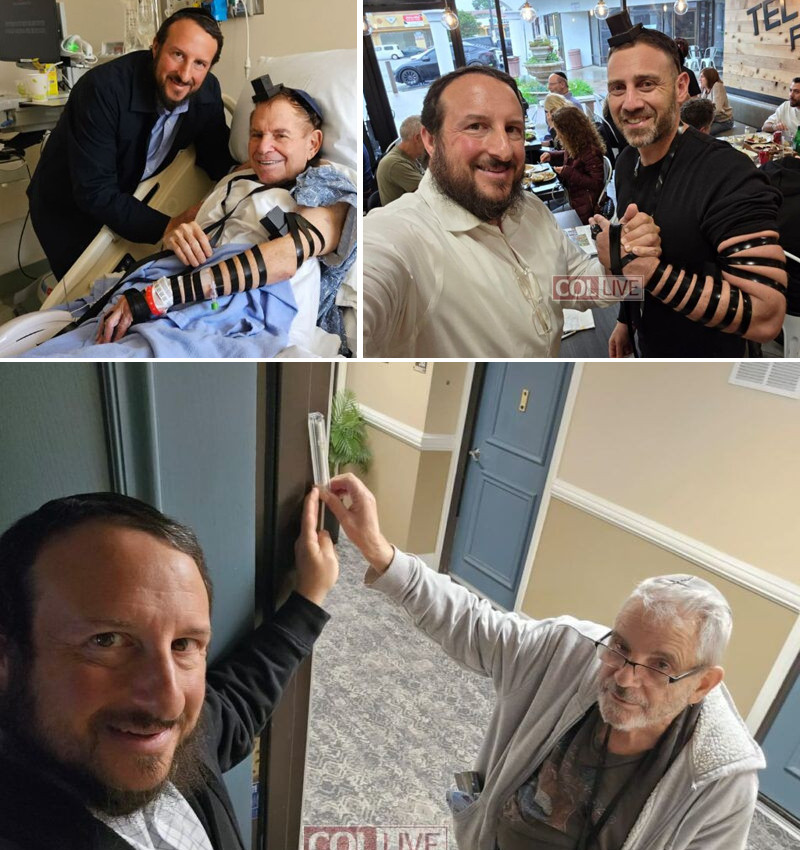
Rabbi Yossi and Daniella Gordon, Chabad of Woodland Hills, CA
By: Chaya Chazan
“Two great life milestones occurred on Yud Nissan, 1973,” my father, Rabbi Josh Gordon A”H, used to say. “My eldest son, Yossi, was born, and the Rebbe gave his approval for us to begin Chabad of the San Fernando Valley.”
The timing was especially serendipitous, as it was the final day of the famous Shnas Habinyan, the year the Rebbe requested 71 new Chabad institutions be established as a 70th birthday gift. Rabbi Cunin, the head shliach of California, had committed to opening 10 new Chabad centers on the West Coast alone. His offer to my parents to open the Valley’s first Chabad house was one of three they were considering. They wrote a letter to the Rebbe, explaining their various options. The Rebbe circled the San Fernando Valley – a place my father had loved on sight, even though he’d never heard of it prior to Rabbi Cunin’s offer.
That same month, my parents packed everything they owned, and flew with me, their barely three-week old son, to begin their shlichus. My pidyon haben was the first community event.
At the time, my parents were the only shluchim in the vast area. Today, there are over 30 Chabad houses serving the same area!
——————-
I grew up proud not only to be a shliach’s son, but also a shliach’s grandson! My grandfather was sent to Newark, New Jersey by the Frierdiker Rebbe, and remained in the area for the rest of his life, impacting thousands of individuals.
While I watched my father give his world-famous shiurim, counsel people, arrange bar mitzvahs, weddings, funerals, and fill the myriad roles of a shliach, I couldn’t help but aspire to that same deep and active love for every Jew. But I also saw what many others didn’t – the creased worry lines, growing more prominent day by day, from the stress of always being in debt and never fully sure where next month’s rent was coming from. It was a huge burden I was anxious to shoulder myself.
As a bochur, I had the opportunity to assist and observe other shluchim all over the world. They all had the same inspiring drive, focus, and dedication to their mission; they all bore the same permanent stress marks from financial worries.
I was impressed by one particular shliach, who married his shlichus with a lucrative career. He seemed to have the best of both worlds. During the workday, he was a businessman. During the evenings and Shabbos, he was a congregational rabbi, who would lead davening in his shul. He never had to stress about money. He never seemed worried that his gas and electricity would be shut off if some miraculous donor didn’t materialize.
“Maybe I could do that,” I’d muse to myself.
After my wife and I got married, we discussed the issue at length. Her father was also a businessman – a respected South African diamond merchant.
“Maybe it would be best for me to build a career,” I reasoned. “Once I’ve established myself, I could help my father in his work – especially financially!”
My wife agreed, and we decided I’d learn the diamond trade from her father. We temporarily moved to South Africa, so I could truly learn everything from the ground up. As I was beginning to think of striking out on my own, my in-laws moved to America. The diamond business is notoriously hard to break into. When every deal involves hundreds of thousands of dollars, jewelers can’t be faulted for being wary of new faces.
When I’d come home from a long day at work, my wife would ask me, “So Yossi, how was business today? How many diamonds did you sell?”
“Well, I didn’t sell any, but I did get some!” I’d reply. “There was a guy I met that I helped put on tefillin, and a lady who promised to start lighting Shabbos candles…”
“Oh, Yossi!” my wife would laugh. “Shlichus is in your blood! You can’t hide from it!”
A short while later, we moved back to California, and I opened my own shop. Unfortunately, my plans of grand successes and writing my father multiple blank checks never panned out.
“Nu?” my father urged. “You gave it your best shot. Maybe now you can give shlichus a try?”
It didn’t take much to convince us. It was almost as if my rational brain had been fighting my inborn shlichus instinct all these years, and it was relieved to finally be set free.
We chose Woodland Hills, an up-and-coming quiet, beautiful neighborhood, and opened our Chabad house. I switched from dealing in physical diamonds to polishing spiritual ones, which is infinitely more rewarding!
—————–
We advertised our presence in the local Israeli newspaper, inviting everyone to an open house, meet-and-greet event. We had a huge turnout, and we were so excited to see how many people filled the room – at first.
I opened the event by introducing ourselves, and explaining that our mission was to serve the Jewish community in any way we could, especially spiritually.
“Will you have a save-the-whales event?” one attendee called out.
“What about climate change recognition?” another asked.
Flustered, I tried explaining that these causes – worthy though they may be – don’t fall under the purview of a rabbi per se.
“We’re excited to offer Torah classes,” I told them. “Shabbat services, holiday programs for families, Hebrew tutoring, and more like that!”
The evening wasn’t a total waste. As I walked around, I chatted with as many people as I could. I was delighted to meet Eric*, who’d actually attended my father’s shul in Encino a couple of times. We spoke for a while, and I asked him to sign our guestbook, including his contact information, before he left.
“No, I don’t want to leave my contact information,” he said. “Take this instead.”
He handed me a check with a smile.
To this day, Eric remains a close friend and supporter of Chabad.
————————-
I also serve as a hospital chaplain, visiting Jewish patients and helping however I can.
One day, I saw a new name on the list. I knocked on the door; An elderly man was in the bed, his son sitting by his side.
“Hi, my name is Rabbi Gordon from Chabad,” I introduced myself. “Can I give your father a blessing?”
The son, Ned*, welcomed me in, and we hit it off immediately. His father worried we were being too jovial, and rebuked his son for telling a joke in a rabbi’s presence. I assured him I’m “not that kind of rabbi,” and the tension eased.
I helped both Ned and his father put on tefillin, and I continued visiting them every day. For the remainder of his father’s time in the hospital, Ned agreed to put on tefillin every time I asked.
Even after his father passed away a short while later, Ned and I continued our friendship. I was ecstatic for him when he got married, and overjoyed to hear of the births of his twin sons – especially since he was already 65 years old!
His sons are learning for their bar mitzvahs, and join their father in putting on tefillin every day!
—————-
“Good morni-!” my cheery greeting died on my lips as I pushed open the door of the hospital room. It was hard to see the patient in the bed through the mess of tubes, bags, and bandages stuck every which way. Dozens of machines surrounded her, beeping, counting, and measuring.
Is she awake…? I couldn’t help but wonder.
She then opened her eyes and gestured for me to come in.
“How are you…?” I asked, settling gingerly on a chair.
“Thank G-d!” she effused.
I was dumbstruck by her answer. Clearly, she’d just endured a devastating medical event, and it looked like a long, painful recovery awaited her. How could she smile and thank G-d in such circumstances?
“I’m amazed at your faith,” I told her. “How do you have the strength to thank G-d in all this?”
“Yesterday, I was totally fine. I was driving to work, stuck in regular freeway traffic, when all of a sudden, a car plowed into me. I lost consciousness, and knew nothing until I woke up in this bed.
“When I regained consciousness, I asked the doctor what had happened. He told me I’d been in a terrible, multi-car collision. ‘You shouldn’t even be alive!’ he told me. ‘Why? Because of the accident?’ I asked. ‘Well, that, too,’ the doctor answered. ‘When you first got here, you were unconscious, so we rushed you to an MRI to check for brain activity. We discovered that you were alive – but we also saw something else: a huge tumor. You were whisked off to emergency surgery, where they were able to remove the entire tumor.
“‘If not for the car accident and you losing consciousness, that tumor could’ve killed you at any moment.’ So yes, Rabbi. I’m here with multiple casts, bruises, and more IVs than I care to count, but I thank G-d for putting me in that car accident, saving my life.”
———————–
I was making my rounds in the oncology ward, and knocked on Louis’* door. I asked him to put on tefillin, and he firmly declined.
“May I ask why you refused?” I pressed.
“I’m an atheist,” he answered. “I don’t believe in G-d.”
Immediately, I remembered two lines my uncle, Rabbi Manis Friedman, always says about atheism: “The G-d that you don’t believe in, I don’t believe in either,” and “You may not believe in G-d, but G-d believes in you.”
I repeated both of them to Louis, and he chuckled. We launched into a conversation, and as I got up to leave, Louis stuck out his arm.
“Okay, Rabbi. You can put tefillin on me.”
I wrapped the straps around his arm and helped Louis, the atheist, repeat the words of Shema, affirming his belief in the One and Only Creator.
——————-
A major advantage to being a second and third generation shliach is having parents to guide and mentor you as you find your way. It also helps to get a glimpse at all the “weak” points firsthand. I’d witnessed my parents go through years of hearings and meetings until they were finally legally designated as a synagogue in a residential zone. I wanted to steer clear of that, if possible.
Our first Chabad house was a little storefront on the main road. It was just one room, and the door opened directly into the parking lot. There was nowhere for kids to play, and parents were worried their children would run right into the parking lot. It was difficult to get families to come, so we usually ended up with just a group of men. I knew our shul would have limited growth without involving the entire family, but I couldn’t see a way out.
A few years later, we were able to buy the storefront next door as well. We were able to knock down a wall, and finally had a separate room for a kid’s group, a kitchen, and a spacious women’s section.
A dear friend in the community agreed to pay the second mortgage for two years. Then the economy crashed, and my usual donors apologetically shook their heads. I couldn’t afford both storefronts anymore, and we, very regretfully, gave one up.
A few years later, my wife called me excitedly. “He finally said yes!” she shouted.
“What are you talking about?” I asked.
“Our neighbor! I’ve been asking him every few weeks if he’s ready to sell. He finally said yes!”
“But that’s on a residential block,” I said, slowly.
“This is too good an opportunity to pass up,” my wife argued. “Call your father and ask him what he thinks!”
My father advised me to speak with a lawyer, who told me that if I wanted to put a shul in a residential neighborhood, I couldn’t have chosen a better property.
“Offer much more than the asking price,” my father advised.
“Why?” I asked. “The going rate is much lower!”
“True. But if you offer much more than the asking price, he’ll agree to sell immediately, without any conditions at all.”
My father’s advice, as always, proved wise and true.
As soon as we began holding services in our new Chabad house, we were amazed to see the immediate growth. Now, there was a beautiful lawn and yard for the kids to play, and families felt comfortable attending altogether. Attendance jumped week by week, and it seemed like everything was going perfectly!
Then, of course, the zoning issues began, as I knew they would.
“This is a temporary setback,” my father encouraged me. “It will be really hard for the next while, but trust me, it will be worth it in the long run!”
Of course, my father was right, as usual, but I didn’t know “the next while” could last more than 6 years!
Baruch Hashem, the house has been a tremendous asset to our shlichus, and, exactly as my father said, it was worth every bit of effort that went into making it our own!
—————–
I didn’t know why Mr. Chador* had asked to meet with me, but he explained soon after arriving.
“I’d like my boys to have their bar mitzvahs here,” he said.
“Boys?” I asked.
“Yes,” he answered, smiling. “I have triplets – two boys, and a girl.”
“That’s so nice!” I said. “But can I ask, why here? You’ve never come to our shul before. Why did you search us out for this bar mitzvah?”
“These children were born as a result of a bracha from the Lubavitcher Rebbe,” he explained. “Of course they should celebrate their bar mitzvah in Chabad!”
I asked him to share the story with me, and he happily obliged.
“My wife and I had been married for many years without children. We’d just about given up hope, when my friend, who was in a similar situation, called with a crazy idea: he told me he’d met a chassid who’d told him the Lubavitcher Rebbe performed miracles, and could definitely bless us with a child.
“I told my friend I didn’t believe in rebbes, but he insisted. We made up to meet in Crown Heights on Sunday morning, when the Rebbe would be distributing dollars. I’d expected to meet with the Rebbe in a small office somewhere, so imagine my shock when I rounded Eastern Parkway and saw a line stretching all the way down the street!
“‘There’s no way I’m waiting in that line!’ I told my friend. ‘That’ll take hours!’ He paid no attention to me and dragged me into the line. After an hour or so of barely perceptible progress, I lost patience. ‘I can’t do this anymore,’ I told him. ‘I’m leaving!’
“A nice young man just ahead of us turned around when he heard this. ‘Let me ask you a question,’ he said. ‘If you knew there was a treasure waiting at the end of this line, would you still insist on leaving?’ ‘Of course not,’ I answered. ‘I promise you that what awaits you at the end of this line is far more precious than that,’ he explained. I was convinced, and we slowly inched our way closer to the front of the line.
“My friend went before me. The Rebbe handed him a dollar, and then gave him another one, along with a ‘Bracha v’hatzlacha.’ My friend continued past the Rebbe, but the Rebbe motioned him back, and gave him a third dollar. The exact same scenario repeated when it was my turn. Both of us figured that was simply how the Rebbe handed out dollars, but chassidim outside explained it was very unusual for the Rebbe to give more than one dollar – let alone three.
“‘It must mean something significant,’ the chassid told us. ‘Look out for it!’
“A few months later, my friend called to tell me his incredible news: his wife was pregnant – with triplets! A few weeks later, I was able to tell him that we, too, were expecting – also triplets!
“So do you see why these children need to be bar mitzvahed in a Chabad house?” he concluded.
Of course, I agreed. We held a beautiful bar/bas mitzvah for the miracle triplets, celebrating their entry into Jewish adulthood.
*Names changed to protect privacy





Yasher Koach Rabbi Gordon for this beautiful story, Much Hatzlachah in your Shlichus!
R’Yossi one of the soldaten in this generation