Rabbi Raphael and Goldie Tennenhaus, Chabad of South Broward, Hallandale, FL
By: Chaya Chazan
My paternal grandparents escaped Romania before the war with their four children, heading to the friendlier shores of Canada. My father left Montreal in 1940, seeing that the city was already saturated with immigrants establishing their own businesses. He decided to venture further east, initially taking a position with one of his uncles. He moved to Bathurst, New Brunswick, a beautiful coastline city in Canada’s Maritime Provinces.
The business was booming; Yiddishkeit was a scarce commodity. There were only a handful of ten families or so in our “community.” The scion of proud Vizhnitz chassidim, my father remained staunchly dedicated to his heritage. One of his aunts begged him to remove his yarmulkah when he graduated from his Catholic college. He refused, and proudly shook the priests hand – yarmulkah firmly in place. The priest announced, “We should all learn from David and display our faith proudly.” He taught the non-Jewish population to check the skies for three stars to know when he’d be opening his store on short winter Motzei Shabbosim. He was the only person for miles to wear a beard and peyos and look the part of a Chassidic Jew.
In the early 1940’s, the Frierdiker Rebbe sent nine bochurim to Montreal. They were Tememim from the yeshiva in Otwock, Poland, and each had managed to survive the Nazi genocide, staying one step ahead of death until they finally reached the safe shores of Canada. Of course, my father was eager to meet these “firebrands plucked from the flames,” and took the 15-hour train to Montreal.
Watching how the bochurim conducted themselves throughout that Shabbos, especially their long-drawn, avoda-filled davening, preceded, of course, by hours of rigorous study of Chassidic texts, awed him and made an indelible impression on him.
This introduction to Chabad Chassidus eventually led him to establish a close relationship with the Frierdiker Rebbe, and, later, the Rebbe as well. My father was zoche to receive many letters and personal guidance from the Rebbe. Many of these concerned my father’s status as the de-facto shliach in New Brunswick. The nearest shluchim were in Montreal, so, as the most visible representation of Yiddishkeit, the Rebbe made my father responsible for the spiritual well-being of every Jew in the area. The Rebbe instructed him to seek out Jewish children in the surrounding towns and teach them the basics of Yiddishkeit. Although there weren’t enough people to always have a minyan, my father made sure there were 10 men present for each tefillah of the Yomim Noraim.
As our family grew, my father realized that Bathurst presented too strong a challenge to our chinuch. He wrote to the Rebbe, asking for “permission” to move to Montreal. The Rebbe agreed, but asked him to wait until after the Yomim Noraim, so the yearly minyan would not be disturbed.
I grew up in Montreal, attending the Lubavitch yeshiva, but the lessons we’d learned in Bathurst – the dedication required for shlichus, and looking to the Rebbe for inspiration and guidance – were ingrained in every moment of my childhood.
—————-
My good friend suggested that I meet his sister, and I agreed. A short while later, we got engaged.
“I really want to move on shlichus,” I told her.
“We have to stay close to my parents in Florida,” she insisted. “If we move to Cape Town, my mother will never talk to me again! She’s a Holocaust survivor and it would be too painful for her to be separated from her children.”
When an opportunity in Hollywood, Florida arose, just a 25-minute drive from her parents, it seemed like the perfect solution. Although my friends warned me that shlichus in Florida at that time would present many challenges, we were ready to face them, head-on.
Rabbi Sholom Lipsker A”H, one of the early shluchim to Florida, had great influence on Dr. Marvin Shuster and his family, who lived in Hollywood. When Dr. Shuster was in the year of mourning for his father and required a minyan every day, Rabbi Lispker would help by sending yeshiva bochurim to make up the quorum. At one point, that no longer became possible, and Dr. Shuster was instrumental in helping us move to the area to continue his minyan.
Rabbi Avraham Korf A”H assigned me the entire South Broward County, which, today, is one of the most densely Jewish populated areas outside of New York and Israel. In 1980, we were the only shluchim there. Now, there are over 40 shluchim serving that area, and you can catch a Chabad minyan for Shabbos Shacharis every mile!
———————
Dr. Shuster named his minyan “Shomrei Hadas Chabad,” and when we arrived, I asked his permission to change the name. I suggested naming it for the Rebbe’s father. I wrote to the Rebbe, asking for approval for the name change.
“If you agree to conduct the shul according to the will of my father, based on what is known and what could be assessed, then I will mention it at the gravesite [of the Frierdiker Rebbe.]”
The shul, now called Congregation Levi Yitzchak-Lubavitch, is now in its 46th year!
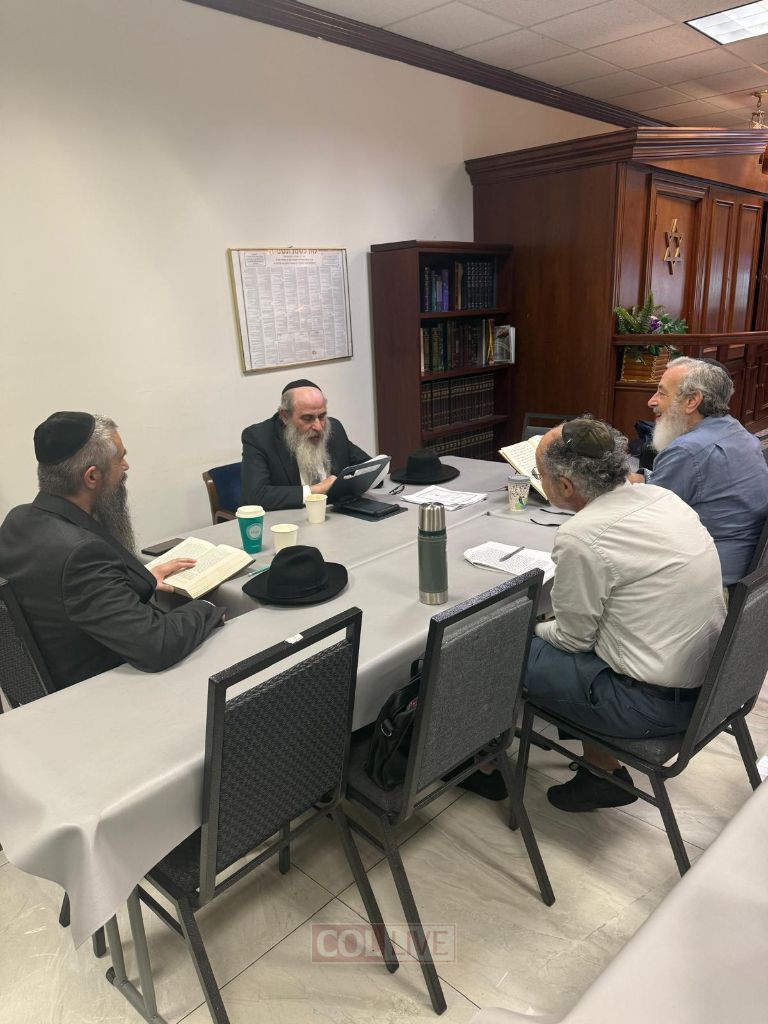
Every morning, we have five scheduled minyanim for Shacharis – as well as many other impromptu ones that pop up as people arrive. There are daily shiurim given throughout the day, as well as a kollel in the building.
I helped a good friend of mine, Rabbi Elituv, publish a set of sefarim with collected explanations and sichos the Rebbe gave on Rambam. I encouraged the young – and older – men to commit to learning three perakim of Rambam a day, following the most demanding schedule of completing the yearly cycle. I promised a set of the new sefarim for whomever would take on the challenge.
“We can’t!” some of them complained. “Learning one perek is hard! How can we learn three?”
“In the same way that you can’t learn one, you can’t learn three!” I quipped. “There is a better chance that when you learn three perakim, you will come across many halachos that you understand. When learning only one perek, you take the chance that it could be a difficult one, and you won’t understand much. The odds of coming across halachos that you will understand are much greater when you learn three perakim.”
Baruch Hashem, I had to buy a lot of sets of the Rebbe’s biurim on Rambam!
—————–
In the 80’s, when we first moved to Hollywood/Hallandale Beach, the area was mostly filled with the elderly, many of them Holocaust survivors. It was a privilege to meet them and serve them, but, at the same time, I knew the future depended on engaging the next generation.
With the Rebbe’s bracha and approval, we opened satellite Free Hebrew for Juniors which offered engaging, kid-friendly classes for Jewish children on all things Yiddishkeit. Baruch Hashem, they were well attended, and those children became the foundation of Chabad of South Broward as it is today.
—————
My crew of elderly Holocaust survivors enjoyed coming to shul and having a place to meet their friends, but they had one complaint:
“We’re not used to the Lubavitch way of doing things,” they told me, in their straightforward, simplistic way. “We’re Hungarian chassidim, used to the way we did things in ‘der alter heim.’ In general, we’re happy to follow Lubavitcher minhagim in your shul, but there is one thing we’d like to change: you don’t say the Yehi Ratzon before blessing the new month. Can we add it, even though it’s not part of your nusach?”
I hesitated. All things considered, their request was reasonable and would require only minor adjustments. But then I remembered the Rebbe’s instruction when I asked to name our shul for his father: As long as you follow the will and directives of my father….
As I vacillated in my mind, the men before me grew impatient.
“We’re not asking for anything major! If you won’t agree to do this, we’ll just go to the Conservative Temple down the road and say it there!” they contended, hotly.
As a young, impassioned, and somewhat impetuous shliach, I fired back, just as hotly, “If that’s the litmus test on your yiras shomayim, then go for it!”
They returned to Congregation Levi Yitzchak a few weeks later, looking shamefaced.
“The Conservative Temple doesn’t know how to make a good cholent,” they explained. “We like it better here – even without the Yehi Ratzon!”
About 25 years later, long after all these precious neshamos had returned to Hashem, I was reading the memoirs of Rebbetzin Chana, the Rebbe’s mother. One passage made me sit up in my chair, and I read it again, slowly, making sure not to miss a word.
Rebbetzin Chana described how, in his later years, her husband, Reb Levik, began to add the paragraph of Yehi Ratzon before blessing the new month. He’d suffered so much throughout his final years, so the sentences asking Hashem to keep shame, embarrassment, and pain away felt especially apt.
I instantly thought of that group of determined elders and felt a pang. Saying the Yehi Ratzon would have been exactly following the ways of the Rebbe’s father…
(When I repeated this story at a farbrengen, Rabbi Shmuel Lew told me he’d watched the Rebbe flip to the back of his siddur where a copy of this Yehi Ratzon was taped on, and recite it quietly to himself before the chazan began the next paragraph.)
——————
Mr. and Mrs. Abe Dalesman were a precious couple who’d married during the war. The Satmar Rebbe was their mesader kiddushin – the very last couple he married in Satmar before escaping with his chassidim via train.
Mr. Dalesman told me how he remembered when the Nazis came to his hometown and rounded up all the Jews.
“Bring the rabbiner!” they called. “Der rabbiner!”
Their reason for calling him forward was tragically obvious, and many of the townspeople began shedding tears as the rabbi walked between them to his doom.
“My dear children,” the rabbi called, softly. “We must do every mitzvah with simcha – even the mitzvah of kiddush Hashem! Don’t cry; sing a Simchas Torah song!”
He began humming a beloved, jaunty melody, encouraging everyone around him to join in. The festive tune muted the harsh response of the gun, as the rabbi fulfilled the ultimate mitzvah with a smile and a lively tune on his lips.
This, and many other stories the Dalesmans and other survivors shared with me, left me in awe of their fortitude, courage, and fierce love of Hashem.
I was able to bring the Dalesmans to meet with the Rebbe, both for farbrengens and for dollars.
“Rebbe, I want nachas from my children and eineklach!” Mrs. Dalesman blurted out, her eyes filling with tears.
“How many children and grandchildren do you have?” the Rebbe asked. He gave her dollars for all of them and a bracha to see nachas from them.
——————
We’d hired a sofer in Kfar Chabad to write a Sefer Torah in memory of my brother-in-law and sister-in-law, Reb Tzvi and Itty Ainsworth, A”H, who tragically perished in the Surfside building collapse in 2021. In the autumn of 2023, the sofer told me the Torah would be ready soon. I took the opportunity to spend Sukkos in Eretz Yisrael and visit family there.
Our flight left in the early morning, and I didn’t want to miss Kriyas Hatorah while on the plane. I took along a small Sefer Torah that could be easily carried. When it was time for Shacharis, I began roaming the aisles, searching for my minyan. The secular El Al flight attendants were disapproving, but I ignored their pointed hints and soon had gathered eight more men.
I slipped my yarmulkah out from under my hat and placed it on the head of the steward next to me. “You’re our tenth,” I told him, simply.
Although he’d been giving quite an attitude about the impromptu minyan, as soon as the yarmulkah descended on him, his perspective shifted. He grew emotional as we completed kriyah, and kissed the Torah with reverence.
As it turned out, the sefer Torah got a lot more use than I thought it would when I originally brought it.
We were there on that fateful Simchas Torah, and making our flight home was clearly no longer an option. The Torah was not ready, and I insisted on waiting until the sofer completed it. Since I knew we’d have a prolonged stay, I wanted to make sure we weren’t in Eretz Yisroel for 30 consecutive days, as that raised questions about whether one was allowed to leave the Holy Land.
Following advice the Rebbe had given my father-in-law, I called Rabbi Mendy Klein, the shliach in Eilat, which is not included in the Biblical borders of Eretz Yisroel, and asked if I could come for a visit.
“Would you be able to visit some army bases while you’re here?” he asked.
“Of course!” I agreed, immediately. And my sefer Torah went along with me.
As we approached the gate of the army base, I had an idea. “These soldiers were all called up in the middle of hafakos,” I told Rabbi Klein. “They never had a chance to dance the daytime hakafos. Should we do that now?”
Rabbi Klein was hesitant at first, but when we met the soldiers, who were just finishing Mincha, it felt right. We danced and sang, lifting the tiny sefer Torah up high. The soldiers kissed its leather mantle with wet cheeks and thanked us for renewing the joy of the interrupted Simchas Torah.