
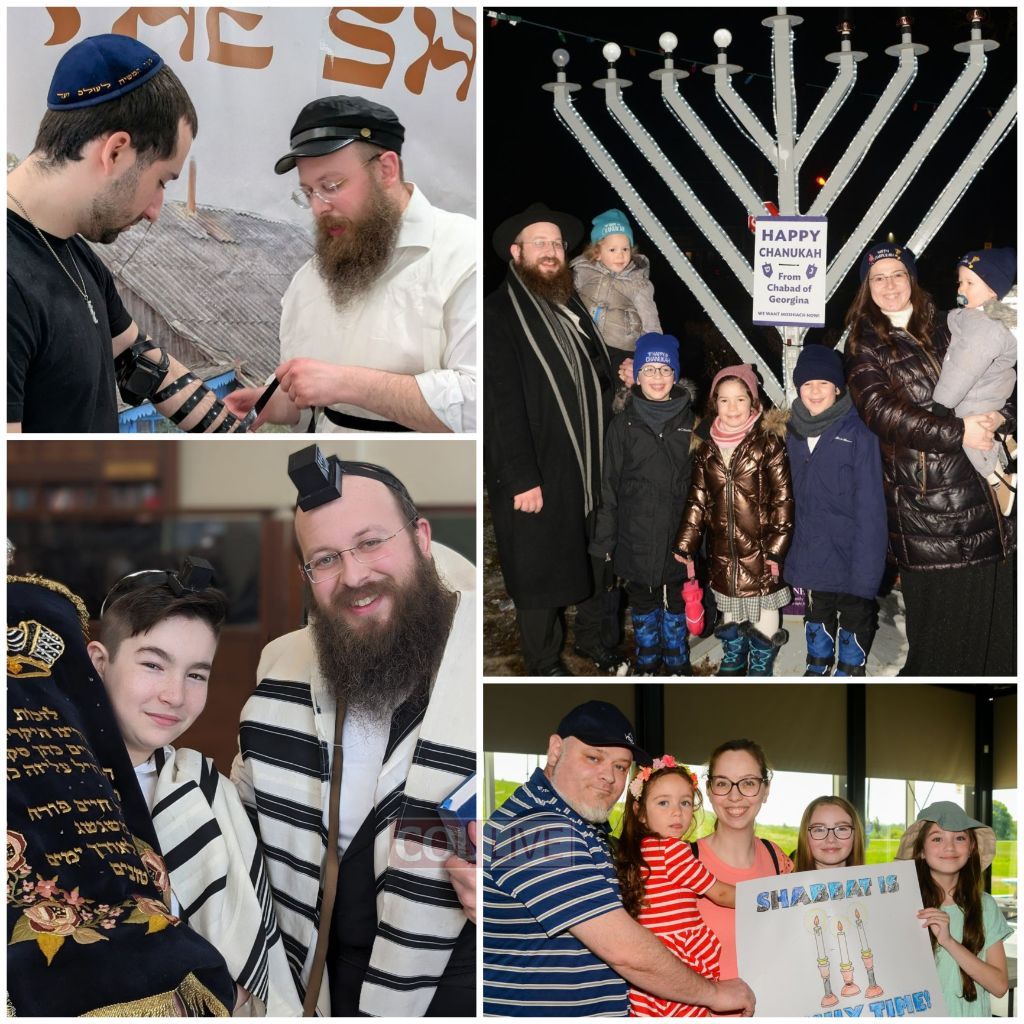
Rabbi Yossi and Chaya Vorovitch, Chabad of Georgina, Georgina, Ontario
By: Chaya Chazan
Watching my parents dedicate their lives to the Rebbe’s shlichus imbued me with a wonder and deep passion to do the same. After my wife and I married and spent a year in kollel, we were excited to begin our search for a shlichus of our own.
When Dr. Fine*, a member of my parent’s Chabad house, heard that we were looking, he got very excited.
“You should check out Georgina!” he exclaimed. “I had a practice there for years, and all summer long, I met swarms of Jews who live there. There’s definitely potential!”
Georgina is the original “cottage town” of Ontario. For many years, it was the summer residence of wealthy families who vacationed in Georgina’s quaint and spacious cottages, enjoying the breezes off Lake Simcoe. As time went on, Georgina slowly became a permanent home for many residents.
Originally, the city’s ordinances forbade Jews from buying property here. One clever Jew bought a large property through his non-Jewish assistant, and resold it to other Jews. They turned one of the cottages into a shul, which still functions in the summer months. This year, we’ll be celebrating its 78th birthday!
When we first arrived, we knocked on doors, trying to find as many Jews as we could.
“You must’ve made a wrong turn!” many insisted. “There are no Jews here, besides us!”
“Come to our barbeque and see how wrong you are!” I told them.
Curious, they came to see. It was almost comical to see their eyes grow wide as they entered and saw so many people – including some friends and neighbors they’d never dreamed were Jewish!
———————
When the Tree of Life Synagogue in Pittsburgh was brutally attacked, we were all horrified. Our community held a vigil in solidarity with the victims and Jewish people everywhere. That was where we met Gertrude*, who seemed overly excited to meet us.
“If only Herb* could be here,” she kept saying. “He would be so, so happy!”
She told us that her dear husband, Herb, had recently passed. He was a lifelong friend of Chabad and often expressed his wish that Georgina would get its very own shluchim.
The next morning, I flew to New York for the International Kinus Hashluchim. With the first Chanukah of our shlichus quickly approaching, I had one heavy weight on my mind: how to pay for the large public menorah we’d need. I knew it would be expensive, especially since it needed to hold up in Georgina’s extreme cold.
As I walked into 770, I thought, “Rebbe, please give us a bracha!”
Almost before I finished my thought, my phone rang.
“Hi, Rabbi!” Gertrude sang out when I answered. “I’ve been thinking – Herb would really want me to help you out in some way. It would be a lovely way to honor his memory. I just can’t think of a specific thing -”
“Gertrude, I have good news!” I interrupted, with a laugh. “Your husband loved G-d, and he loved Georgina. Why not honor his memory by bringing light to thousands around the city?”
Gertrude was very happy with my suggestion, and I immediately ordered a beautiful, large menorah. It has since become the focal point of one of the most highly anticipated events of the year, enjoyed by the entire community, Jew and non-Jew alike.
——————–
“Should we have a Lag Baomer event?” my wife asked, a week after our first Pesach on shlichus.
“We probably should,” I answered. “But it would be nice to spend Lag Baomer in Meron and visit my grandmother in Israel.”
We were torn, and tabled the discussion for another time.
A few days later, a fierce ice storm made the roads completely impassable. Everyone was stuck at home – and this was in May!
“I guess that’s that,” my wife commented. “Who’d show up to a Lag Baomer event in the freezing cold?”
“Let’s write to the Rebbe before making any decisions,” I answered.
We wrote all our concerns on a paper and stuck it into a random volume of the Igros Kodesh. We couldn’t believe our eyes when we opened the sefer and read the letter. It was addressed to shluchos of London, England. Since my wife is from London, it felt like the letter was addressed to us, personally. The letter continued with the Rebbe encouraging them to use the opportunity of the upcoming summer holidays, when everyone would be visiting their vacation cottages, to spread Yiddishkeit. If that wasn’t pointed enough, the Rebbe included a post-script that asked for an update on their Lag Baomer and Shavuos events.
“I’ll call the venue and ask about availability,” I told my wife, as we closed the sefer. “We got our answer.”
———————–
Finding Jews in a new city is not an easy task. One way we met new people was driving up and down each block very slowly, while my wife and I each scanned the passing houses for mezuzos. When we found one, we’d knock on the door and introduce ourselves.
That’s how we met the Gordons*. The parents and children welcomed us cheerfully enough, and seemed happy to meet. A couple of months later, when we visited them with our sukkah mobile loudly blasting cheery Jewish music, they didn’t even answer the door. As we headed back to the truck, we saw them peeking from the upstairs windows, and realized they were deliberately ignoring us. We just shook it off and moved onto the next house.
The next day, Mrs. Gordon emailed me with an explanation of sorts. She told me that they didn’t like the gender segregation in shul, and didn’t want to take part. I told her I understood, but hoped we could still remain friends.
In fact, when I was ready to print a Tanya a short while later, I remembered the Gordons had a side business selling toner, and I made sure to order everything I needed from them.
Still, I was surprised when Mrs. Gordon called out of the blue, asking to register her children for Hebrew school. She told me that when her mother had dropped off our toner order, she was excited to see it was a Chabad house. She desperately wanted her grandchildren to have their bar and bat mitzvahs and convinced her daughter to sign them up for Hebrew school to give them pride in their Jewish identity. Mrs. Gordon was convinced, although she warned her mother she’d have nothing else to do with us aside from the Hebrew school.
But, as the mishna states, one good deed follows another. Soon, the Gordons became one of our leading families, and even encouraged others to sign their children up for Hebrew school as well!
————————
We’re on excellent terms with all our neighbors – bar the one Karen in the neighborhood, who happens to live directly across the street. Karen hated the noise and traffic that came from hosting minyanim and events in our basement shul and filed complaints each and every time. They passed a bylaw prohibiting cars from parking on our block, but that barely stopped Karen’s bitter litany.
One day, her husband approached me.
“I usually don’t get mixed up in these things,” he said, “but my wife was very upset by what happened yesterday.”
I apologized again, and he accepted it with a small smile. “I’m Jewish, by the way,” he added.
My jaw dropped. Someone had lived just meters away from me for seven years without me ever realizing they were Jewish?
Karen still delivers her complaints, but now she receives something too – matzos for Pesach, challos for Shabbos, and more – delivered by her friendly neighborhood Chabad shliach.
————————–
“I’ve just met a woman from Georgina named Estelle*,” a shliach from Toronto told me. “She was in the hospital when I came to visit. She’ll be home soon, but she told me she’s planning on using medical assistance in dying. Can you speak with her?”
Of course, I agreed, but I was extremely nervous. What could I – a young man with just a third of her life experience – say to her to change her mind? I davened to Hashem to put the right words in my mouth, especially when I found out she was a Holocaust survivor!
When I met Estelle, I understood why she’d made her decision. She was sad and lonely. Although she’d suffered much in life, she spoke about her Yiddishkeit with loving warmth. When she recalled singing Oifen Pripichuk, her eyes brightened. I immediately pulled out my phone and showed her a video of my son’s recent siddur party, where his class had performed that very song. Her eyes sparkled as she listened to the pure, sweet voices singing the age-old Yiddish melody. As I watched her lean closer to the screen, I knew what I had to do.
The next Friday, I brought my kids to visit Estelle. Her eyes lit up when she saw them, and a bright smile remained on her face throughout the visit. I brought them again every week, and somehow, Estelle’s plans for MAiD got pushed off. We would sing with her, bring her challos, and sit and chat. She asked to light Shabbos candles, and I could clearly see how these visits were restoring her to life, bit by bit.
One week, a couple of months later, my family and I went out of town. On Thursday night, I got a call from Estelle’s son. “My mother is in the hospital, and the doctors say she probably won’t make it much longer,” he told me. Then, putting me on speaker, he spoke with his mother. “Mom, everyone is here now, and I even have the rabbi on the phone. You already have all the paperwork done for MAiD – why not verbally confirm it now?”
I was on the phone, miles away, and I was desperate. I sang Oifen Pripichuk over speakerphone and promised her I’d be there for my regular Friday visit. Amazingly, she declined MAiD.
We drove all night to get back to her on time, and made sure to say Viduy and confirm her end of life plans. The next day, on Shabbos, Estelle passed away peacefully, in her sleep. We were able to give her a proper kevuras yisroel, allowing her neshama to finally be at rest.
—————
While Covid was challenging in many different ways, it actually helped our shlichus solidify and expand. Many people chose to ride out their quarantines in beautiful Georgina rather than their year-round homes in the city. Once they were here, they got to see the community in action and wanted to get more involved. Having regular minyanim was something we could only dream about before, but with the sudden influx of visitors, we established a group that committed to showing up consistently. We still learn and farbreng together every week.
The goal of quarantine was to stop the spread – but baruch Hashem, it didn’t stop the spreading of Yiddishkeit!
———————
We’re living in unprecedented times, when the prophecies about “children bringing back the hearts of their fathers” is coming true before our very eyes.
Unfortunately, Georgina is not immune to antisemitism, and we’ve even had the police arrest a man who vandalized our Chabad house and intimidated us at home. One day, Josh*, a former Hebrew school student who now plays for his high school baseball team, called for advice.
“There’s been some ugly talk about Jews on the field lately,” he told me. “My mom is really scared and wants to pull me off the team.”
“I understand her concerns,” I said. “What do you want to do?”
“I want to stand up for my people and answer their false accusations,” Josh answered, hotly. “That’s why I called: I want to make sure I know what to say. Can you help me with that?”
“I’d love to,” I said, swallowing past a sudden lump in my throat.
The parents are convinced they’ve seamlessly blended into the fabric of Canadian society. When they’re faced with comments that prove that no one but them has forgotten their heritage, they’re shocked, scared, and hurt. Their children are standing up for their faith and blazing the way for their parents to follow.
———————-
Hendon* comes to our events regularly. At one event, he laughingly remarked, “Before I moved to Georgina, I lived in Toronto. In fact, I lived directly across the street from a shul. But in all the years I lived there, I never stepped foot in that place. All of a sudden, I moved here, to the middle of nowhere. And now, I’m coming to events for Lag Baomer and Shavuos – things I’d never even heard of before!”
——————-
Vicki* and her family were very involved in the community. Vicki had attended Hebrew school as a kid, and her family had started keeping some mitzvos. It was heartbreaking when Vicki was diagnosed with a serious kidney disease at just 16 years old. Vicki’s mother, Sarah*, was trying her best to cope, but was having a hard time.
“It’s just not fair, Rabbi!” she said, tearfully. “Why should my daughter suffer? We light Shabbat candles. We go to shul. We give charity. We’re already doing more than so many other people. So why us? Why does my little Vicki have to suffer?”
It was impossible to answer her pain, but I suggested writing a letter to the Rebbe. I was going to explain more, but Sarah cut me off.
“Oh yes! That’s right,” she said. “When I was 15, I had a heart condition. My parents took me to New York to see the Rebbe, and we waited in line for dollars. The Rebbe gave me a dollar and a blessing for health, and I made a full recovery. Writing to the Rebbe is a great idea!”
Vicki liked the idea as well, and sat down to write her letter. She poured out her heart in two-pages that we placed in an Igros Kodesh. When we opened the sefer, we read the Rebbe’s response to someone, explaining how to have bitachon in difficult situations. The letter brought a lot of comfort to Sarah and Vicki.
——————–
We got to know Gabby* and her elderly mother, Francine*, quite well over the years. Gabby volunteered for us for a while, and they came to many events.
Although the family had deeply Chassidic roots tracing back to Chernitsov, they didn’t know much about Yiddishkeit. Francine was married to a non-Jew, and they’d already planned to be cremated and have their ashes buried side by side in a non-Jewish cemetery after death.
I broached the idea of an eternal neshama and the power of a kosher kevurah many times. Slowly, the idea took root, and Francine agreed to change her end of life plans.
I was there in the last days of her life, and we said Viduy together. She passed away the next day at home, and I sat with her, fervently reciting non-stop Tehillim, until the chevra kadisha came to pick her up.
Baruch Hashem, she changed her mind in time, and was zoche to a kosher kevurah k’halachah.
—————-
Tracy* was a good friend, so when she found out that her estranged brother was in the hospital with stage four cancer, she told us right away. I was able to meet with him, and help him put on tefillin. After months in the hospital, his condition worsened, and he passed away a short while later.
Unfortunately, we now had a meis mitzvah. He was penniless and didn’t have any children to cover the cost of his funeral. Tracy also couldn’t afford it, so we were at an impasse. I couldn’t allow his body to just wait in the morgue, so I worked hard to raise the necessary funds. Baruch Hashem, we were able to give him a kevuras yisroel.
——————-
Hashem provides the solution before the problem even arises! As a shliach, I’ve been lucky to see this in action.
We live close to the waterfront, and the views are spectacular. Often, instead of davening at home, I choose to go to the public park and daven on a park bench. Not only do I feel closer to Hashem out in His beautiful nature, but my tallis and tefillin are obviously a spectacle that has helped me identify and meet many Jews.
One day, I was in the park, when I overheard a couple speaking in Russian. I knew the chances of their being Jewish were high, so I went over to introduce myself. Irina* was Jewish; her husband was not. Their young daughter was playing on the playground, so I struck up a conversation while they watched her. Irina was friendly and forthcoming – her husband less so. After a few minutes, I said goodbye and continued on my way.
The next time I saw Irina was when she and her daughter attended our Chanukah event. Irina actually won the “Guess how many dreidels” competition, so I had her contact information on the card.
Months later, I was walking with a shomer Shabbos friend, Dr. Mintz*, and we passed by the park. I saw Irina walking towards us, pushing a baby buggy. I waved hello and greeted her, but then, I suddenly realized that the stroller wasn’t appropriate for the daughter I’d met.
“Who do we have here?” I asked, peeking through the hood of the stroller.
“This is my son! He was just born three days ago!” Irina beamed.
“Mazal tov! Mazal tov!” I wished her. “Will he be having a bris?”
A shadow crossed her face. “No. My husband is really against it.”
“It’s not quite as scary as everyone makes it out to be,” my friend, the doctor, chimed in. “The rabbi just had a bris for his son, and the mohel came to his house. I’m a doctor, and even I was impressed with his professionalism!”
Irina smiled uncomfortably and repeated that they weren’t planning on giving their son a bris. After Shabbos, I remembered I had Irina’s information from the Chanukah event. I emailed her a continued explanation on the importance of a bris.
After a few conversations back and forth, Irina finally agreed. On a beautiful, sunny morning, five days later, her little boy was initiated into the covenant of Avraham.
*Names changed to protect privacy





Unbelievable nachas to see the friends succeeding in the holy mission!
From Khanin family
Yossi I am impressed with how you built your life and this shlichus. Your an inspiration
Well done guys!!