
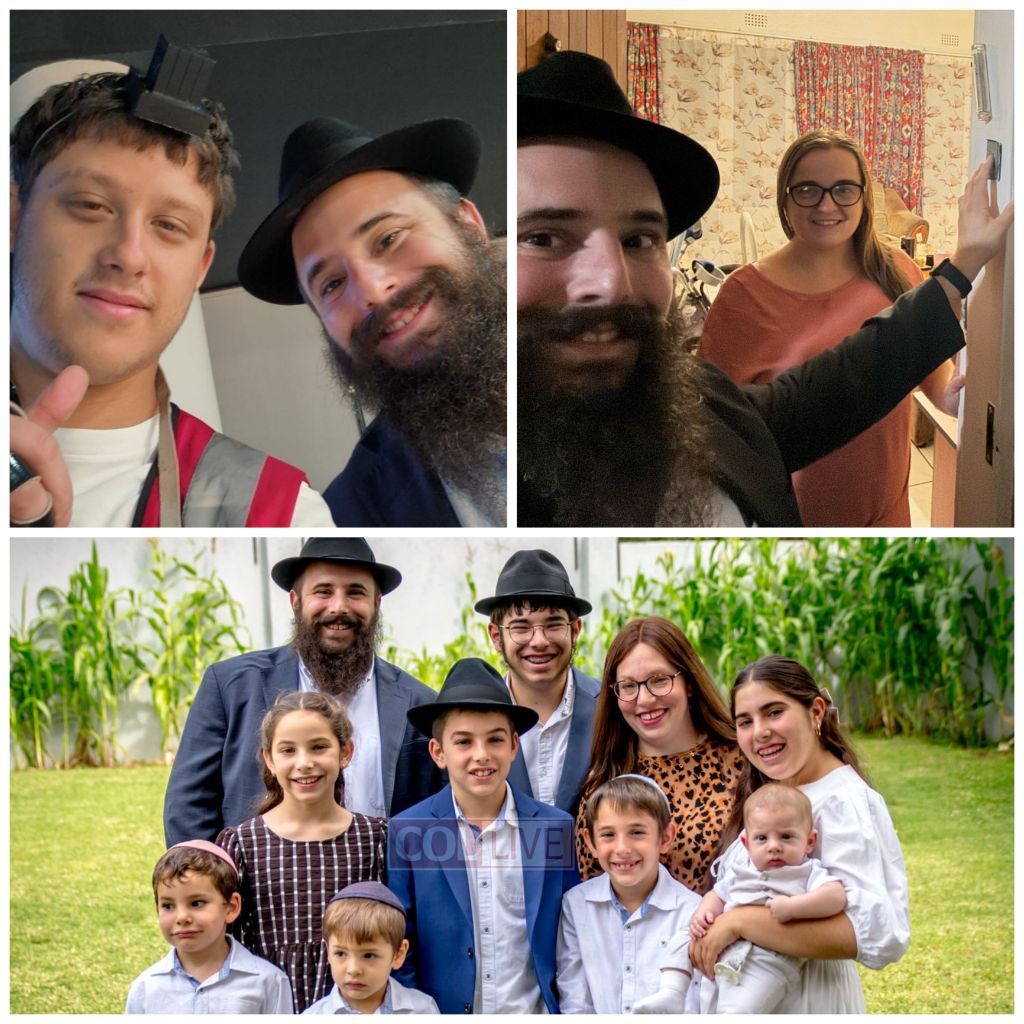
Rabbi Pini and Rochie Pink, Chabad of Greenstone, Johannesburg, South Africa
By: Chaya Chazan
While neither my wife nor I grew up as shluchim, our parents showed us that a chassid’s main task in life is to fulfill the Rebbe’s mission in any way they can. My father is a principal of a boys’ school, my father-in-law was a dentist, but they both used their jobs and positions to spread Yiddishkeit and influence others. My mother-in-law does incredible work with families in London, providing support, aid, and therapy for children at-risk. Their lives inspired us to dedicate our lives to this mission, so we were ecstatic when a rabbi I’d worked with as a bochur offered us a position in South Africa.
Although that position didn’t end up working out in the long run, it was clear Hashgacha Pratis, since it brought us to South Africa, where we’ve been for the last 16 years.
We spent a few years assisting my brother and sister in-law, Rabbi Mordechai and Sorale Rodal, with their Chabad house until we were ready to establish a center of our own. At one event, featuring Mandy Wiener, a prominent Jewish South African journalist, interviewing Rabbi Joseph Telushkin about the book he’d written about the Rebbe, she remarked to a few shluchim, “I don’t understand. The book speaks so much of the Rebbe’s determination to find every Jew and teach them about G-d, but I’ve been living in Greenstone for years and there’s no shliach there!”
My ears perked up, and I contacted her the next day to follow up on her suggestion. My wife and I went to visit her, and Chabad of Greenstone was born!
Greenstone is a gated community, so we don’t have the high walls and electric fences so ubiquitous in other parts of Johannesburg. Most of the residents are young families with small children, so we try to include lots of children’s events in our programming!
—————–
South Africa took Covid very seriously and enacted many safety precautions, so Rosh Hashanah of 2020 was challenging to plan. After a lot of discussion and rearranging, we advertised services with social distancing for the approved amount of time, followed by an outdoor shofar blowing. Our main goal was to help as many Jews as possible feel safe to daven and hear shofar.
“What should I do, Rabbi?” Ernie* wailed. He didn’t even have to explain what was troubling him. Ernie was an elderly man in his nineties, and although he’d been coming to our Chabad house for a long time, I knew his children were very worried about his health, and would never agree to let him attend a public event during Covid.
“I know you won’t be able to come to shul on Rosh Hashanah, Ernie,” I consoled him. “But don’t worry! I will come to your house to blow the shofar!”
Ernie was very thankful and we agreed on an approximate time.
After shul, the outdoor shofar blowing, the Yom Tov meal, and visiting other, closer houses to blow shofar, my son and I walked for an hour and a half to Ernie’s house. He lives outside the Greenstone development, so, like all other houses in Johannesburg, his house was surrounded by a wall and electric fencing. We couldn’t just knock on his front door, or try to see if he was home through the window. All we could do was yell “Chag Sameach!” at the top of our lungs, hoping he’d hear us through all the brick and glass.
“You know you can let them know you’re here if you just push this button,” a helpful, albeit confused passerby pointed out. He demonstrated by hitting the button, and the gate finally slid open. But instead of a smiling Ernie welcoming us in, the front door was filled by his daughter, her arms crossed over her chest, her foot tapping impatiently, and a frown on her face.
“Shana tova!” I greeted her. “We’re here to blow shofar for your father.”
“He’s sleeping,” she told us.
“We made up to meet ahead of time. I know how important this is to him. Would you mind checking if he’s actually asleep, or simply resting?”
“I know he’s sleeping,” she snapped. “Besides, even if he was awake, I still wouldn’t let you in! Do you know how dangerous it is for a man his age?”
I pointed out that we could remain on the doorstep and blow from there, but she refused to budge. Swallowing my disappointment, I asked, “Well, you’re Jewish too! Can we blow the shofar for you?” In answer, she swung the door shut in our faces.
It was discouraging. We’d walked so far, only to be turned away empty handed. We began our trek home, each block seeming twice the length as it had previously. As we passed by one house, we saw a large group exiting, obviously Jewish. From their chatter, it seemed like they had just finished their Yom Tov meal together. My son and I exchanged looks. Perhaps this journey was not a complete waste after all!
“Shana tova!” I called to them. “Have you heard shofar today?”
“No,” they replied. “With Covid and all, we couldn’t risk going to shul.”
“I can blow it for you right now!” I offered.
They stood in solemn silence, listening to the shofar’s blasts in the warm spring air. My son and I returned home, our earlier disappointment mollified by having done some good.
The next day, Ernie sent me a very contrite email, apologizing for missing us the day before. As I typed out a response, my phone rang.
“Hi Rabbi. This is Sharon*, from camp.” As soon as she told me her name, I remembered her. There is one central day camp for all Chabad house families in Johannesburg, and she’d sent her son to Gan Yisroel the previous summer.
“This may sound strange,” she continued, “but I think I saw you walking on Paliser Road yesterday. That’s very close to where I live! What were you doing in that area?”
“Yes, I was,” I replied. “I actually live right near there too! We have a Chabad house right there!”
Sharon couldn’t believe it. We lived only two blocks from each other, but neither of us had known how close we were! Thanks to the Rosh Hashanah hike we’d thought of as a failure, Sharon and her family got more involved with Judaism. We recently celebrated her son’s bar mitzvah – in our shul only two blocks from their house.
———————
Our whole family was on the way to shul one Simchas Torah morning, when we passed by a woman walking her dog, comfortably attired in a tracksuit. We stopped in our tracks when we heard her wish us a Good Yom Tov, and we immediately stopped to talk with her. She told us her name was Elizabeth* and she lived nearby.
“I actually really need to speak with a rabbi,” she mentioned. “I have an important question to discuss.”
“Come to shul!” we invited her.
She looked down at her clothes with embarrassment. “No, I can’t! Not wearing this!”
I tried assuring her that she was welcome no matter how she was dressed, but she kept shaking her head. “Then please come to our home later,” I pressed her, giving her our address.
Elizabeth came a few days later, her question clearly weighing on her mind. I invited her to make herself comfortable and unburden herself.
“My husband, Richard*, and I have been happily married for years, and we recently decided to start a family. Richard isn’t Jewish, but it never really mattered because when we discussed it before, he said he’d be fine raising our children as Jews. But now that I’m actually pregnant, he’s suddenly changed his mind. He thinks we can try giving them the best of both worlds, picking and choosing what to keep from each tradition.
“Richard is a doctor, and he’s adamantly against giving our son a bris. I don’t even know how to begin to convince him! Can you help?”
I assured her I’d do everything I could, but, as it turned out, their first child was a girl. A few years later, when she fell pregnant again – this time with a boy – she brought up her concerns once more.
“I’d be happy to speak with him,” I assured her.
I met with Richard in their home, and while he was friendly and agreeable, he remained implacable in his refusal for a bris. After using every argument and explanation I could think of to no avail, I thought of another tack.
“I have a friend who is both a medical doctor and an experienced mohel. Why don’t you speak with him, doctor to doctor, and see if he can address your concerns?”
After a long talk with my friend, Richard agreed to give his son a bris. But, months later, when Elizabeth finally had her baby, Richard got cold feet and refused to give his consent. After many more talks, we finally agreed on a compromise. The bris was held in a surgical suite, with the mohel officiating. We then brought the baby home and continued the name-giving ceremony and celebration there.
While everyone was eating, talking, and enjoying the celebration, Elizabeth looked around with tears in her eyes.
“Rabbi, do you realize that if I hadn’t been walking my dog at that exact time and place, we wouldn’t be celebrating my son’s bris right now?”
——————-
My phone hadn’t survived my toddler’s fascination with it, and his tendency to throw it across the room when it wouldn’t do what he wanted. It was early 2020, and rumors were swirling about Covid and government shutdowns. People were anxious about what was coming, and I relied on my phone to be in touch with the many who reached out, looking for support and guidance.
Insurance led me to a phone technician in the local shopping mall, and, in true repairman style, he promised me he could have it ready “in just a few hours.” Of course, when I returned to pick it up, a necessary part hadn’t come on time, so it would take “just a bit longer.”
Three days later, my phone was finally ready. It was just in time, as government lockdown went into effect the next day. All non-essential businesses were closed, including, of course, the phone repair shop. Unfortunately, there still seemed to be an unresolved issue with my phone. I called the technician and asked if he could fix it.
“My store is closed,” he answered. “There’s nothing I can do.”
“Please,” I begged him. “I’m a rabbi, and I need to be in touch with my congregants, especially in this state of emergency. Please help me!”
He was silent for a moment. “Okay, I’ll help you. Come to my house, and I’ll give you a new phone.”
I thanked him profusely and drove to his house immediately. As he set up my new phone, he remarked, “You said you’re a rabbi?”
I nodded.
“I have two requests: Can you get me a mezuzah for my front door? And a Jewish girlfriend?”
“I can get you the first one in about 20 minutes,” I laughed. “But the second might take a bit longer!”
I came back later to help him hang up the mezuzah, and saved his contact information in my new phone. We kept in touch, and, once Covid restrictions eased, we began learning together regularly. He’s grown and learned so much about Yiddishkeit, all thanks to a broken screen – although I can’t say I’ll encourage my toddler to keep throwing my phone around!
——————-
Jordan* had grown up in a traditional home, but had drifted away as he got older. Judaism was important enough to him that he asked his wife, Isabel*, to convert before they got married, but he was satisfied that her Reform “conversion” was good enough.
Every Simchas Torah, our shul has an unspoken minhag of repairing to my home for a farbrengen and seuda after hakafos. By then, everyone is feeling particularly mellow and vulnerable, thanks to the lechaims enjoyed in shul.
On that Simchas Torah, the mood was more earnest, as rumors of a massive terrorist attack in Israel were filtering through. Under normal circumstances, I would never bring up the subject, but the combination of the alcohol, Simchas Torah joy, and solemnity regarding Israel made me brave.
“Jordan, Isabel,” I said, mostly steadily, pointing a shaky finger at them. “Your conversion is no conversion at all! If you want to be Jewish, do it properly!”
Jordan was taken aback, but Isabel cocked her head and looked at me, thoughtfully. “You’re right, Rabbi,” she said. “I’ll convert through the Beis Din.”
The next morning, sober-headed, I remembered our conversation and wondered if it had been a drunken, empty promise, or if Jordan was serious. When she called to ask for the Beis Din’s number, I was excited to see she really meant what she said.
In South Africa, all conversions take place through the central Beis Din, who have a set list of conditions for all prospective converts. One of these is that the partner must be willing to commit to Judaism as strongly as the convert, so they can learn and grow together. While Isabel studied halachah and began practicing the mitzvos, Jordan had no choice but to follow along. They now keep Shabbos and kashrus, and are pushing each other to continue growing.
—————————
In our house, when we say, “No ball in the house!” our kids immediately look at the Shabbos candles. They remember one time when an overly passionate kick knocked into the Shabbos display, twisting the silver candlesticks into an odd coil.
Baruch Hashem, I was able to contact a Jewish silversmith, who picked up the candles and repaired them. Calling on his services renewed our connection, and made him think of us, when, a couple of weeks later, they needed a rabbi.
The silversmith’s wife called to tell me about a man who lived just a few blocks from me. She knew he was going through a very hard time, and was scared he would take drastic actions.
I dropped everything and rushed to the man’s house. He admitted that he’d had some very dark thoughts and that he was having difficulty navigating everything life was throwing at him. He was recently divorced, had lost his job, and was spiraling quickly. We talked for a long time, and made plans to meet up again.
As I was about to leave, I made an offhand remark about how remarkable it was that we lived just a few blocks from one another, but I’d never known his name, or that he lived here.
“Have you ever seen me around?” I asked. “Did you know Chabad was so close by?”
“Oh, of course!” he answered. “I just wasn’t interested in religion, so I made sure to steer clear of you!”
We were able to get him therapy and financial aid so he could get back on his feet and gain a new lease on life.
It was a reminder of our job as shluchim: to help every Jew we meet, whether the help they need is of a physical or spiritual nature, and whether or not they want our help!
————————–
Everyone loved Danny*. His family was very involved with the community, and he was just the happiest, friendliest kid. The entire community prayed for him when he was diagnosed with a liver disease, and we all rejoiced when he received a liver transplant and recovered from his surgery.
On Purim of 2020, Danny’s mother, Bindy*, received a call during the seuda. We watched her face carefully as it turned white, reddened, and finally, relaxed into a small smile. We all breathed a sigh of relief as she pocketed her phone and turned, calmly, back to the table.
“Danny had us worried for a moment!” she explained, brightly. “He fell ill and had a fever so we rushed him to the hospital. They just diagnosed the issue – it’s just the measles!”
Unfortunately, for someone as immunocompromised as Danny, even a small illness could be fatal. The measles quickly ravaged his body, and it was only a few days later that he went into complete organ failure. The community was devastated to learn of his passing. He was only 18.
The tragedy hit us hard. Bindy, of course, was inconsolable. “Why would G-d do such a terrible, awful thing?” she cried. “If such a horrible thing could happen to such a good person, maybe there is no G-d!”
Each word was etched in pain, and it was difficult to swallow our own tears and meet her eyes, so raw with emotion.
It took a long time, but it seemed like the message was slowly starting to sink in. We began preparing for Shavuos, with my wife making her famous cheesecakes which we distributed throughout the community.
I texted Greg*, Danny’s father, to pick up his cheesecake, but he didn’t respond.
“Come on, Greg,” I texted, teasingly. “I know you’re not going to turn down Rochie’s cheesecake!”
That too, went unanswered. The next morning, a Hatzalah volunteer called to tell me Greg had passed suddenly. I couldn’t even process what he’d said at first. Greg? Passed? Right after Danny? How? It couldn’t be? My thoughts raced, and I immediately thought of Bindy. How could she handle two such tragic losses in such a short time? Would she be able to find peace and consolation in her relationship with G-d?
We brought in counselors and rabbanim to address the quintessential questions: Why do bad things happen to good people? How do we keep our faith when G-d deals us a difficult hand?
It was heartbreakingly inspiring to watch Bindy rebuild her connection with Hashem, brick by painful brick. I was heartened to hear her begin a question with, “Well, if, G-d forbid, something else happens to me…”
G-d was once again part of her equation. She’d been through the worst of the worst, and had come out on the other side, with renewed emunah and belief in Hashem, forged through tears.
——————
I was working in my office in the central Chabad House of Johannesburg, when the secretary came in to let me know there was a man in the lobby asking for a rabbi. I was the only one in the building, so I immediately went down to greet him.
I saw a man with long hair, shuffling his feet uncomfortably as he waited. Though I shook his hand and introduced myself, he remained silent.
“Can I please put on tefillin?” he finally blurted out.
“Of course!” I responded. I led him into the sanctuary and helped him wrap the leather straps around his arms. The man broke down in uncontrollable sobs. They seemed to come from his very soul.
“Is everything okay?” I asked, concerned. “Do you want to talk?”
He mutely shook his head and tried to calm down. I helped him remove the tefillin and tried to get his name and contact information. He refused to divulge any personal information. I pushed my card into his hands and urged him to call whenever he needed anything.
A few weeks later, I was once again working in my office, when the secretary told me there was a man in the lobby, asking for me by name. When I went downstairs, I saw it was the same man. Once again, I helped him put on tefillin, and, once again, he broke down in convulsive sobs. I tried to get his name again, but he still refused to say anything.
A few months later, we were ready to open our Chabad house in Greenstone. We were looking for a house, and toured many properties. One day, we were shown a property by someone who looked familiar, although I couldn’t place him. His name tag said his name was Doug*, so I asked, “Hey Doug! Are you Jewish?”
As I asked the question, I finally realized why he looked so familiar. Doug was the man who’d come to put on tefillin! By his flushed face, it was clear that he had already recognized me.
“Do you want to put on tefillin?” I asked.
“Not in public,” he said, shaking his head. “I get very emotional, and it’s too embarrassing.”
He agreed to follow me back to the Chabad house and put on tefillin in privacy, where he could express his emotions freely. As expected, he became very emotional, crying uncontrollably.
I now knew his name and number, so I was able to contact him regularly. He agreed to come to the Chabad house every so often to put on tefillin, and, every time, he cried and shook with emotion. “It’s too much for me, Rabbi,” he explained. “That’s why I can’t do it more regularly.”
A few years later, we were looking for a new place, and Doug showed us around one place. He agreed to follow me back to the Chabad house to put on tefillin, but this time, he recited the Shema quietly and serenely, and removed the tefillin calmly.
“What happened?” I asked, confused.
“I’ll be very honest, Rabbi,” he said, squaring his shoulders. “I grew up very traditional, but I lost touch with my roots as I got older, and I married a non-Jewish woman. When I came to you that first time, I was so emotional because she’d just told me she was pregnant. I felt so guilty that I, a Jew, was having a child that wasn’t Jewish. The tefillin reminded me of who I was and how far I’d gone. When I came a few weeks later, I was shaken because I’d just accompanied my wife to a prenatal visit, and I’d seen the baby on the sonogram. Seeing a live, moving fetus made it feel even more real, and I was filled with guilt and shame.
“Now, it’s not the tefillin that reminds me of my roots; it’s you. I have your number saved in my telephone, and every time I see it, I’m comforted to know that no matter how far I’ve strayed, I have a rabbi I can call on at any time.”
*Names changed to protect privacy



Best of the best
We love the Pinks! Best family and awesome shluchim!