
The following is a public letter by Agudas Chassidei Chabad International – Lubavitch World Headquarters:
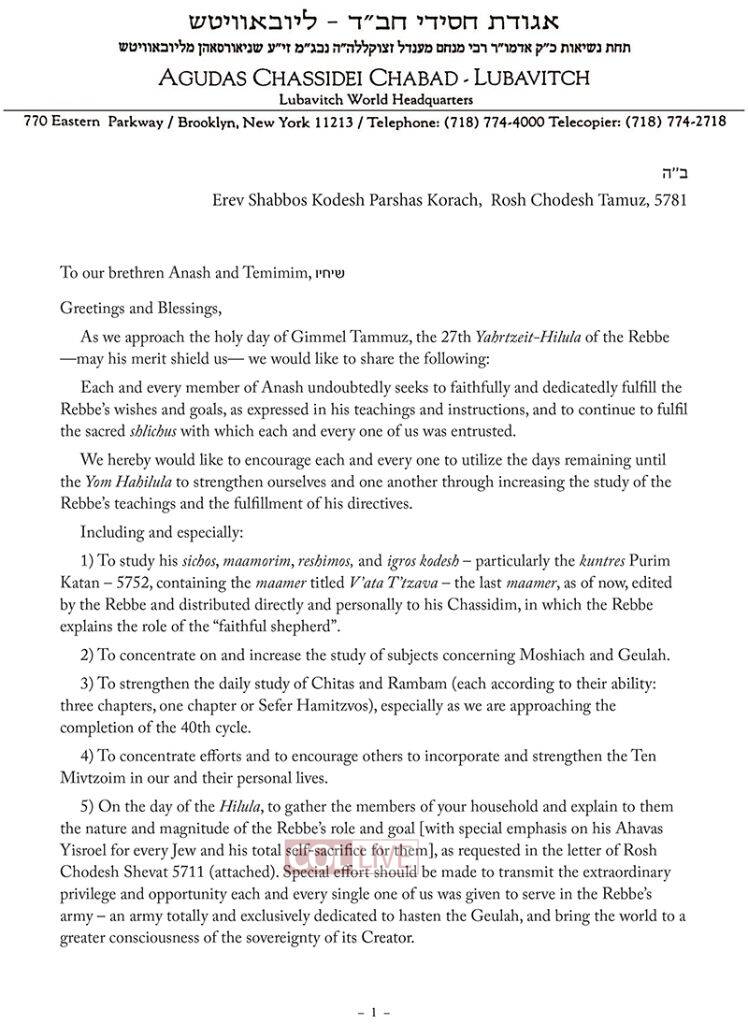
Greetings and Blessings,
As we approach the holy day of Gimmel Tammuz, the 27th Yahrtzeit-Hilula of the Rebbe —may his merit shield us— we would like to share the following:
Each and every member of Anash undoubtedly seeks to faithfully and dedicatedly fulfill the Rebbe’s wishes and goals, as expressed in his teachings and instructions, and to continue to fulfil the sacred shlichus with which each and every one of us was entrusted.
We hereby would like to encourage each and every one to utilize the days remaining until the Yom Hahilula to strengthen ourselves and one another through increasing the study of the Rebbe’s teachings and the fulfillment of his directives.
Including and especially:
1) To study his sichos, maamorim, reshimos, and igros kodesh – particularly the kuntres Purim Katan – 5752, containing the maamer titled V’ata T’tzava – the last maamar, as of now, edited by the Rebbe and distributed directly and personally to his Chassidim, in which the Rebbe explains the role of the “faithful shepherd”.
2) To concentrate on and increase the study of subjects concerning Moshiach and Geulah.
3) To strengthen the daily study of Chitas and Rambam (each according to their ability: three chapters, one chapter or Sefer Hamitzvos), especially as we are approaching the completion of the 40th cycle.
4) To concentrate efforts and to encourage others to incorporate and strengthen the Ten Mivtzoim in our and their personal lives.
5) On the day of the Hilula, to gather the members of your household and explain to them the nature and magnitude of the Rebbe’s role and goal [with special emphasis on his Ahavas Yisroel for every Jew and his total self-sacrifice for them], as requested in the letter of Rosh Chodesh Shevat 5711. Special effort should be made to transmit the extraordinary privilege and opportunity each and every single one of us was given to serve in the Rebbe’s army – an army totally and exclusively dedicated to hasten the Geulah and bring the world to a greater consciousness of the sovereignty of its Creator.
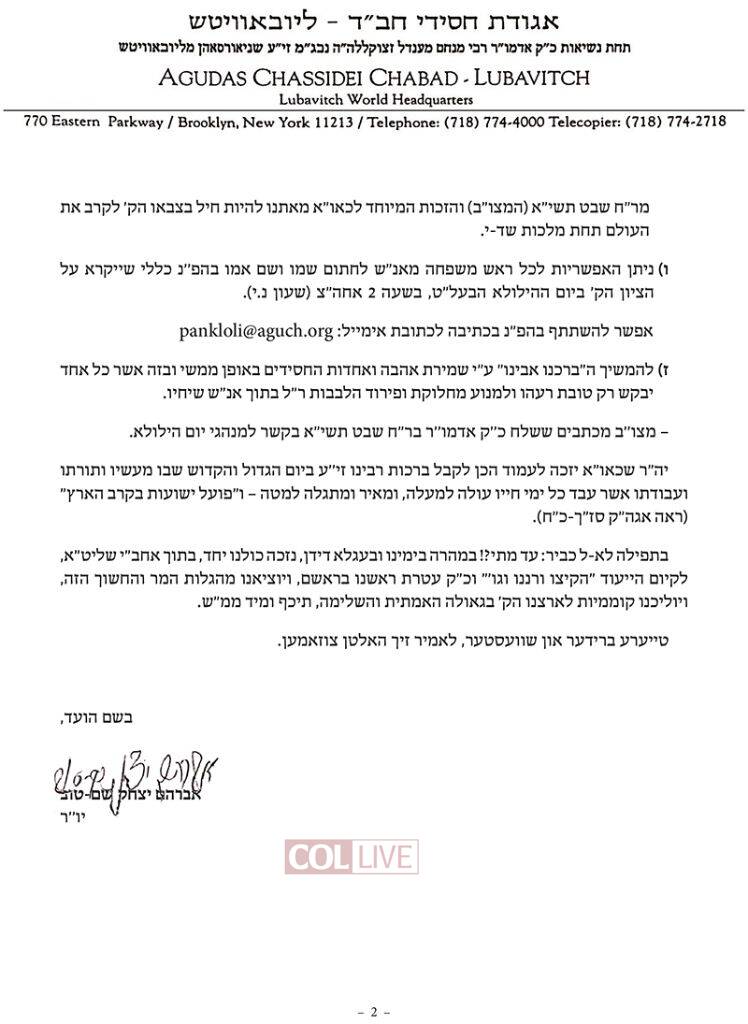
6) G-d willing, on the day of the Hilula, the Pan Kloli will be read at the Rebbe’s Ohel and broadcast live. To be included in the Pan, the head of each household should please send their name and mother’s name to [email protected] Names should be sent in before Sunday, Gimmel Tammuz, 12 PM EST.
7) It is incumbent upon every one of us to create the vessels for receiving the Rebbe’s holy blessings of “Barchainu Avinu” through strengthening and increasing our “Kulonu K’echod”, the brotherly love and unity among us – to seek the wellbeing of all our fellow Jews, may they all be well, and further the Rebbe’s message to the world.
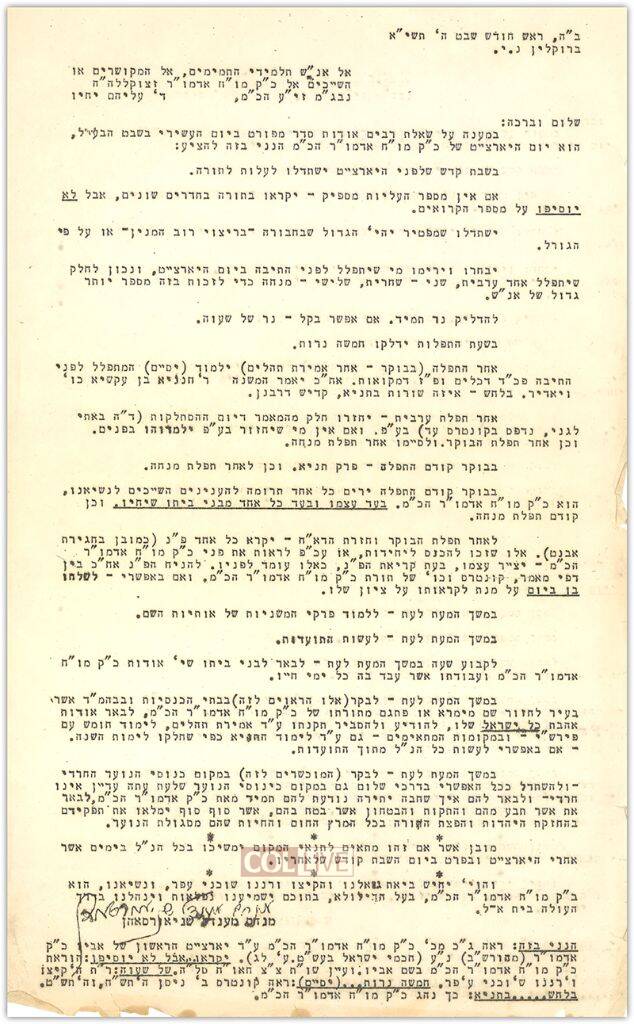
Attached, please find the public letter the Rebbe wrote on Rosh Chodesh Shevat 5711 instructing us how to observe a Hilula and its appropriate customs.
May it be the will of Hashem, that each and every one of us be ready to receive the blessings of our Rebbe on the holy day of the Hilula, the day in which all of the Rebbe’s life’s teachings and accomplishments ascend even higher and illuminate and reveal themselves here on earth with even greater intensity and effectuate salvations in the midst of the earth (see Igeres Hakodesh, chapters 27-28).
We beseech our Merciful Father in Heaven: Ad Mosai?! How much longer?! May we merit together with all of Klal Yisroel, may they live and be well, to witness the fulfillment of the verse, “Arise and rejoice, etc.” with the Rebbe at the lead, to take us out of this bitter and dark exile and bring us, upright, to our Holy Land, through the true and complete Redemption, immediately and literally, Mamesh.
On behalf of the board,
Avrohom Shemtov,
Chairman
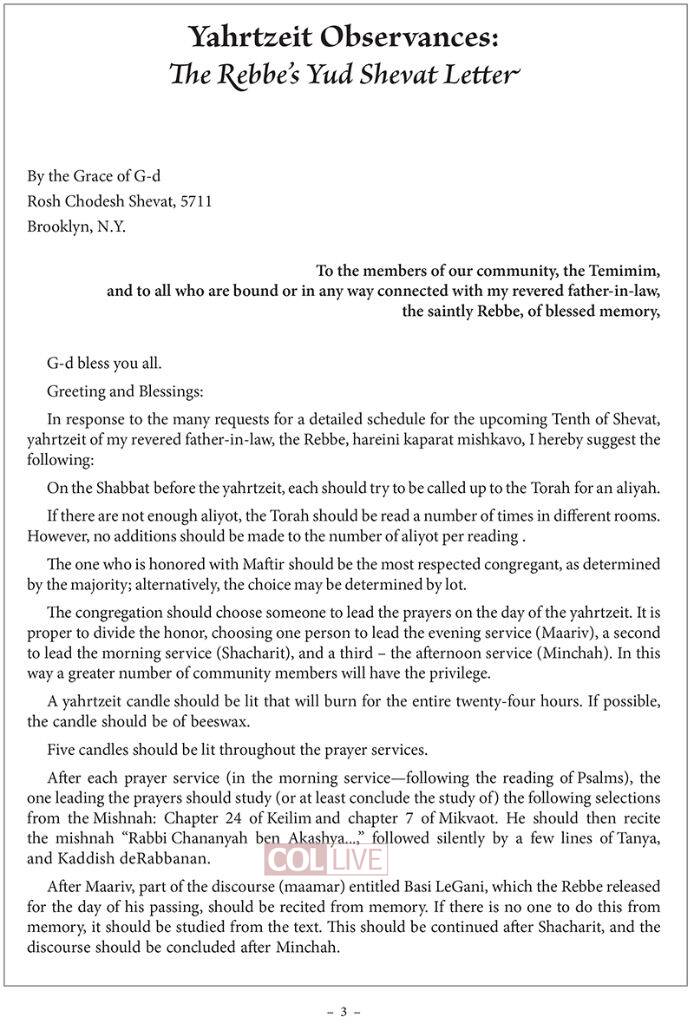
Yartzeit Observances
The Rebbe’s Yud Shevat Letter
By the Grace of G‑d
Rosh Chodesh Shevat, 5711
Brooklyn, N.Y.
To the members of our community, the Temimim, and to all who are bound or in any way connected with my revered father-in-law,
the saintly Rebbe, of blessed memory, G‑d bless you all.
Greeting and Blessings:
In response to the many requests for a detailed schedule for the upcoming Tenth of Shevat, yahrtzeit of my revered father-in-law, the Rebbe, hareini kaparat mishkavo, I hereby suggest the following:
On the Shabbat before the yahrtzeit, each should try to be called up to the Torah for an aliyah.
If there are not enough aliyot, the Torah should be read a number of times in different rooms. However, no additions should be made to the number of aliyot per reading.
The one who is honored with Maftir should be the most respected congregant, as determined by the majority; alternatively, the choice may be determined by lot.
The congregation should choose someone to lead the prayers on the day of the yahrtzeit. It is proper to divide the honor, choosing one person to lead the evening service (Maariv), a second to lead the morning service (Shacharit), and a third – the afternoon service (Minchah). In this way a greater number of community members will have the privilege.
A yahrtzeit candle should be lit that will burn for the entire twenty-four hours. If possible, the candle should be of beeswax.
Five candles should be lit throughout the prayer services.
After each prayer service (in the morning service—following the reading of Psalms), the one leading the prayers should study (or at least conclude the study of) the following selections from the Mishnah: Chapter 24 of Keilim and chapter 7 of Mikvaot. He should then recite the mishnah “Rabbi Chananyah ben Akashya…,” followed silently by a few lines of Tanya, and Kaddish deRabbanan.
After Maariv, part of the discourse (maamar) entitled Basi LeGani, which the Rebbe released for the day of his passing, should be recited from memory. If there is no one to do this from memory, it should be studied from the text. This should be continued after Shacharit, and the discourse should be concluded after Minchah.
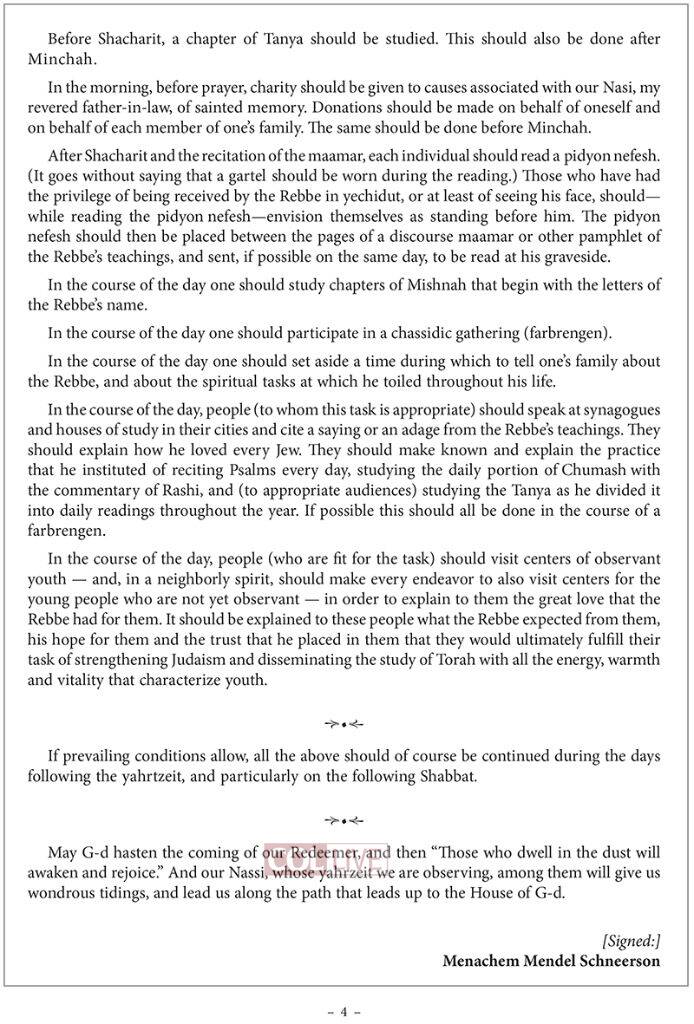
Before Shacharit, a chapter of Tanya should be studied. This should also be done after Minchah.
In the morning, before prayer, charity should be given to causes associated with our Nasi, my revered father-in-law, of sainted memory. Donations should be made on behalf of oneself and on behalf of each member of one’s family. The same should be done before Minchah.
After Shacharit and the recitation of the maamar, each individual should read a pidyon nefesh. (It goes without saying that a gartel should be worn during the reading.) Those who have had the privilege of being received by the Rebbe in yechidut, or at least of seeing his face, should—while reading the pidyon nefesh—envision themselves as standing before him. The pidyon nefesh should then be placed between the pages of a discourse maamar or other pamphlet of the Rebbe’s teachings, and sent, if possible on the same day, to be read at his graveside.
In the course of the day, one should study chapters of Mishnah that begin with the letters of the Rebbe’s name.
In the course of the day, one should participate in a chassidic gathering (farbrengen).
In the course of the day, one should set aside a time during which to tell one’s family about the Rebbe, and about the spiritual tasks at which he toiled throughout his life.
In the course of the day, people (to whom this task is appropriate) should speak at synagogues and houses of study in their cities and cite a saying or an adage from the Rebbe’s teachings. They should explain how he loved every Jew. They should make known and explain the practice that he instituted of reciting Psalms every day, studying the daily portion of Chumash with the commentary of Rashi, and (to appropriate audiences) studying the Tanya as he divided it into daily readings throughout the year. If possible this should all be done in the course of a farbrengen.
In the course of the day, people (who are fit for the task) should visit centers of observant youth — and, in a neighborly spirit, should make every endeavor to also visit centers for the young people who are not yet observant — in order to explain to them the great love that the Rebbe had for them. It should be explained to these people what the Rebbe expected from them, his hope for them and the trust that he placed in them that they would ultimately fulfill their task of strengthening Judaism and disseminating the study of Torah with all the energy, warmth and vitality that characterize youth.
•••
If prevailing conditions allow, all the above should of course be continued during the days following the yahrtzeit, and particularly on the following Shabbat.
•••
May G‑d hasten the coming of our Redeemer, and then “Those who dwell in the dust will awaken and rejoice.” And our Nassi, whose yahrzeit we are observing, among them will give us wondrous tidings, and lead us along the path that leads up to the House of G‑d.
[Signed:]
Menachem Mendel Schneerson