
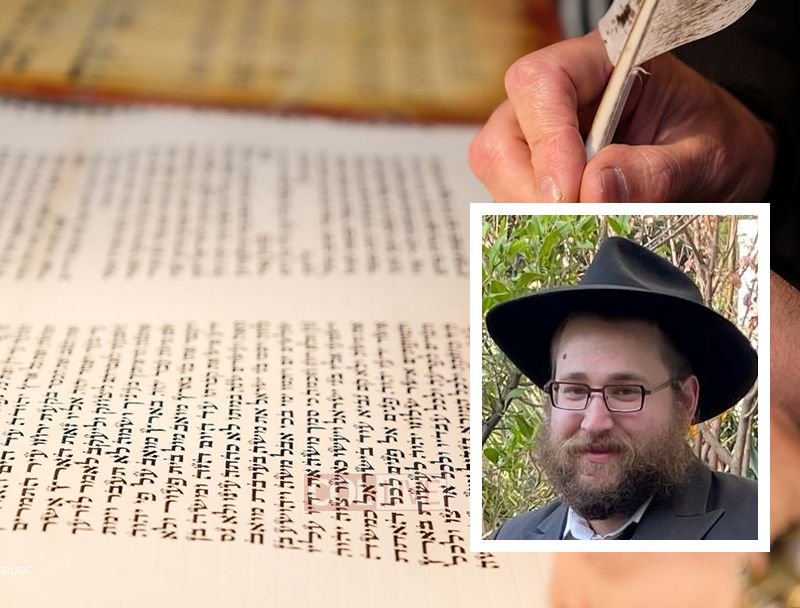
By Yosef Kaufmann
Over this past Elul, as I checked mezuzahs and tefillin, one thing became painfully clear: we are facing a serious lack of education about the world of STa”M (Sifrei Torah, Tefillin, and Mezuzahs) — especially within our own Chabad community.
Time after time, people bring me their mezuzahs and tefillin, assuming that all is well. But when I begin to explain issues that I encounter while checking, the usual response is, “I don’t speak this language.” These are sincere, frum people who want to do the right thing — but they were never taught how to navigate this area of Yiddishkeit that is both halachically complex and spiritually fundamental.
Chazal have taught us that STa”M is not just parchment and ink — it is a physical expression of Hashem’s presence in our lives. Every aspect of each letter carries kedushah; every detail matters. The Rebbe spoke many times about the shemira that kosher mezuzahs bring. When something so central to a Yid’s connection with Hashem is neglected or misunderstood, it affects both the gashmiyus and ruchniyus of our homes.
As a sofer, I can say with certainty that too many people are unknowingly using mezuzahs or tefillin that are well below the standard that a Chossid should have. Not out of neglect, but out of a lack of knowledge. They were never given the tools to know better. To understand the difference between a 10cm and a 15cm mezuzah. To appreciate that the extra expense is a worthwhile investment in the spiritual foundation and protection of one’s home and family.
This should be a priority for all mechanchim. Our chosson teachers also have a huge impact and responsibility: they are preparing our bochurim to build and establish chassidishe homes. The mezuzahs they are about to affix to their doorways — and the tefillin they will, iy”H, one day buy for their sons — are not side details. They are part of the very foundation of that home’s kedusha and protection. Teaching how to buy STa”M, what to look for, what questions to ask, must be included in that preparation.
The same applies to our bar mitzvah boys. Alongside learning how to put on tefillin properly, they should be taught how to recognize basic issues — such as cracked retzuos, so they can avoid, chas v’shalom, putting on problematic or invalid tefillin. This awareness is not beyond them; on the contrary, it empowers them to take true ownership of the mitzvah.
That is why I turn now, with respect and urgency, to our roshei yeshivah, rabbonim, and chosson teachers, principals and mechanchim: please make STa”M education a part of your curriculum and guidance. Even a single shiur, a short discussion, or a few minutes in a chosson class can open eyes and prevent years of unintentional issues.
As a small step in that direction, I have put together a short STa”M Buyer’s Guide — a simple resource to help people know what to ask, what to look for, and how to make informed decisions when buying mezuzahs and tefillin. But this can only go so far. Real change will come when the awareness begins in the classroom, in yeshivah, and under the guidance of our rabbonim and teachers.
If we can give our community the language of STa”M — the ability to ask, to discern, and to take pride in the beauty and hiddur of these holy items — we will be fulfilling not only a halachic responsibility but also a directive of the Rebbe: to ensure that every Yid is surrounded, physically and spiritually, by the Kedusha of kosher mezuzahs and tefillin.
Let’s not let another Elul go by with people saying, “I don’t speak this language.” Let’s start teaching it.





what is the difference between a 10cm and a 15cm mezuzah.
There are a number of reasons for this. The main reason is because by a 15cm, the letters are thicker, so there is less chance that they will crack when the are rolled up and put in to a case. It’s also easier for a סופר to write the proper shape of the letter with a larger מזוזה, and less chance of messing up the form. And much more.
when i was buying my mezuzahs.
in the same ksav
please post links and info
The best soifrim might not have a link or WhatsApp.
The best soifer is someone who you know personally is a yorei shomayim and knows halacha.
If you don’t know someone like that ask around. The main thing is buy directly from the soifer. The stores take wherever they can get a nice ksav without testing on halacha.
Stam is about yiras shomayim and halacha. Ksav comes afterwards.
who is the best
Perhaps there could be some online shiurim on this topic? For people who are past bar mitzvah and chosson classes?
Chosson teachers need to educate about Sta”m?? And maybe they should give a class on kashrus, taxes, how to change your car’s oil and what goes in chicken soup? I know this is tangental but it’s fully ridiculous to put the responsibility of every gap in knowledge a young man (or woman) might have as they go to the chuppah on the chosson (and kallah) teachers’ shoulders. Nobody can know everything about everything at 20 years old, and no one person can teach it all to them in 8-10 classes. Can we please accept that there will be different people… Read more »
They aren’t coming for guidance and to ask questions, they are just coming to get their tefillin and mezuzos checked. Which is why when he starts explaining issues etc. they just say “I don’t speak that language”.
Chosson teachers should be teaching about marriage.
Sofreim should be teaching about STA”M
need to make absolute certain all their scrolls are completely kosher!!!!!!!! someone needs to tell them all!
The guide describes 4 types of scripts: Sfardi, Bais Yosef, Arizal, and “Chabad” presumably referring to the alleged “Alter Rebbe Ksav”. However, while it’s not used outside of Chabad, it’s only used by some Lubavitchers; other Lubavitchers prefer Arizal. Therefore, it seems inappropriate to label it as “Chabad” because this implies that Arizal is less “Chabad”.
Ktav Is part of Arizal’s ktav
Someone correct me if I’m wrong
The Rebbe called it ksav chabad in tens if not hundreds of places in igros kodesh so please don’t get offended by the generalization something when our Rebbe did so himself.
These are the rebbes words, responding to someone about a doubt if he should get alter rebbe’s ksav for a relative was a chossid: The doubt in this matter is astonishing, since the rule and the psak din is that in the place of Rav – including all of those connected to Rav – the custom is like Rav. And the question that he asked, that in his view the practice that is desirable in the eyes of HaKadosh Baruch Hu is that which is practiced by most of Klal Yisrael, this question is astonishing, since the Alter Rebbe also… Read more »
Idk about all the intricate halachos of mezuzhas and tefilin. I go to a Sofer who my mashpia recommends and l tell the Sofer l want the mezuzhas/tefilin to be up to Chabad standards.
If a Lubavitcher tells the Sofer” your speaking a language….” that it self seems to be an issue.
It’s not about being more chabad or less there’s no competition here. Simply put the ksav of the Ariza”l isn’t chabad it’s Jewish, it’s a relatively universal ksav and you will find it in any Ashkenazi place. The ksav of the alter Rebbe on the other hand is the only “chabad” ksav there is. Yes, if someone doesn’t have access to ksav chabad for whatever reason we will go to arizal before any of the other ones but the alter Rebbes ksav IS the chabad ksav.
As a sofer of 30 years who has written many articles on this topic as well as having advised many Rabbonei anash on this issue, I am rather shocked by the author of this article as well as some of the subsequent comments which seem to imply the Arizal ksav is inferior in some way and is considered “Ashkenazi” and not Chabad??!?!? Lets state some facts: the Ashkenaz ksav is Ksav Beis Yosef. Arizal ksav is used by most Chassidim, including many in Chabad (although Chabad Arizal has certain nuances that are different to the regular Chassidish Arizal (such as… Read more »
Please create a series of shiurim about the issues that you believe are important and publish them online. That is likely the most effective way to educate people about the issue.
Asking others to do what you feel is important is not that likely to gain much traction. But if you create quality lessons and make them widely accessible, it is most likely that it will lead to a more educated population.
There are so many other halachos that yungeleit have to learn. Beyond Semicha and Taharas Hamispacha. How to treat your wife, how to educate your children, how to create a Jewish home, hilchos Shabbos and Yom Tov, etc. and that’s on top of learning how to make a kosher living, masa umattan, ribis, treating workers, and so much more. It is hard to teach everything.
Maybe they should add practical classes to Yeshiva learning! Like Safrus, kosher…. many other, Gemara is important but so is learning to run a household . And yes, learning basic mechanics and plumbing can’t hurt.
Do they use alter rebe, because the maggid asked him to make it? Or not
Many chassidim have low quality mezuzas because of cost. I get a sofer needs to make a parnassa. But when a basic 10 cm is going for $60-100 a piece , how does one afford a house full of 15 to 20 cm mezuzas?!
At the end of the day, we are consumers. There should be consumer protection laws in place (like there are for electric appliances, car seats, smoke alarms.) Every mezuzah should have a bar code that includes: name of Sofer, date it was written, size of lines/letters, type of script, type of klaf, etc. How this crucial element has slipped through the cracks is astonishing and correctable. Could kashrus agencies open up a STaM Department?
All those wondering, THE absolute best sofer out there! Yiras Shamayim to the next degree. Powerful and informative article wow machayil el chayil!