
By COLlive staff
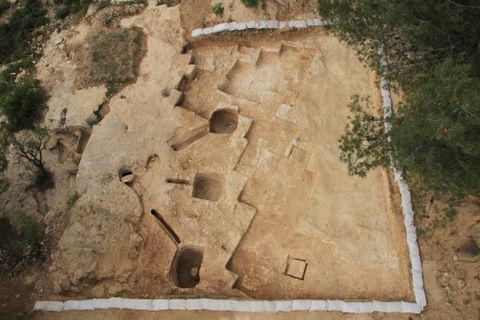
In an archaeological excavation the Israel Antiquities Authority conducted in the Qiryat Menachem quarter of Jerusalem, a rare ritual mikvah was exposed that dates to the late Second Temple period.
“Numerous ritual baths have been excavated in Jerusalem in recent years, but the water supply system that we exposed in this excavation is unique and unusual,” said Benyamin Storchan, director of the excavation on behalf of the Israel Antiquities Authority.
“The ritual bath consists of an underground chamber entered by way of steps. The mikvah received the rainwater from 3 collecting basins (otzar) that were hewn on the roof of the bath, and the pure water was conveyed inside the chamber through channels.”
The ritual baths known until now usually consist of a closed cavity that was supplied with rainwater conveyed from a small rock-cut pool located nearby. The complex that was exposed at this time is a more sophisticated and intricate system.
He said the bath was apparently associated with a settlement that was situated there in the Second Temple period. Presumably, due to the lack of rainfall and arid conditions of the region, the inhabitants sought special techniques that would make it possible to store every drop of water.
“It is interesting to note that the bath conforms to all of the laws of kashrut, like collecting the water in it naturally without human contact, and ensuring that the water does not seep into the earth which is why the bath was treated with a special kind of plaster,” Storchan said.
The ritual bath, which is located in a picturesque valley where there are ancient agricultural installations, was uncovered a short distance from the houses in the Qiryat Menachem quarter.
“The neighborhood community has expressed great interest in the conservation of the mikvah,” said Jerusalem district archaeologist, Amit Re’em.
“The Israel Antiquities Authority and the Moriah Company are working to make this delightful treasure a site for the benefit of the residents and visitors.”
After the ritual bath went out of use, the place served as a quarry and the channels filled up with earth. During the twentieth century the immersion chamber was cleaned, a round opening was breached in its ceiling and it was used as a cistern.



Who says they are going to use it? How will they fix it?
What’s wrong with this mikveh? What rov wouldn’t allow it, or Moshe Rabbenu’s shechitah or tefillin? Where do you get such stupid ideas?
After all the chumras and additions from gedolei haposkim over the centuries, no Rov today would allow use of such a mikveh, in fact, no Rov today would eat from Moshe Rabeinu’s shchitah either, or allow the use of his tefillin.
maybe they should make it bor al gabie bor and then moshiach would come, I can’t wait! we want Moshiach now
No, just the one bor. They had no filtering or cleaning, and no heating, so there was no need for a second bor.
Just like the mikva in Massada, we once again observe a complex part of Jewish law and oral tradition having been practiced as we know it today, centuries before the Mishna and Gemarra was transcribed. 2,000 years later, and thousands upon thousands of pages of halachic debate over the last 1500 years (from when the Gemarra was organized and transcribed), over multiple continents where we’ve lived and been chased to and from, our oral tradition still proves to maintain its accuracy.
thank you for sharing, very interesting!
bor al gabei bor?
bor al yad bor?
moshiach now
wow this is amaznig