
Great Awakening
When this young man fought at El-Arish, his Torah and mitzvoth fought for him. The Divine Presence came down into the trenches to assist the soldier fighting on the borders of the Land of Israel.
The Rebbe
The State of Israel – how did the Rebbe see its creation? Secular or profane? Mistake or miracle? The Avner Institute presents excerpts of insightful interviews, based on Rabbi Gutnick’s private audiences, and the Rebbe’s keen eye of Israel’s sheer existence as a path filled with opportunities, potential and missed, for greater religious observance and emergence into a true Torah nation. With special thanks to Rabbi Avrohom Moshe Gutnick for the interviews.
“And You Shall Spread Forth”
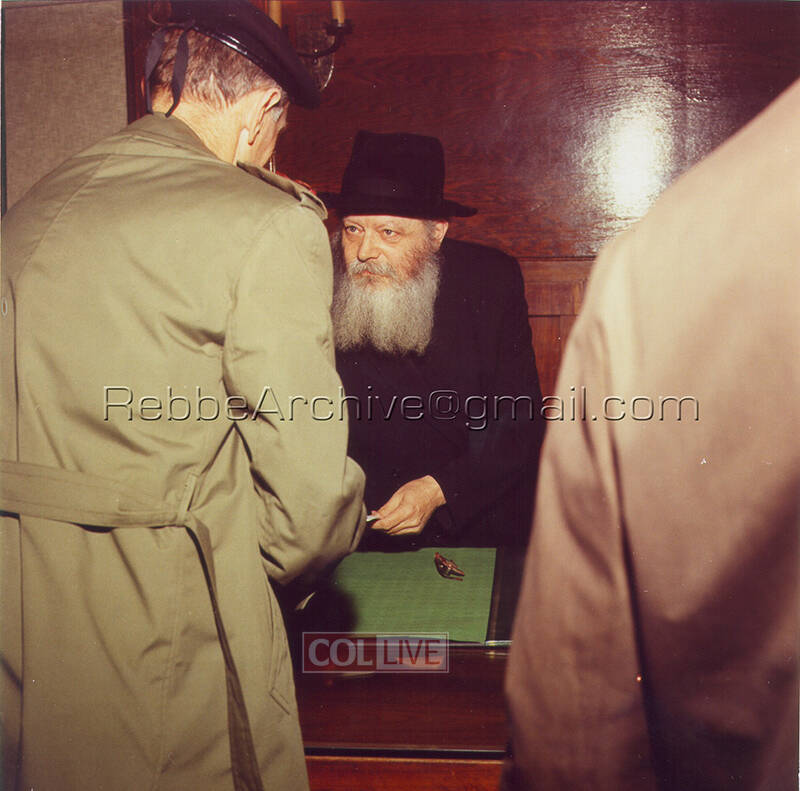
Rabbi Chaim Gutnick was privileged to have had unusually long private audiences with the Lubavitcher Rebbe, sometimes lasting several hours. One of these took place on Erev Shabbos Nachamu, 5 Menachem Av 5727 (August 11, 1967), shortly after Israel’s Six Day War. Excerpts were transcribed and adapted from Rabbi Gutnick’s own recollections.
Rabbi Gutnick began by relating his recent visit to Israel, whence he described the tremendous surge of Jewish pride in the aftermath of the Six Day War.
Gutnick: Jewish leaders are searching for ways to utilize the recent feelings of arousal towards Judaism. The Jewish community has felt a binding unity and a spiritual awakening, but the fact that these feeling are now passing over hurts very much; it pains Jewish leaders that this opportunity has not been utilized to bring more Jews closer to Judaism. They hope that Lubavitch and the Rebbe, who uses the motto “Ufaratztah [and you shall spread forth]” will do something about it.
Rebbe: We have to tell them that the Jewish nation must return to Torah and the observance of mitzvoth.
Gutnick: I have already spoken about that last Shabbos, and last year as well. What will be added to the community by speaking about it again?
Rebbe: Don’t be ashamed – repeat the speech you said last year. An Australian communal leader visited me recently and presented me with reports from conferences on secular matters. He related how they talk and talk and don’t do anything, and he had come to the conclusion that the only thing that can be done practically is that which pertains to religious observance.
I told him, “If so, when you return to Melbourne, why don’t you bang on the table when you meet with the [Victorian Jewish] Board of Deputies and say, ‘My friends, you have sent me to conferences — the conferences are not worth anything! Let us now send out a call to Torah and good deeds.’” The community leader answered me, “If I did that, they’d think I’m crazy.”
Then I was visited by an official of Mapai, who also related how all the conferences didn’t bring any practical results to Jews. He was told that maybe he should show an example and return to Judaism – and begin by laying tefillin. He, too, said that even though he had revealed his soul to me, he just could not picture it: getting up one Monday morning, going into his lounge room and laying tefillin, and his wife, with whom he has been living for some thirty years, walking in and seeing him standing in the corner with tefillin on. He will be so embarrassed in front of her and she will consider him crazy.
I told him that he was making a mistake. He knew himself that he was supposed to do this, and that his return to Judaism must start by laying tefillin, but he was ashamed of his wife! The truth is, he does not even know if his wife knows that this is the right thing to do but is ashamed to tell him. Each one is embarrassed of the other.
And you, too, are ashamed to repeat a speech which you delivered last year, even though you know you are supposed to say it. If there was an alternative, fine, but there just isn’t. Everything has been tried to bring Moshiach and it hasn’t helped. So why shouldn’t we try the right thing –to observe Torah and do good deeds? Let it be told to Jews that at least for one year they should be a Torah nation, at least for twenty-four hours.
Gutnick: Even if I return to my congregation and tell them about the miracles that we have seen in Israel [during the Six Day War] and compel them to return to Judaism, and even if other rabbis do the same, how will it be possible to reach all Jews?
Rebbe: First of all, if you do it, a second person will also do it, and a third and a fourth. We don’t know how far it will go. Secondly, there is another ruling stated in the Rambam’s Mishneh Torah – a person should consider the world evenly balanced [by good and evil deeds]; through one good deed he can “tip the scales” for the good. When you return a Jew to Torah and good deeds, there is no way of knowing if that will tip the scales.
Gutnick: I take it upon myself to do this, when I return to Australia after Tisha B’Av.
Chance Times 3
Rebbe: Three times in our generation, G-d has granted us an opportunity for the beginning of the Redemption. But these opportunities were missed, and it is the Jewish leadership which is to blame.
The first opportunity was in 1948. You know that I have a particular enthusiasm for Rashi’s commentary on the Torah. Rashi says regarding the waters of the Flood that, at first, G-d brought down “rains of blessing” upon them and waited to see if they would repent; only after they failed to do so did this turn into the very opposite of “rains of blessing,” G-d forbid.
In 1948, G-d sent “rains of blessing.” This was a time when even the Russians supported the Jewish people against the British, who had attempted to annihilate the nation of
Israel. This was a time of opportunity. But the Jewish leaders stood by and debated whether or not to make mention of G-d’s name in the “Declaration of Establishment.” Thus the Redemption was put off by fifty years.
The second opportunity was the [1956] Sinai Campaign. Had the Jewish people believed that their salvation would come from G-d rather than from French MIGs and British warplanes, all would have been different.
But never has there been an opportunity such as this one. This was a war won by Torah and mitzvoth. There can be no doubt of this. A Jew in Moscow recited Psalms, and a Jew in Buffalo, New York, lay tefillin, and this helped the Jews defeat their enemies in the Land of Israel. Had the Jewish leaders utilized the opportunity to rouse the people to the observance of Torah and mitzvoth, our situation today would be entirely different.
Think about it: a young man in Israel was summoned, handed an Uzi, and told: “Leave your wife and children at home and go to El-Arish to fight.” In every war there are draft-dodgers; here, no Jew, not even one for whom the word “Jew” is nothing more than an appellation, refused to fight. It was a time when the entire people of Israel were in a state of “We shall do and we shall hear.” When this young man fought at El-Arish, his Torah and mitzvoth fought for him. The Divine Presence came down into the trenches to assist the soldier fighting on the borders of the Land of Israel. Had the Jewish leaders told that soldier to utilize the reserves of faith and courage that were revealed in him during the war toward a commitment to Torah and mitzvoth, with the same “We shall do and we shall hear,” he, and the entire Jewish nation, would have responded, and everything would have been different. But again the leaders were silent, and the great opportunity was lost. They were too timid to tell the Jew the truth: that this is the time for a return to Torah.
The very first chapter of the first section of the Code of Jewish Law begins not with the Rambam’s “Thirteen Principles of Faith,” but with the Rama’s ruling: “One should not be intimidated by mockers.” Why? Because when one does not fulfil this rule, one is prevented from fulfilling the entire Code of Jewish Law.
Perhaps I speak too sharply, but the Jewish leadership is bankrupt. They avoid me because they know that I will demand of them to speak the truth. Their timidity, contrary to the rule “One should not be intimidated by mockers,” is holding back the Redemption. Jews must be told to keep Torah and mitzvoth.
I have initiated the tefillin campaign; this is only the beginning. My hope is that through the mitzvah of tefillin, the Jewish people will be brought closer to other mitzvoth – to keep kosher and Shabbat, and ultimately the entire Torah. My aim is that millions of additional hands should become tefillin-wearing hands.
Gutnick: The Rebbe demands that there be at least a majority of Jews observing Torah and mitzvoth. For one day, General Arik Sharon put on tefillin at the Western Wall. But what will happen tomorrow? It will no longer be possible to consider him part of the majority.
Rebbe: He put on tefillin that day, and would’ve put on again the next day as well, had someone gone to visit him and encourage him to do it. But nobody did.
Gutnick: Will the Jewish people listen to us if we speak to them about Torah and mitzvoth?
Rebbe: Yes, the Jewish people will listen. Not only teenagers, but also forty-year-olds – people advanced and established in their lives – are ready to hear the truth, if only their leaders will speak it to them.
Gutnick: Have we missed the opportune moment? Is it not too late?
Rebbe: No, it is now August. If we do our job, if the shluchim [emissaries] do their job and tell the world the truth, we can bring the Redemption.
This week is Shabbos Chazon. You have most probably heard my discourses – that in this period one must be happy. Let us be happy and go out and farbreng with Jews and relate to them the awakening that has taken place, and may G-d help the redemption actually come.
Special Preference
Rebbe: The boys in the yeshiva write to me that you deliver lectures, but I do not want you to be the guest speaker. Three times a week is better than twice a week; twice a week is better than once a week.
The Rebbe gave Rabbi Gutnick a Tanya, the Alter Rebbe’s Laws of Talmud Torah, and a discourse on Yud-Beis (12) Tammuz, the birthday of the Previous Lubavitcher Rebbe Yosef Yitzchak Schneersohn and the day he was freed from Soviet prison.
Rebbe: One must learn Tanya and Laws of Talmud Torah. Reprint the Laws of Talmud Torah in Australia with an introduction explaining that it’s from the Yeshiva Gedolah [in Melbourne], and for spiritual reasons publish it in 5727 (1967), before the end of the year of hakhel [year following Shmittah, the sabbatical year), which according to our opinion ends on the festival of Succoth. The Tanya does not have to be printed in 5727, but of course the sooner the better. And since I’m telling you to spend so much money, here is a check.
(The Rebbe gave Rabbi Gutnick a blank check.)
Gutnick: But the Rebbe didn’t write a sum on the check!
Rebbe: Indeed, it is customary to write a sum.
(The Rebbe wrote out the check for $1000.)
Rebbe: Regarding the Yeshiva Gedolah: for the moment it should not be officially named “Tomchei Temimim,” just “Yeshiva Gedolah.” Also try to include the name “Zal,” and I mean Zal with an alef! [So it doesn’t mean in memory.] Also, do not put the word Lubavitch there [in the name] for the time being.
The yeshiva should be under proper leadership. The opening of the yeshiva should be publicized in South Africa and in the Jewish Chronicle, in England. It is very possible that if someone from these places asks me where to go I might tell them to go to Australia.
Gutnick: I forgot a small matter.
Rebbe: I heard from my father-in-law, the Rebbe, that “by a Jew there is no small matter.”
Gutnick: Does the Rebbe have anything special to give over to the shluchim of Yeshiva Gedolah?
Rebbe: Nothing special. By me they always have special preference.
Gutnick: The Australian students have shown self-sacrifice by attending yeshiva instead of going to university. They feel let down because only the Americans receive letters from the Rebbe, and they feel that they are being neglected.
Rebbe: You are right, I will correct this. I see that at least they are fighting over self-sacrifice — Australian versus American.
Soon afterwards, the Rebbe sent a communal letter to the students of the yeshiva with a special handwritten message.
Ultimate Goal
Rabbi Gutnick mentioned a statement of Maimonides, the Rambam – that Moshiach will succeed in compelling all Jews to follow the path of Torah.
Rebbe: The statement in Rambam – that [Moshiach] will go around and compel Jews to follow the Torah and do good deeds – does not mean that he himself must go over to each person; that is impossible. Rather, it will be achieved through shluchim and through their shluchim, and so on. It would suffice for me if shluchim told all Jews that they must return to Torah and good deeds. This would help bring the fulfilment of the ultimate goal. When that happens, we will be able to speak of the beginning of the redemption.
Gutnick: I don’t see how it is possible to compel all Jews, even through shluchim. Perhaps the Rambam means that Moshiach will merely want to do so and engage himself in this task?
Rebbe: I am speaking to you “below ten handbreaths” and you are creeping up “above ten handbreaths.” This, that Moshiach will compel all Jews to return to the Torah, doesn’t mean potentially, it means actually. This is not a sermon, this is a halachic ruling. There is nobody among the rabbinic authorities who argues with the Rambam on this point.
People tell me of a commentary by Ramban [Nachmanides] on Song of Songs . . . a Yerushalmi . . . but this is all interpretation. Interpretation of a verse of Torah is one thing; Jewish law is another. The Rambam states explicitly: a person will compel the Jewish nation. If not all of them, at least a majority.
We must tell the Jewish nation that they must return to Torah and good deeds. When you return [to Australia], you must deliver a sermon about practical Jewish observance – tefillin, kashrus, and Shabbos.
To receive this to your inbox, email [email protected]