
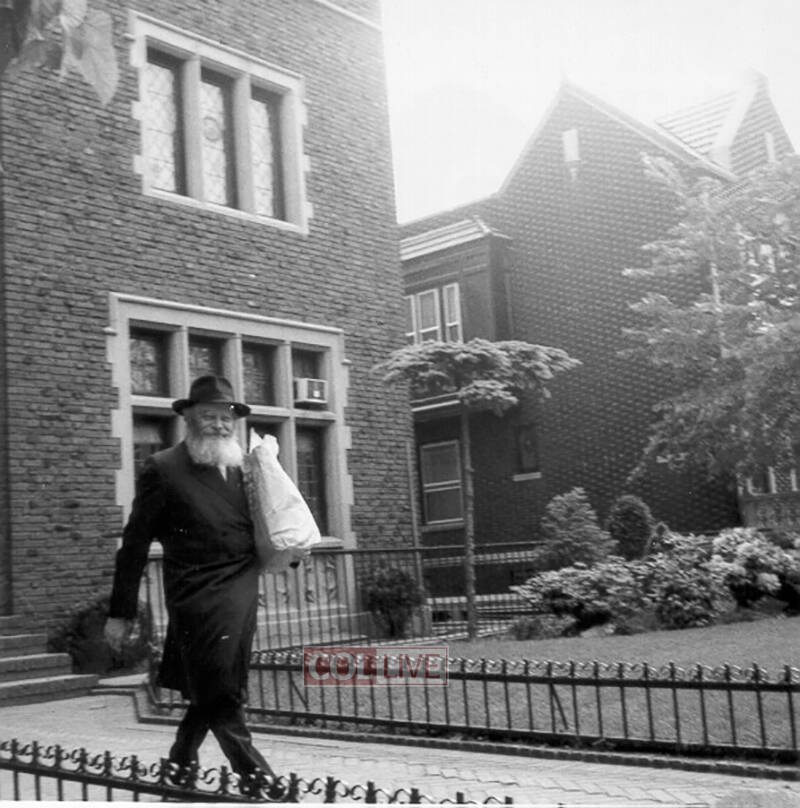
What was it like to be the Rebbe’s follower? The Avner Institute presents an interview with Rabbi Issar Frenkel and memories of his illustrious father Yedidyah Frenkel – former Chief Rabbi of Tel Aviv – whose spiritual enthusiasm and intense scholarly and educational activity reflected his devotion to the Rebbe and the Rebbe’s far-reaching influence.
“I have seen a true Chassid”
You don’t sense anything special when you stand in the doorway of Rabbi Issar Frenkel’s house, a typical building at Number 16, Bavli Street, in North Tel Aviv. There are no outward indications of what happens inside. You have to sit down with him at his work table, listen to him, and let your eyes drift over the pictures and documents filling the wall behind his desk.
Slowly, photographs and rabbinical citations of his eminent father, Rabbi Yitzchak Yedidyah HaLevi Frenkel, coalesce. They bring everything the son is saying – not simply because of his father’s life story; rather his father, former Chief Rabbi of Tel Aviv, was strongly attached to Chabad Chassidus. Both father and son forged their own links with the seasoned Chassidim of Tel Aviv and beyond, and through them, with the Rebbe.
Heart & Soul
My father’s ties to Chabad Chassdis and to the Rebbe were full of life. He grew up in Warsaw, and in his youth had already met followers whose distinctive qualities provided into a glimpse into that unmatched universe of Chabad.
When he arrived in Eretz Yisrael, my father met elder Chabad rabbis who had left their imprint on Tel Aviv. Age differences were no obstacle to the warm friendships that flowered.
One exceptionally close friend was the famed Chassid Pinye Althaus. Reb Pinye was the heart and soul of Tel Aviv’s Chabad Chassidim; he set the pace for the shteibl on Nachlas Binyamin Street. If anyone wanted to hear a niggun, a Chassidic melody, Reb Pinye was the address. A master of song, he was ignorant of no melodic nuance. His ability to tell a story was equally unmatched.
My father was also friendly with the Chabad rabbis who served over 40 years ago in the municipal Rabbinic Office. One of them was the scholarly Shaul ber Zislin. His physical personification of kol atzmosai tomarnah [“My whole being sings Your praises”] is unforgettable to this day. In his advanced age, with great effort and enthusiasm, Reb Shaul Ber would stand, scraping the chametz off household utensils during the last days before Pesach. I loved to contemplate the wondrous sight of his total focus on the item he held.
“Have you ever seen a true Chassid?” I could, without hesitation, answer “Yes.”
Reb Shaul Ber wasn’t at my wedding, but I can still hear the sweet Chabad niggun he sang during the festive meal of my sheva brachos. No less vivid are my memories of R. Schwartzman, head of the kashrus division in the Tel Aviv Rabbinate, and a leading Chabad rabbi there; and the erudite Alexander Yudassin, filled with archetypal Chabad warmth.
We had one-of-a-kind neighbors, too, families whose Russian-Chassidic radiance seeped through the Tel Aviv of yore. One of them, for example, worked all day in a book bindery and studied Torah long hours afterwards. Here was a Jew with a long, flowing beard who didn’t budget a hairsbreadth from the rich tradition he had received, going about his business, utterly unimpressed by the surroundings. And there were many like him, each exerting a profound influence.
Singular Images
Over the years my father’s attachment to Chabad Chassidus deepened, and the time came to visit the Rebbe. While Tel Aviv’s Chief Rabbi during the 1960s, he traveled to the U.S. for a few days on a communal mission, During that trip, he had his first yechidus, private audience.
My hands tremble as I read an old postcard with my father’s handwriting:
To my precious sons!
It is now 2:00 AM, Friday morning. I just had yechidus with the Lubavitcher Rebbe. He spent two hours with me. Such an extraordinary person! He asked me to give you his best wishes, and said that you should publish more; plus, you should know that he reads all of your writings. He spoke with me about the Tel Aviv Rabbinate, and the rabbinical situation in general, and waited very much that I send him my own Chassidic writings.
When my father returned home, he described the conversation in minute detail, and spoke of the powerful impression the Rebbe’s presence had made upon him.
In this way Chabad became an integral part of our family’s life. We traveled every year to the Yud-Tes (19) Kislev farbrengen, held first “in the pardes” (Chabad Yeshiva’s old stone building, rambling and picturesque, in the middle of a citrus orchard outside Lod), and eventually in Kfar Chabad. My father once told me: “I felt that my feet were independently taking me to Kfar Chabad, to join in the festivities in this amazing community.”
I’ll never forget those farbrengens. The dancing swept us off our feet. Rabbis and political leaders from across the spectrum spoke, but these were not the events that drew me the most. Far more impressive to me were the farbrengens of Reb Nachum Goldshmidt or R. Zevin – the singular images that captivate me: the Divine attachment, the fear of Heaven.
My father also loved to join meetings of noted Chabad rabbis who excelled in Torah outreach and community-oriented activities. He listened intently to their words and contemplated their ways.
Again and again he’d repeat to us a key Chabad teaching: “A cool, reserved mind presiding over a tempestuous heart.” These words frequently found their way into his lectures, whether in reference to relationships between husband and wife, rabbi and student, or any other interpersonal dynamic.
My father expounded: “It’s an ongoing struggle in one’s soul, like the waves rising and falling – sometimes capriciously, at other times like a raging storm.”
At times, that famed melody of the Alter Rebbe, the first Lubavticher Rebbe, would grace my father’s Sabbath Eve festive meal. It began with quiet, inner restraint which stirred to a yearning to break free, to rise above; then the climax – stormy and intense. Release and fervent deliverance, once achieved, were followed by rest and calm. A sonorous study in contrasts: cool intellect and passionate feeling.
Beloved
My father’s last visit to the Rebbe was in Iyar, 5744/1984. It was Monday, 3:15 PM – mincha time in the small ground-floor study hall at 770. Everyone was waiting for the Rebbe.
When he entered and saw my father standing on the side, the Rebbe was clearly delighted. Smiling broadly and grasping his hand in both of his, he said, “Thank G-d, we meet again. You’ve had celebrations meanwhile – grandchildren and great-grandchildren have been born; marriages have been made. May G-d grant further joyous occasions.” The Rebbe spoke a short while longer with him on scholar topics; then he went to his customary place for the afternoon prayer.
Afterwards, the Rebbe again turned to my father to continue their exchange. In addition to words of Torah, their conversation now touched on a Chabad project located in a secular part of Tel Aviv.
“Its very centrality can have a profound influence,” my father said.
To this the Rebbe replied, “As the community’s spiritual leader, when you speak accordingly, it becomes a psak din, word of law.”
He continued, “I would like to appoint you as emissary to convey my greetings and good wishes to my congregants and other Jews in Eretz Yisrael. Your name is Yedidyah – G-d’s beloved! – which indicates shalom, peace.
“May you be blessed from G-d’s House,” the Rebbe cried. “There exists no greater honor than to welcome an honored guest in G-d’s House, and the blessing too, is correspondingly greater.”
The Rebbe parted from my father with heartfelt wishes for success. Then he went to his room.
Back at home, my father was welcomed at the airport by a delegation of Lubavitcher Chassidim, on the Rebbe’s request At all times he regarded his regular participation in Chabad events in Israel as the fulfillment of a personal obligation.
Children’s Call
During the last year of his life my father was hospitalized. The decision to perform the emergency operation hit him like lightning on a clear day.
“I’ve agreed to take part in the Siyim HaRambam at Yad Eliyahu,” he complained, referring to the completion of the learning cycle of Rambam’s Mishneh Torah. “I won’t go back on my word.”
Dr. Vizhnitzer, who attended to him with great care, apologetically explained, “But the surgery is critical.”
At the end of pre-op, my father’s words reached the assembly through a live broadcast. Everyone at the siyum prayed for his recovery, and their collective efforts were rewarded: the operation was successful. G-d had decreed life.
Significantly, my father’s last public appearance was at the ceremony marking the completing of a Torah scroll dedicated to Jewish children. His words on that occasion: “Let us all give our blessings and prayers for the Lubavitcher Rebbe, who spares no effort, and has dedicated his entire life, day and night, to strengthening and spreading the teachings of Torah, and bringing Jewish souls back to their Father in Heaven. May G-d bless and strengthen him, and the whole Jewish people, and let us all be privileged to swiftly experience the new light shining upon Zion – with the revelation of our righteous Moshiach.”
When he returned from that event, filled with emotion, exhausted from the heat and his efforts, my father told me: “He Who sits in Heaven is my witness. I have no physical power left. Whatever I’m able to do comes from the strength of my soul, my sense of obligation, but not my body. I was summoned by Jewish children, and I arose in response to their call!”
Connection & Legacy
My own connection to the Rebbe began in 1955, with the publication of my work, Yechidei Segulah, which had been reprinted and translated into a number of different languages over the last forty years.
It contains biographical portraits of nearly fifty famed Torah scholars. I started with the Malbim, since my great-grandfather was his frequent guest and, growing up, I absorbed many stories about him. I concluded with the past generation’s great Jewish leaders, a number of whom I was privileged to know and appreciate. Naturally, one of those outstanding personalities was the Rebbe Rayatz, the Previous Lubavitcher Rebbe, about whom I wrote a sizable chapter.
The individual chapters first appeared in a magazine called She’arim. Later, as material accumulated, I put it all together as Yechidei Segulah. I wanted to reach the general population and, in particular, young readers, to introduce them to their heritage. Remember, youth-oriented reading material was scarce in those days.
The closing chapter was about a Torah scroll that reached the Rebbe through an inheritance. I sent the book to the Rebbe. Not long after, when I opened my mailbox and found the Rebbe’s lengthy response, I was quite surprised. It felt like Yom Tov. I was aware that the Rebbe’s vision was global – but how had he found the time to read my work? And from the wording of his letter, it is clear how closely he had read.
The Rebbe, by the way, always made a point of paying for any book he was presented with. In my case, too, he saw to it that in exchange for my gift to him, two volumes of Chabad Chassidic writings should be mailed to me.
The Rebbe’s Letter
23 Menachem Av 5715/1955
Greetings and Blessings!
I acknowledge with thanks the receipt of your two works: (1) Yechidei Segulah, and (2) Rabbi Meir Yechiel of Ostrovtze. You will no doubt continue this worthy practice of sending works to my library in the future, particularly since your efforts will thus benefit the public.
Concerning the former work, here are a few observations offered out of my fondness for the subject:
Leafing through these texts to the extent that time permitted, I felt that much could have been improved had footnotes been appended either at the close of each chapter or at the end of the book. This would enable the in-depth reader to access additional detail beyond that which appears in the present relatively abbreviated text. And – to add clarity to the reader’s understanding of these unique individuals – lists could be included of the subjects’ works. Since, as I noticed on the dust jacket, a second volume is being readied for publication, my comments need not be construed as lamenting over the past. This is especially so since the coming volume can also include reference material for the first volume.
Though these chronicles of Torah masters should not resemble the chronicles of those who have nothing of substance to say, [it would be advisable to] equip them with attractive appendages: bibliographies, lists of dates, and so on. This is especially appropriate in our orphaned generation. Today, people in certain circles can be drawn towards a ray of light only if their interest is first aroused by the sight of a book’s extraneous features – and from them they will eventually arrive at its core.
On this approach, Rambam’s words are well-known regarding children’s education (and their relevance is self-evident regarding neophytes in Torah knowledge; see his Peirush HaMishnayos on the beginning of ch. 10 of Tractate Sanhedrin. See, too, Yad HaChazakah [Mishneh Torah] at the end of Hilchos Teshuvah.)
Incompatible Parties
An additional small point, but one of great urgency in our times, when darkness is mistaken for light, and vice versa. In your work you have grouped together individuals of different and sometimes opposing stances. The Zohar comments metaphorically (the Rebbe’s handwritten marginal note: Volume I, p. 27b; and see the corresponding Biurei HaZohar) that Moshe Rabbeinu’s final resting place is in the Torah – and it is only close friends who are buried side by side. This feature, too, is not always observed in your book.
Now, it is possible to arrange the biographies into certain groups, if your intention for whatever reason is to address all of them; or, at the least – if they are to be organized linearly – incompatible parties need not be placed side by side. This will avert errors on the part of the naïve reader, who may think that all the people meeting together in the pages of a single book must also be closely-matched neighbors regarding their greatness in scholarship and service of G-d. A word to the wise . . . .
Having seen that the outline for the second volume includes the name of the Rebbe Rashab [fifth Lubavitcher Rebbe], I’ve asked that his biography – compiled several years ago on the basis of notes made by my revered father-in-law, the Rebbe [Rayatz] – be sent to you under separate cover.
With respect, and with my blessings for your success in strengthening the practice of Yiddishkeit – in the authentic spirit of our Father Yaakov, and filled with the light and warmth of Chassidus.
[signature]
N.B. Given the special respect afforded to kisvei hakodesh, Scriptural writings, it seems wholly inappropriate to print Torah verses that are written in classical sofer’s script, even in works of Halachah and Aggadah, and all the more so in historical literature. I therefore found it surprising that you had done so in your work. It is surely understood that this bears no semblance to the practice of printing a portion of Megillas Esther – in which [G-d’s] Name doesn’t appear, and which can serve an educational purpose regarding the writing of a Megillah. None of this applies here, though [where verses containing the Name do appear, and that specific tutorial potential is not present].
To receive this to your inbox email: [email protected]



Fascinating to read the kesher Rabbi Frenkel zl had with Rebbe and Chabad. I never knew that Rav Frenkel is a Levi and I assume that we are family as my Zydas were Frenkels, Leviim from a long history of Rabbonim in Poland,