The past year has been tougher than ever for Ukraine’s Jews: data shows that the number of Jewish soldiers killed in battle was higher than in previous years, more Jewish institutions were struck by missiles, and the number of Jews drafted into the army also rose — bringing with it greater concern for their safety.
At the same time, Ukraine lost American support this past year, Russia made significant advances on the battlefield after fully repelling Ukraine’s “counter-offensive,” and their attacks on city centers became broader and deadlier.
Another blow to Jewish life in Ukraine was the sharp decrease in donations from world Jewry, as resources were redirected toward supporting Israel. This financial decline has had profound effects on community life, forcing the closure of numerous projects intended for both physical and spiritual welfare.
Nevertheless, Jewish communities across Ukraine wrapped up their preparations last weekend to celebrate their fourth consecutive High Holiday season under the shadow of war — a war that shows no end in sight.
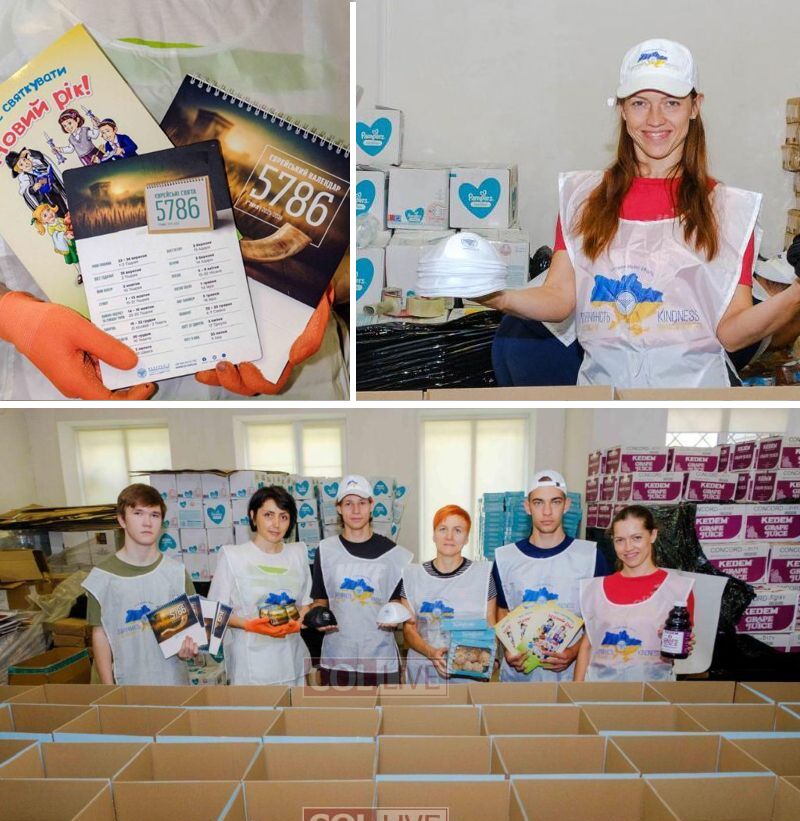
The highlight of the holiday preparations was the distribution of extensive holiday kits, filled with festive necessities, to 51,500 Jews in 169 cities and towns across Ukraine. As with every holiday, this was a massive logistical operation carried out jointly by the Federation of Jewish Communities of Ukraine (FJCU) and Chabad emissaries in the country, with distribution networks spanning from embattled eastern regions such as Donetsk, Luhansk, Kharkiv, Kherson, and Zaporizhzhia — to Khust, Uzhhorod, and Munkács in the far west, near the Polish and Slovak borders.
Each kit contained a wide range of items, including a special booklet on the laws and customs of the four Tishrei holidays, a jar of honey, Shabbat and holiday candles, a bilingual Hebrew–Ukrainian desk calendar, a matching wall calendar, kippot, grape juice, sweets, a cosmetics set, and a glossy brochure detailing the Federation’s work with Ukrainian Jewry, with contact information for those in need of personal assistance.
The centerpiece of this year’s package was a children’s book translated into Ukrainian for the very first time: “It’s Time to Celebrate the New Year”, originally written in English by author Rachel Groner Forrest. Through family-friendly storytelling, the book introduces children to the spirit of the holidays and the timeless traditions of the Jewish people. “This way, we help transmit our heritage to the next generation,” said Federation representatives proudly.
Another area of collaboration with Chabad emissaries focused on establishing as many regular prayer services as possible, ensuring that Jews could attend holiday minyanim both in large cities and in smaller towns lacking an active rabbi or synagogue.
Rabbi Mayer Stambler, head of the Jewish communities of Ukraine, remarked: “The words of our prayer ‘Avinu Malkeinu — put an end to plague, sword, famine, captivity, and destruction,’ carry chillingly real meaning this year as well. After a particularly harsh year, tens of thousands of Jewish families in Ukraine will celebrate the new year — and alongside the joy of the holidays, they will plead with G-d to end our suffering and hasten the true and complete Redemption.”
He added: “The very fact that the darkness is intensifying shows us that Redemption is near. When the night grows darkest, it is a sign that dawn is soon to break.”