
Ari L. Goldman – The Jewish Week
Twenty years ago next week, on the night of Aug. 19, 1991 — the night that Gavin Cato and Yankel Rosenbaum were killed — my editor called me at home to tell me that riots had broken out on the streets of Crown Heights. “We’re covered for tonight but I want you to start your day there tomorrow,” he said.
Over the next three days, working 12 hours shifts and only going home to sleep, I saw and heard many terrible things. I saw police cars set on fire, stores being looted and people bloodied by Billy clubs, rocks and bottles. One woman told me that she barricaded herself into her apartment and put the mattresses on the windows so her children would not be hurt by flying glass.
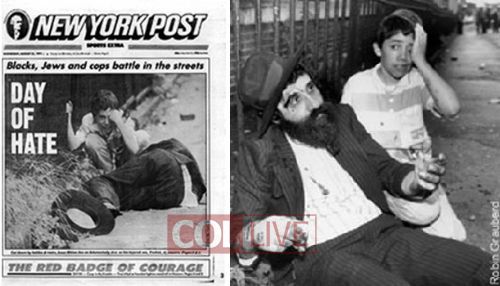
Over those three days I also saw journalism go terribly wrong. The city’s newspapers, so dedicated to telling both sides of the story in the name of objectivity and balance, often missed what was really going on. Journalists initially framed the story as a “racial” conflict and failed to see the anti-Semitism inherent in the riots. As the 20th anniversary of the riots approaches, I find myself re-examining my own role in the coverage and trying to extract some lessons for myself and my profession.
At the time, I was a religion writer at The New York Times and was well connected in the Lubavitch community, the predominant Jewish group in Crown Heights. I was one of probably a dozen Times reporters and photographers on the streets over the course of the riots. We were a diverse group, representing many religions and racial backgrounds.
My job was to file memos to the main “rewrite” reporters back in the Times office in Manhattan about what I saw and heard. We had no laptops or cellphones in those days so the other reporters and I went to payphones and dictated our memos to a waiting band of stenographers in the home office. The photographers handed their film off to couriers on motorcycles who took the film to the Times.
Yet, when I picked up the paper, the article I read was not the story I had reported. I saw headlines that described the riots in terms solely of race. “Two Deaths Ignite Racial Clash in Tense Brooklyn Neighborhood,” the Times headline said. And, worse, I read an opening paragraph, what journalists call a “lead,” that was simply untrue:
“Hasidim and blacks clashed in the Crown Heights section of Brooklyn through the day and into the night yesterday.”
In all my reporting during the riots I never saw — or heard of — any violence by Jews against blacks. But the Times was dedicated to this version of events: blacks and Jews clashing amid racial tensions. To show Jewish culpability in the riots, the paper even ran a picture — laughable even at the time — of a chasidic man brandishing an open umbrella before a police officer in riot gear. The caption read: “A police officer scuffling with a Hasidic man yesterday on President Street.”
I was outraged but I held my tongue. I was a loyal Times employee and deferred to my editors. I figured that other reporters on the streets were witnessing parts of the story I was not seeing.
But then I reached my breaking point. On Aug. 21, as I stood in a group of chasidic men in front of the Lubavitch headquarters, a group of demonstrators were coming down Eastern Parkway. “Heil Hitler,” they chanted. “Death to the Jews.”
Police in riot gear stood nearby but did nothing.
Suddenly rocks and bottles started to fly toward us and a chasidic man just a few feet away from me was hit in the throat and fell to the ground. Some ran to help the injured man but most of us ran for cover. I ran for a payphone and, my hands shaking with rage, dialed my editor. I spoke in a way that I never had before or since when talking to a boss.
“You don’t know what’s happening here!” I yelled. “I am on the streets getting attacked. Someone next to me just got hit. I am writing memos and what comes out in the paper? ‘Hasidim and blacks clashed’? That’s not what is happening here. Jews are being attacked! You’ve got this story all wrong. All wrong.”
I didn’t blame the “rewrite” reporter. I blamed the editors. It was clear that they had settled on a “frame” for the story. The way they saw it, there were two narratives here: the white narrative and the black narrative. And both had equal weight.
After my outburst things got a little better. The next day’s report began like this: “Black youths hurling rocks and bottles scuffled with the police in the Crown Heights section of Brooklyn last night, even as Mayor David N. Dinkins tried to personally calm the racially troubled neighborhood after two nights of violence.”
But the Times still had trouble changing its frame. Perhaps most troubling was an article written in the midst of the rioting under this headline: “Amid Distrust in Brooklyn: Boy and Scholar Fall Victim.” The article compared the life of Gavin Cato, the 7-year-old boy killed in the car accident that spurred the riots, and the life of Yankel Rosenbaum, 29, who was stabbed to death later that night. It recycled every newspaper cliché and was an insult to the memory of both victims, but, again, it fit the frame.
“They did not know each other,” the article said. “They had no reason to know… They died unaware….” In the eyes of the Times, the deaths were morally equivalent and had equal weight.
The Times editorial page followed suit. “The violence following an auto accident in Crown Heights reminds all New Yorkers that the city’s race relations remains dangerously strained,” the editorial said. It concluded by praising Mayor Dinkins, giving him credit “for a hard night’s work” and doing “the job that New Yorkers elected him to do.”
The one who first broke the frame and spoke the truth was the fearless poet of the New York newspaper business in those days, Jimmy Breslin, then a columnist for Newsday. He was one of numerous reporters, photographers and television journalists who were beaten or otherwise injured during the riots. In Breslin’s case, he was dragged from a taxi by a group of rampaging young men, pummeled and stripped of his clothes. That night, he vowed to tell the truth of his humiliation, although he anticipated the resistance. “And someone up in the higher echelons of journalism, some moron starts talking about balanced coverage,” he said.
The other person who spoke the truth was the brilliant former executive editor of the Times, A.M. Rosenthal, who by 1991 had become a columnist for the paper. Rosenthal was one of the first journalists at the Times to call the riots what they were. “Pogrom in Brooklyn,” was the headline of his column on Sept. 3, 1991, just two weeks after the riots ended.
“The press,” Rosenthal wrote, “treats it all as some kind of cultural clash between a poverty-ridden people fed up with life and a powerful, prosperous and unfortunately peculiar bunch of stuck-up neighbors — very sad of course, but certainly understandable. No — it is an anti-Semitic pogrom and the words should not be left unsaid.”


The media SKEWS its articles? who’da thunk it???!!! We see what a brilliant job they do this day and age doing so. Kudos to Mr. Goldman and his brilliantly written article.
Im glad even if its been 20 years people are still trying to tell the world the truth!
where, how is bitton today
I wish teachers would explain to the students that the media is rotten and skews information. They should go into that in depth and explain it….to all the school kids from all backgrounds.
Hard to believe; time really flies; hopefully, we will never go through that again!
It only took 20 years for someone from the NY Times to finally use the verbage- “riots”. In all the stories that the NYT ran during that nefarious period, they always described the situation as ” disturbances”. In the lawsuit by the CHJCC against New York City, I was deposed by the city as I had been one of attestants in the supporting affadivits. The first question asked by the Corp Counsel of NYC (after the standard preliminary questions ) was- ” When did I first become aware of the disturbances on the evening of August 19 ?” My reply… Read more »
Welcome to ‘Neanderthal New York.’ Oops, sorry, it’s The Big Apple. (By the way, a very informed friend told me that Mayor Giuliani, though he did a great job…gave ‘peanuts’ to our community after the riots/pogrom.’). See, ‘Pirke Avos’ tells us we can’t trust the government…their egos are too big. And the liars at the ”editors helm,’ they’re too busy telling their children to be polite, be honest…etc. Ha! ha! And what about other newspapers and their staff, and owners? They cannot understand when their children go ‘astray in America?’ “What’s happened to children today?” They ask. “We copy the… Read more »
BS:D
The Times version today to the same set of facts would make their version of 20 years ago mild-the NY Times has only regressed in its anti Jewishness.No self respecting Jew should ever read that paper
finally the truth will be told…even though its 20 years later it still needs to be said.