
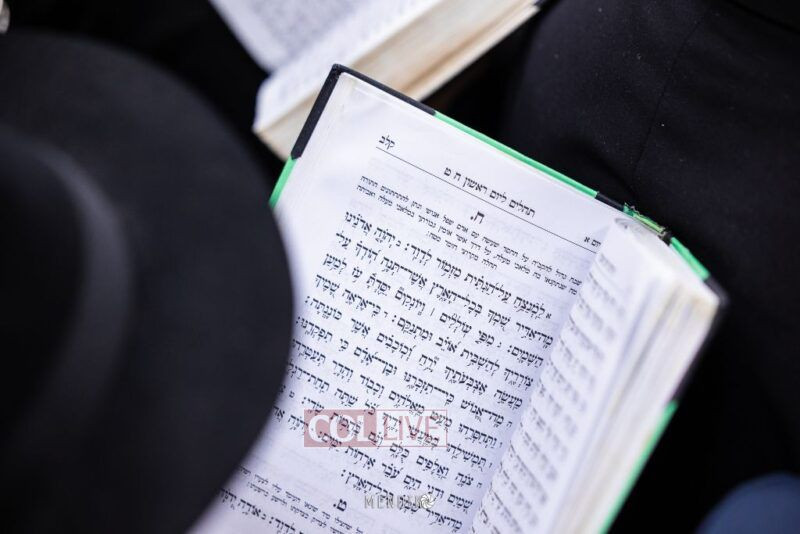
This Shabbos, the 20th of Adar is a very powerful day to Daven for whatever you need, as we learn from Choni HaMagel’s prayer for rain.
The narrative of Choni HaMagel’s prayer for rain holds timeless lessons for Jews in their service to Hashem. Taking place in Adar Sheni, the story highlights the importance of persistence in prayer, regardless of one’s spiritual stature.
Choni’s prayer journey, marked by initial drops of rain, followed by excessive rainfall, and finally, the desired normal rain, underscores the significance of praying for blessings tailored to one’s capacity. Each Jew, likened to a child beseeching their father, is urged to pray earnestly, adjusting requests as needed. The tale emphasizes the need for humility and a realistic assessment of one’s capabilities when approaching prayer, both for personal needs and communal aspirations like redemption.
*******
From the Rebbe’s talk 40 years ago 20 ADAR 2 5744
We said previously that there is a lesson to be derived from today’s date, the twentieth of Adar. Megillas Ta’anis (and tractate Ta’anis 23a) states: “On the twentieth [of Adar], the people fasted for rain … When they saw that the greater part of the month of Adar had passed and the rains had not come, they went to Choni HaMagel (the Circle Drawer), and told him to ‘Pray that rain may fall.’ He told them, ‘Go and bring in [to shelter] the Pesach ovens so that they should not rot [for these ovens were in the courtyard, and were made of clay]. He drew a circle, stood inside it … and said: ‘Master of the universe … I shall not move from here until You will have mercy upon Your children.’ Rain then began to fall in drops. His disciples said to him … ‘We believe that these rains are falling merely to release you from your oath’… Thereupon He said, ‘Master of the Universe, it is not for this I have asked, but for rains [to fill] cisterns, ditches and caves.’ Rain then began to fall, every drop as big as the opening of a barrel. His disciples said to him, ‘We believe these rains are falling only to destroy the whole world.’ He said, ‘Master of the Universe, it is not for this I have asked, but for rains of benevolence, blessing and bounty.’ Rain then fell normally. They instituted that day (the twentieth of Adar) as a festival, for the rains fall only in the merit of Israel.”
he first thing to be noted from this episode is that it took place in Adar Sheni, the Adar closest to Nissan. Choni HaMagel told the people to “Go and bring in [to shelter] the Pesach ovens so that they should not rot,” indicating that otherwise, there wouldn’t be enough time to build new Pesach ovens. If this episode had taken place in Adar Rishon, there would have been an extra thirty days in which to build them. And, of course, there is nothing forcing us to say that this episode took place in a leap year — which would certainly make it the month of Adar close to Nissan.
As all matters of Torah, this episode should serve as an eternal lesson in service to G‑d. However, Choni HaMagel lived in the times of the Bais Hamikdosh, and was one of the greatest sages, to the extent that Shimon ben Shetach said to him, ‘Were it not that you are Choni I would have placed you under the ban … But what shall I do to you who acts petulantly before G‑d as a son who acts petulantly before his father and still he grants his desires.” If, then, Choni was of so lofty a stature even among the other sages, what lesson can people like us learn from his conduct?
There is a perplexing matter in this episode itself. Why did Choni’s prayer for rain not bring “rains of blessing” straight away? Why did rains first fall only in drops, and then in too much force, and it was only after his disciples pointed out that these were not beneficial to the world that Choni was forced to say that “It was not for this I asked” — and only after all this did rain come down normally? Surely Choni himself knew that the people’s request for rain was for normal rains, rain that would benefit them, and not for drops or for destructive torments. Why then didn’t he pray in the first place for “rains of benevolence, blessing and bounty”?
This question applies not just to Choni’s prayers, but also to the way G‑d answered it. G‑d certainly knows what type of rain is beneficial. Why then did Choni have to pray again and again for the proper rain?
This episode, however, has profound lessons for Jews. Every Jew is obligated to fulfill the mitzvah of praying to G‑d, which is “that a person should beseech and pray every day … asking for his needs” (Rambam, Hilchos Tefillah 1:2). In other words, when a Jew needs something, he is obligated to pray to G‑d to fulfill his need. It is an obligation on all Jews, men, women and children (because of educational reasons). The story of Choni HaMagel teaches how a person should pray. Since each Jew is a child of G‑d, as written: “You are sons to the L‑rd your G‑d” — and this applies regardless of his personal spiritual standing, as our sages have said, “Whatever the circumstances, they are My children” — a Jew’s prayer to G‑d should be “as a son who acts petulantly before his father.”
What does this mean? A Jew turns to G‑d and firmly requests his needs. Once, twice, and if he sees his request has not been fully answered, he says, “It was not for this I asked.” And if he sees the blessing is too much that he cannot, as yet, handle so much largesse, he should not be ashamed but should ask that the blessing be given to him in a manner commensurate to his situation.
Of course, only Choni HaMagel could draw a circle and say “I shall not move from here until You will have mercy upon Your children.” Only he could be sure that his prayer would be immediately answered. But what we can learn from Choni HaMagel is that just as he asked rain to fall, as a son asks for things from his father, so every Jew requests his needs from G‑d as sons of their father. How can we compare ourselves even in this respect to Choni? Our sages say that “A person is obligated to say ‘When will my deeds reach the deeds of my fathers, Avraham, Yitzchok and Ya’akov.” And because Choni HaMagel has blazed the path for us, it is now easy for each Jew to do likewise.
Now we can understand why the rain did not come down “normally” in the first place. The world can be viewed in two different perspectives: From the world itself, seeing only its external appearance; or from above, seeing its true, inner nature. When Choni viewed the world from his lofty level, he saw it in its inner perspective, on a level much higher than it is externally. Thus, to him, even when the rain came down in drops or in torrents, it could still be proper and “normal.”
Likewise, although G‑d certainly knows what kind of rain is needed, nevertheless, when viewed from above, the world appears to be a level fitting for a lofty type of blessing.
It was therefore necessary for Choni’s disciples to tell him to pray for rain which the world needs: not too much. Although from Choni’s perspective the world was lofty enough to absorb such blessings, nevertheless, externally, as the world actually is, it is not yet on that level. It needs “normal” rain.
After we are told of this story, we know that when we pray for our needs, we should in the first place pray that the blessing be in a form suitable for us. This is why we pray, “Your treasure-house which is good for us, open”: Although G‑d knows what is “good for us,” we are saying that since the true good is too lofty for us to absorb, we ask G‑d not to wait until we are ready to receive this true good, but to immediately grant that which is “good for us” — according to our capabilities.
If the above holds true of a Jew’s prayers for his personal needs, it certainly applies to the prayers of all Jews for the redemption: “Speedily cause the scion of Dovid Your servant to flourish … for we hope for your salvation every day.” This prayer should certainly be uttered “as a son who acts petulantly before his father” — and G‑d certainly should fulfill it — immediately.



Thank you for this article
It gave me encouragement to keep on praying for something I need.