
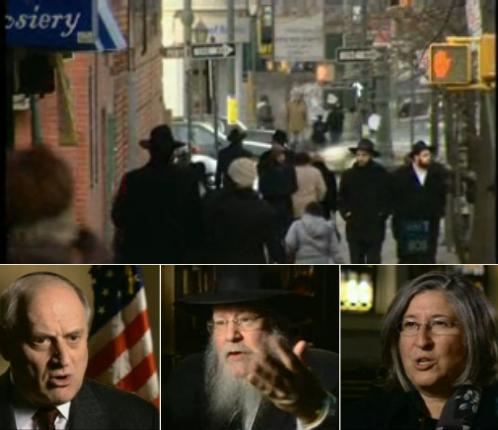
One of the world’s most vibrant and diverse Jewish communities lives in New York. Michael Maher meets prominent members of the community with very different attitudes to Israel, and the recent actions in Gaza.
Their views matter, because they influence American policy, and Israel relies on US support in its conflict with Hamas. Hamas is allied to Iran, and Israel is Washington’s most important ally in the region.
Many members of New York’s Jewish community see the war against Hamas as part of a bigger war against Islamic fundamentalists, citing the recent attacks in Mumbai as an example. Others say that Israel must negotiate with Hamas, even though they are deemed to be a terrorist organisation.
Everyone is waiting to see whether the election of a new US President will mean a change in US policy in the Middle East.
Transcript
MALCOLM HOENLEIN: Hamas does not care about its civilian population and, even more, wants to put them in harm’s way. Then you get collateral damage.
RABBI ELLEN LIPPMANN: I felt that Israel’s response, even after all that frustration, was too large, too focused on the military.
RABBI SHMUEL BUTMAN: What would you do if they would bomb your town? What would you do? The answer is you have to do whatever it takes. They should stop the bombing!
MAHER: Outside of Israel, by far and away the world’s most influential community lives here in New York. It’s also a remarkably diverse community and Israel’s attacks against Gaza have drawn a range of reactions from it.
As the new Obama administration moves to develop its own policy on the Middle East, America’s Jewish leaders from across the political spectrum, are stepping up their efforts to ensure their voices are heard.
Dawn prayers in Crown Heights, Brooklyn. For this Orthodox Hassidic community, the violence borne of the conflict in the Middle East is keenly felt. Two members of their congregation, Rabbi Gavriel Holtzberg and his wife Rivkah, were killed in the recent terrorist attack in Mumbai.
There’s a strong police presence in the neighbourhood because threats have been made here as well.
RABBI SHMUEL BUTMAN: Security threats, bombing threats, there are always threats and we live with that.
MAHER: Rabbi Shmuel Butman is a leading member of the Lubavitch community, an Hassidic group with close links to the settler movement in Israel.
The Rabbi’s weekly on-line sermons usually focus on spiritual matters, but off air and on the subject of Gaza, he’s uncompromising. The Rabbi says the Israeli Army didn’t say in long enough.
RABBI SHMUEL BUTMAN: Absolutely. We went in, we saw success. Many soldiers say they saw divine intervention, they saw miracles happening and we were successful and we were getting there and then all of a sudden, halt, stop, go home, leave it alone.
MAHER: Not far away in the Park Slope district of Brooklyn is a congregation of a very different kind. Led by Rabbi Ellen Lippmann, here the view on Gaza is not nearly as black and white.
How much tension does this cause in the Jewish community here?
RABBI ELLEN LIPPMANN: A lot, a lot. Jews are a very vocal people. We have been known for a long time as the people with the book and continue to be people of words, it’s painful and difficult but I also think that there’s something healthy about the arguing.
MAHER: The Rabbi herself is active in the peace movement.
RABBI ELLEN LIPPMANN: I believe that even though Hamas is so often, as has been described a terrorist organisation, that they are still the elected governmental representatives of the people in Gaza and that a conversation should happen with them.
MAHER: Talking to Hamas is something that horrifies some members of the Jewish community.
RABBI ELLEN LIPPMANN: Yes absolutely. Yeah of course it does, of course it does and I, I think I understand that horror but I think as former Mayor of Jerusalem Teddy Kollek once said, ‘You don’t make peace with your friends. You make peace with your enemies’.
MAHER: In between the reform movement of Rabbi Lippmann and the Orthodoxy of Rabbi Butman stands the mainstream of America’s six million Jews.
J.J. GOLDBERG: There’s the highly visible group that’s most active in defending Israel and it represents the minority of the Jewish community. The broad majority is sympathetic but not that involved.
MAHER: J.J. Goldberg is a leading authority on Jewish affairs and the author of a book on Jewish power in America. His view that on the issue of Gaza at least, the majority of American Jews supported Israel.
J.J. GOLDBERG: There was a tremendous amount of support for Israel and a sense that Hamas planted itself in populated areas. It put its weapons caches in the basements of hospitals and apartment buildings and schools and then dared Israel to come in and attack, knowing very well that Israel would end up looking brutal on television.
MAHER: In the wake of the Gaza attacks, pro-Israel and Arab demonstrators took to the streets of New York. The city’s political leadership made it clear where it stood, turning up to support constituents it can ill afford to alienate.
GOVERNOR DAVID PATERSON: [New York Governor addressing demonstrators] We recognise the right of the state of Israel to protect itself!
MAHER: And another strong ally, New York’s former Senator Hilary Clinton, will now be playing a central role in the Middle East as the new Secretary of State.
MALCOLM HOENLEIN: I certainly know Secretary Clinton well and I know Vice-President Biden well. We’ve worked with them over the years.
MAHER: Malcolm Hoenlein jokes that he can get the President on the phone so long as he doesn’t call collect. He runs the Conference of Presidents of major American Jewish Organisations, a large umbrella group which wields considerable influence in Washington. Its critics charge that influence has skewed America’s policy in the Middle East towards Israel.
MALCOLM HOENLEIN: That’s an excuse. It’s a way to dismiss and say, well we have failed because they have a special relationship, because of their pernicious lobby, because of this, because of that, when it’s not. That’s an excuse and you create enough lies in order to cover your own failures. It’s the failure of the Arab governments to meet the needs of their people.
MAHER: You’d certainly agree wouldn’t you that you have a very prominent seat at the table in Washington. You, yourself I’m sure have met with the US President.
MALCOLM HOENLEIN: Yes because we earned it. We earned it. We earned it by the credibility of what we say, the legitimacy of the case we make, the authenticity, the facts we present.
US PRESIDENT OBAMA: [Boca Raton, Florida, May 22, 2008] There’s a lot of rumour mongering going around, people have been getting emails non stop. I have said throughout this campaign that we should not negotiate with Hamas or Hezbollah.
MAHER: During the Presidential election campaign, doubts were expressed in some Jewish quarters about Barak Obama’s pro-Israel credentials. But despite these concerns, nearly eighty per cent of America’s Jews voted for him.
Now that Obama is in the White House, from the rabbinical schools in Brooklyn and beyond, Jewish communities are watching the new President, waiting to see which way he moves on the intractable problems of the Middle East.
J.J. GOLDBERG: I think Barack Obama has a very clear sense of where he thinks things need to go in the Middle East and it’s not where the strongest, pro-Israel lobby group would like it to go. He’s going to go I think like a laser towards that middle settlement because of a sense that there just isn’t time to dilly-dally anymore. Things are getting, sliding towards doomsday.
Tags: TV, ABC, Butman, Hoenlein, Crown Heights, U.S. Jews,

what was the point of this video???????????????????????????????????
taking all jews and looking at them as political players in the new world elections even yeshiva students
i blast butman for being intellectual based on emotions instead of being emotional based on intellectualism
we need an array of cool thinkers
ive done it u can be emotional as much as youd like as long as ure brain is saying thats the correct act and style to do at that juncture
may we all be moach shalit al halev
easier said then done
aussie aussie aussie!!!!
well said… the media needs to hear the truth from time to time…
I cannot pin point but this article smells of anti Semitism
From the way they portray the American Jews it looks as if we control the country and it’s policy – as if Mr. Hoenlein can visit the White House whenever he wishes
The reporter is either ignorance or biased
What is this silly slogan she repeats “You don’t make peace with your friends, you make peace with your enemies.” WRONG! It should be “You don’t go to war with your friends, you go to war with your enemies.” Then, after the enemies have been thoroughly defeated, they decide they don’t want to be your enemies any more.