
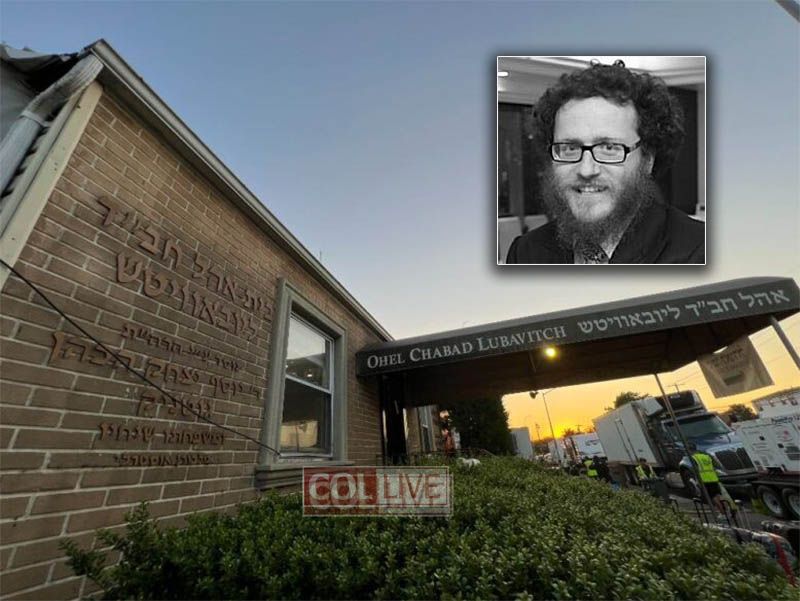
By Rabbi Shmully Hecht – Shabtai at Yale ([email protected])
“Hi, I am Shmully Hecht, and you seem familiar but kindly forgive me for not recalling your name. It has been quite a while.”
“Boruch,” he replied in an undertone.
“Yes, of course, Baruch Thaler!” a name from the past I thought.
His peculiar head covering protruded among the thousands of Borsalinos, shtreimels and felt and knitted kippahs donned by the masses. It was an eccentric hybrid of sorts. Shaped like a sombrero, though undoubtedly not straw. The four-inch brim was down sharply in front and rear, yet it was not quite a cowboy hat. Made of dark midnight black, albeit not a fedora. Short the pinch, it most resembled the hat worn by Harrison Ford in Indiana Jones. In addition to his Rabbinical degree in Lubavitch, Boruch has an MFA from Columbia University and is a fairly handsome chap but Bmchilos kvod zurasoi, with all due respect to his shining countenance, he ain’t Harrison Ford. Not even Charison Ford. The hat on Boruch’s head was a sanguine obtrusion on this rather ominous day.
And speaking of hats and Lubavitch, the Rebbe was the first of the Nesiyim to don a fedora. I am not sure what emotion that evoked among the Chasidim of the era and wouldn’t dare to wonder or inquire, but it was undoubtedly a daring transition in the history of Lubavitch. In fact, early photos of the Rebbe have our Nasi in a grey hat. Yes, the Rebbe in a grey hat. As a Zadik and the Nasi Hador the Rebbe was always impeccably dressed and elegant in appearance. People often commented on how handsome the Rebbe was. Like the Cohen Gadol on Yom Kippur in the shmoneh levushim, the Rebbe’s outward appearance always manifested his absolute regality. The Rebbe was a man of his times. In the eternal link of Jewish leaders from the Patriarch Avraham to the current era, he possessed keen insight to the habits and yearnings of the generation he was to lead, and personally adopted some of the formalities of his time. Even the public ones. Moshe Rabeinu didn’t wear a shtreimel or a borsalino for that matter. Despite what they tell you at Bencraft Hatters.
Formal and religious dress and the traditions attached to them exhibit religious experience, as evidenced in the lengthy laws of the Priestly garb worn in the Holy Temple and lengthy traditional Rabbinic laws of modesty. Cross Dressing is a biblical prohibition. The Torah refers to it as an abomination. I recently asked my nine-year-old daughter Miriam why she is wearing leggings when it’s 90 degrees outside. She replied in absolute innocence, “I don’t want anyone to see my legs.” My nine-year-old daughter! G-d bless her! The chinuch at Southern Connecticut Hebrew Academy is supreme, not to mention the household she is being brought up in, under the tutelage of my righteous wife Toby Hecht.
Uniforms are an integral part of a Nations’ identity and comparable to the National anthem or pledge of allegiance. In A Long Walk to Freedom, Nelson Mandela cites that in South Africa during Apartheid, white prisoners were granted long pants, whilst blacks (referred to condescendingly by the racist Afrikaners as Kafirs) were given shorts, implying that only whites were men. Blacks remained boys. Mandela fought vociferously against this law and was successful in changing it on Robben Island, where he was imprisoned for eighteen years for fighting discrimination. Praise the demise of Apartheid. The Scottish Kilt originated in the 16th century to allow male Scottish soldiers maneuverability in the Scottish Highlands. The thick wool protected the men from the cold. The kilt (yes, yes, the one that looks like a skirt) has become a national symbol of Scotland as evidenced publicly at parades and ceremonies. Traditional Scots never cease to show up in their pleats, proudly blowing their bagpipes and flutes in the accompaniment of the accordion players. They are often the highlight of public assemblage for their exotic appearance and performance. Those puffy, cherry-red cheeks have crowds visualizing a lung gagging out of their mouths. Astronauts in the space station and on the moon are protected from atmospheric conditions, severe weather and pressure, and flying micrometeorites due to the hundreds, yes hundreds of millions of dollars invested by NASA into the development of the Extra and Inter Vehicular Space suits. One pinhole in that suit, and the mission fails. As the final act of preparing for Moshiach the Friedeker Rebbe incessantly prompted us to proverbially “polish our buttons.” Communities and cultures from the beginning of time are identified and reinforced by maintaining continuity through unique music, dance, food, language and even uniform and dress.
That said, in a general sense and particularly on Gimmel Tammuz Chabad Chasidim obsess more over livushei hanefesh than preoccupation with livushei Hagoof. Expressions of the soul, not fashions on the body. Thought, speech and action override our attire. Chabad seeks pnimius. Internalization. We don’t ask Jews to change their clothes before embracing them in our homes and centers. When Yalies ask me for the dress code to events, I often reply with suit and tie, but more importantly to bring their souls. Our spirits were on full display on this auspicious day of 3 Tamuz 5782. Each of us was transmitting our inner voice of the quintessential soul burning brightly within us. Frankly put, at this particular Gimmel Tamuz commemoration the oversized, overhead tent adjacent to the Ohel was the one and only communal head covering.
But I was having flashbacks. I had only seen Boruch’s peculiar hat on a six-day rafting trip down the Colorado River through the entire 220 miles of the Grand Canyon. I navigated the great river with a minyan composed of Rabbis Dov Greenberg, Levi Drimmer, Alter Levitin, our sons, and a childhood friend of our family for six days in Chodesh Elul of a most recent epoch. Covid-Chodesh-Elul was higher than high. Yeridah Zoirach Aliyah. The Chasidic concept that every descent precedes and stimulates a great ascent has even topographical connotations. River guides, infamously referred to as River Rats are the only folk known to me that wear the newly labeled, by yours truly, Thaler Hat. Only River rats. Was Baruch moonlighting as a River guide? From Reb Yoel Kahn‘s shiurim to the Amazon? From Oholei Torah to the Congo? From Crown Heights to the Rio Grande? I once met a Yale Law Student from Alabama who spent his summers, not clerking for the Supreme Court, not working at Davis Polk and not speechwriting for his Senator. He was a river guide. I spent more Shabos afternoons farbrenging with him than with his peers in the cubicles that now run our Country. Frankly, he was a lot more interesting and interested. No wonder the world is upside down.
I took another look at Boruch. Perhaps life is a river journey, I thought. Some days the water is calm and tranquil but then abruptly interrupted by unexpected rapids. Often the tide is up. On others, it’s down. Let’s not forget the moon’s role and, of course, global warming. Additionally, there is our hishtatfus, man’s participation. Opening an upstream dam can rapidly increase the CFS, Cubic Feet of water per Second, that flows downriver thereby increasing the pace of the river, hence shortening a river trip by days. Are there really shortcuts? Don’t we adhere to the derech arucha uktzara, the long yet shorter path taught to us by the Alter Rebbe? What type of boat are you on? Are you seated on the bow or the stern? Feet tightly in the foot cups? Who is on the vessel with you? Follow the guide. Make sure you choose the right one. Asai licha Rav, appoint for yourself a mentor. Not my words. The Great Rebbe’s. Keep rowing. When the pessimist tells you to steer left, you most often should be going right. It’s Talmudic. Look out for the rocks, not to mention the shallow water and eddies. All rivers lead to the sea… Vichulu.
I took another look at Boruch. I blinked. I froze.
Boruch was not with us on the Colorado. In fact, we barely saw anyone through the 220-mile trip. Reb Sholom Jacobson OBM wouldn’t even let us print a Tanya because Jews don’t reside on the River. The Rebbe’s directive was to print Tanyas, and I paraphrase, bimakom shegarim bah Yehudim. In places where Jews live. No one lives in the Grand Canyon. Even the frogs beg for lunch. Animal sightings are rare. An occasional snake spotting was cause for celebration. An overflying bald eagle had us all in awe. A distant view of a bighorn sheep deeply camouflaged into the mountainside was an opportunity to indicate to the boys the source of the shofar. Seeing any wildlife was such an exception that we felt almost obligated to make special blessings at the rare engagements. In the belly of the earth, there is little life. Better said, the essence of life. Pure Rapture. You and your G-d.
Boruch, I was tripping at this point. Not acid. It’s Chosid. Your hat set me back to another place and time. But we were at the Ohel, and I needed to catch my bearings. We were in a sea of Chasidim, jammed like sardines, from all over the world. One often vanishes in crowds. We even lose a sense of ourselves. Our identity dissipates as we mold with the masses. One big Chasidic group assumes a new identity. A new mezius. Like a minyan, when all the rules change. The quantity changes the quality. Dmitri Mendeleev designed the Periodic Table of Elements by their atomic weight. One proton, two protons etc. The sub particle of the atom’s weight literally creates a new phenomenon. And an atom is less than a billionth of a meter in size. Go figure. Ten men, and Kaddish can be recited. The Torah can be read. Dismiss one of the ten and you lose it. Nine is like one. No go. You were shining Boruch and It was amazing to see you. I took another look at you and my mind was vibrating. A flash in time. I saw your face by the Rebbe in 770. It was the 1980s. Your beard is flowing as you listen intently to the Rebbe, moving your fingers through your beard as the Rebbe stares into the ether and the words of the shechina speak through his voice. Your body moves attentively back and forth in the rhythm of the farbrengen. Many have their hands behind their ear moving it forward to catch every word. Time stops. The Rebbe speaks. We bochurim standing side by side with the yungerleit, businessmen, melamdim, Shluchim a few non Lubavitchers dispersed in the crowd. The women huddle together and lean up against the stained glass window to join the experience from the balcony above. Every so often a siddur drops from the ledge and hits a chosid on their head. No response. The Rebbe is talking. A few children sit on their fathers’ shoulders for hours. Others crowd around the Rebbe. Some are even under the Rebbes table peeking out at the Zadik. I’ve been there with Benzion Korf. Reb Pinye’s a zun. Du Gideinskt Pinya, Boruch?! Unforgettable. Beis Rabinu Shebabavel. A glimpse of the Third Temple right there on Eastern Parkway.
Now the Rebbe delivers a Maamor Boruch. Do you recall the voice of the Zadik? Surely you do. It’s written all over your face. It flickers in your eyes. It reverberates in your voice when you teach Chasidus. And you dream of the Rebbe’s voice. The Rebbe pronounces Moshiach to you. Just to you. As if you were the only one there. 770 is empty in your dream. It’s you and the Holy Rebbe. He directs his thoughts exclusively to Boruch. The Rebbe speaks to each and every one of us as if there is no one else there. And you wake up in a cold sweat and sit up abruptly in your bed. Now you are trembling. “I dreamed of the Rebbe I dreamed of the Rebbe, “you shout. But who can I tell?
It reminds me of the joke of the Rabbi of the Reform Temple who plays golf on Yom Kipur morning before services and hits a hole in one. An ace. Mentions it to the President on his way into services as he grabs his white synthetic nylon kipah from the shelf. “Wonderful,” says the President “but who could you tell?”
The Rebbe is saying Lchaim to each of us. He smiles at a child as his face locks in with the young boys. The encounter is sealed and then suddenly the Rebbe moves on to the next child. This child is ninety years old. Same smile. A larger expectation from the Rebbe in that gaze. The Rebbe didn’t let us have it easy and we know it. It was our zchus. The Rebbe’s lips move ever so softly as he nods his head in the direction of one chosid on the bleachers. A hippy in overalls. Everyone stares at the bleachers. Who is the man? Will we ever know. Maybe hes on Shlichus today. Or a melamed. Or a mashpia. Or still wearing his overalls and making the minyan in his little town. Or not making the minyan just yet. We can’t look the Rebbe in the eye. We attempt to blink but we are frozen. The nigun starts. Remember Zama Licha Nafshi Boruch? Of course you do, who could forget?
For 28 years we have closed our eyes when singing the nigun as we transmigrate to 770 to be there with the Rebbe. Even if only for a moment. And then another sicha and another nigun. Time stands still. We have been at the farbrengen now for hours, but no one bothers to check the time. No it’s not the MGM Casino. We are in Azilus. There is no other description for it. Now it’s the Hakafos nigun and the chasidim move up and down like a title wave. A storm at Sea. A mystical cacophony. The nigun is thundering. All of us clapping and singing at the top of our lungs as the Rebbe claps excitedly and puts his hands to his mouth to initiate a mass whistle. The 2Oth century chasidim in 770 are whistling. What would the Besht say? We are literally blowing away the Satan. We sing as the Rebbe motions with his hand to sing louder, to sing louder Boruch. Open your hearts and your souls chasidim. Taamu uriu ki tov havaya. G-d is good. We stood at Har Sinai for those memorable years in the presence of the Moshe of our generation.
I take another look into your deep eyes and gentle smile and once again at your wonderful hat. We are at the Ohel on Gimmel Tammuz but my mind wanders back to the canyon. The hat, the hat. As you recalled subsequent to Shabbos, when Reb Yoel first saw the hat, he asked you, “Vos tragtst du aza modene hitel – why are you wearing such a strange hat?” And thanks for the clarification, Boruch, that it actually does have a name. It’s called a Gamblers Hat… Arizona…
– To Be Continued –



Love it. Keep churning them out