
By COLlive reporter
Photos by Nachman Blizinsky
“As we were going out the door, he called me back and said, ‘When you need something, you come to me.’ And that is how my relationship began.”
This is how Five Towns businessman Leibel Zisman recalls the first of many encounters with the Rebbe, who hadn’t yet at the time assumed leadership of Chabad-Lubavitch.
Zisman was a little sapling, flourishing in the Jewish paradise that was Kovno, Lita, nourished by a Torah-observant community famed for its acts of loving- kindness until it all changed when World War II broke out.
The Russians marched in and set up Communist rule in Kovno, followed by the Germans, who herded the Jews into a ghetto. After several years of deprivations and horrors, during which he witnessed his father and little brother taken by the Nazis, little Leibel, just 13 years old, was shoved onto a cattle-train for the long journey to Auschwitz.
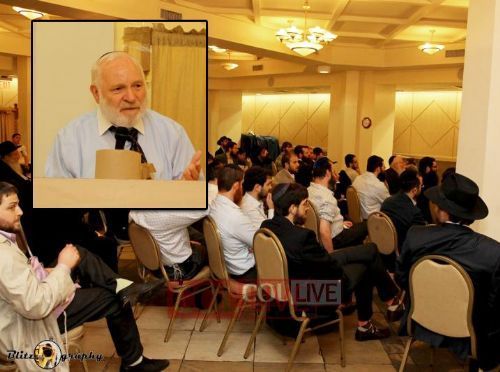
It was those hard times that was the focus of the 80 year-old man’s speech Wednesday night at Congregation Bais Shmuel Chabad in Crown Heights for a crowd of men and women.
Zisman, a child and grandchild of illustrious Chabad chassidim, spoke how he miraculously survived the notorious Nazi death camp, all the while clinging to his roots and to his faith.
He told how 7 decades ago, the Frierdiker Rebbe stared into his eyes and blessed him. He said he was that holy stare that saved his life and instilled in him not just the resilience to survive, but a profound faith that would sustain him and his family through their many difficulties.
“The Rebbe stayed in Riga for a few months before going to America and, at the beginning of March 1940, my father took me to see him,” Zisman recalls in his autobiography “I Believe” which was sold after his speech.
“Outside, hundreds of people were milling about waiting to see the Rebbe, so we had a very long wait – it wasn’t till 2 or 3 in the morning that our turn came. While we were waiting, my father picked me up and stood me on top of a cabinet near the door, so that whenever someone went in or out, I could get a peek at the Rebbe.
“Finally, we were admitted. I remember my father walked in, approached the Rebbe (who was seated behind a desk), greeted him and then took a few steps back. My father told me that one never sat in front of the Rebbe, but it was also rude to hover over him, so out of respect one took a few steps back.
“My father and the Rebbe conversed for a few minutes, and then my father asked the Rebbe to bless me. At this moment, the Rebbe looked at me. He had a powerful stare, his eyes boring into the person as if seeing the core of one’s soul. I felt his eyes going through me, and I was scared.
“I heard my father ask the Rebbe again to please bless me, but the Rebbe just continued to stare. It was as if he was looking through me into some abyss. I started to tremble. And then I heard my father’s voice cracking with emotion, “Rebbe, please, please bless my boy! Rebbe, Rebbe! Bentschn mein yingele! Bentschn mein yingele!”
“My father began to cry. It seemed like time stopped still – my father sobbing, me shaking and the Rebbe staring with his x-ray eyes – but then, finally, the Rebbe pronounced the blessing.”
“But why did he hesitate? What did he see? What forces were arrayed against me? Was it my father’s broken plea that finally swayed him? And is this why I and my brother, who also got a blessing a few years prior, survived when everyone else in our family perished? I will be asking those questions to my dying day,” Zisman said.
Years later, upon arriving to America in 1946, Zisman and his family had a “Yechidus” audience with the Rebbe Rayatz. The Mazkir, R’ Mordechai Leib Rothstein gave the Rebbe a note which explained who they were.
“But he pushed the note away, saying, “I know very well who they are,” and he sent Reb Rothstein out of the room,” Leibel Zisman recalls.
The Frierdiker Rebbe “waited until the door clicked shut, and he looked at me. It was the same look that gave me in 1939, back in Riga. His eyes pierced through me like x-rays. Even though I was a wild kid who had stood up to Nazis and Russians, I started shaking, just like I shook in Riga. And I was just as scared.
“Then he started to ask us questions. He wanted to know exactly what had happened. So we explained to him about the ghetto, about the Grois Aktzia and about the Kinder Aktzia. We told him about our father and about our younger brother, about what happened to our whole family and to the whole Chabad community in Kovno.
“He asked us many questions, and he was particularly interested if certain people had survived. And little by little, he confirmed that nearly everyone was gone. And then he started to cry. He was sitting in his wheelchair, sobbing, his whole body shaking, and we were crying with him. Reb Rothstein must have heard through the door and knocked, but the Rebbe didn’t answer.”



“I believe” by Leibel Zisman
What is the title of this wonderful book ? Can it be gotten at Eichler’s in Flatbush ? At a Crown Heights bookstore ?
I buy this book as a gift for everyone.
What a great inspirational read!!!!!!!
You could see the Hashgocho protis that saved Laibels life
throughout the entire story.
A must buy for everyone. Read it and get more for your family and friends!!!!!!!! Henya L.
He wrote a book.
We need leibel in ch
I’m a Besht Shul member, and I attended this amazing event with my wife.
Thanks Moshe Pinson for the inspiring evening, and Rabbi Yossi Jackobson for asking Laybel the questions that I also had on my mind.
I can’t understand, why so many more people did not attend, this was a incredible time to educate your children about Amalek and the evils that exist, and to also see true heroes of our times.
Reb Leibel was tremendously inspiring! His incredible bitachon, and his descriptions of his and his family’s relationships with the Rebbeim, make his book a great choice for Lubavitchers. Thank you to Rabbi Jacobson and Beis Shmuel for an incredible experience.
I have a feeling the frierdiker rebbe told the secretary to go out so he could ask about who actually survived without anybody worrying about how his health would handle it. It is known that they wouldn’t reveal certain things to the frierdiker rebbe for fear of his health. This goes to show us who our rebbeim were!!
Is there at least an audio recording of the evening. These experiences shouldn’t C”V get lost!
I am the poster of #7, though not a member of Beis Shmuel, I want to say thanks to them for this incredible evening!
is there a video of the evening?
IT was so inspiring,, He had us laughing, he had us crying,, Hashem should continue to bentch him!
Incredibly inspiring.
L’chaim Leibel Zisman – thank you for sharing your story!!!
The name is Moshe Leib Rothstein (pronounced Rutshtein) not Mordechai
his biography and a lot more is there
Ridiculous. You clearly have no idea what a rebbe’s stare looks or feels like.
What an amazing story!
I had that experience 10 years ago… when my son’s BOBOVER Teacher gave me that “holy eye” approval that everyone will turn out in the most Chassidishe derech, and it worked. That special stare can come from any yid, not just a chabad rebbe.