
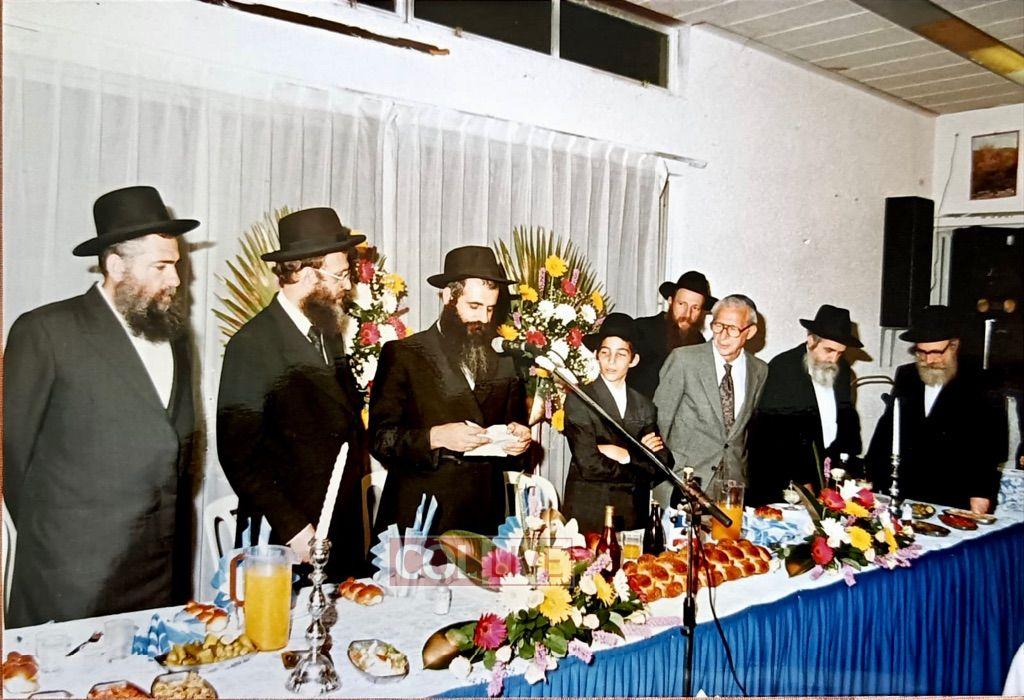
As the Shiva for the late Rabbi Yisroel Halperin, Shliach in Herzlia, Israel, came to a close, Rabbi Yosef Chaim Bolton of Meron recalled a personal story where he experienced Rabbi Halperin’s unique and special character.
It was the 28th of Tishrei, 5751(1991) and my Bar-Mitzvah was to be celebrated in the banquet hall of our little town in Israel. My mother had fretted over every detail to ensure that my Bar-Mitzvah would be something truly special, despite the limited budget.
Everyone knew that the Bar Mitzvah boy was no prodigy. I had struggled with dyslexia and dysgraphia from early on, resulting in a strained relationship with academia and learning in general.
I began learning my Bar Mitzvah maamor well over a year before my 13th birthday to ensure that I would know it perfectly, just like the other boys my age. As the big day drew closer, I would constantly review it in my mind until I knew it thoroughly.
The day before my Bar Mitzvah celebration, I went to look at the preparations being made at the hall and beheld a brightly lit room bedecked with flowers and drapes, a far cry from the dreary hall I was used to seeing. My grandparents had also just arrived from America and I was feeling exuberant and confident.
On the car ride to the hall, I checked with my father that he had brought along the sefer which I had learned the maamor from. My heart skipped a beat when he told me that he had not. But I told myself not to worry; I didn’t need the sefer. I had reviewed it hundreds of times by now, it was almost etched in my brain. Besides, Abba surely knows it by heart after practicing all those times with me, I told myself. And if he doesn’t, my teachers or family members will help me along if I need.
The celebration was to begin with my recitation of the maamor. As the preparatory niggun before the maamor was sung, my heart began to pound. In just a few short moments, the niggun would end, and all eyes would be on me. I was determined to show them that I, too, could achieve this great accomplishment and recite all three parts of the maamor by heart.
But as the niggun drew to a close and a hush came over the crowd, my mind went completely blank; I simply could not remember a single word. I tried to get my father’s attention with a kick under the table but to no avail; he couldn’t recall how the maamor started either. I frantically turned to one of the mashpi’im in the room who, inexplicably, was also at a loss for words. Not a sound could be heard in the room as I urgently tried to remember that first line that would launch me into the rest of it. But it was no use. The crowd began to sing the niggun that follows the maamor and I, in my misery, burst into tears. Everyone tried to convince me that it was “no big deal”, that “I had done well for getting this far” but their words did nothing to console me; I wanted, desperately, to try again.
Only Rabbi Halperin understood me at that moment. Quietly, without a fuss, he darted across the street to a family we knew and borrowed the sefer from them. “Here”, he said, as he handed me the sefer, “now you can start over.” And so it was; I recited the maamor by heart from beginning to end without missing a beat.
In the course of his speech later on in the evening, Rabbi Ashkenazi, the Rabbi of Kfar Chabad, commented that he had learned from my stubborn determination what it means to be a chossid; never to succumb to one’s struggles and to keep on pushing forward.
I learned a powerful lesson from Rabbi Halperin’s actions that night: A chossid doesn’t try to remedy someone else’s pain with mere words, he springs into action and does all that he can to resolve the issue fully as if it were his own.



Beautiful story beautifully written. Thank you for sharing.