
By Yisrael Cohen
The year 5744 marked a revolution in the study of Torah for world Jewry, as the Lubavitcher Rebbe instituted the universal study of Rambam- Maimonides’ massive halachic codex, Mishneh Torah- consisting of fourteen books titled Yad Hachazakah. The daily study of Chita”s- Chumash, Tehillim, and Tanya- had been a fixture long before; the Rebbe’s goal was that every Jew should study the Oral Torah- Torah Shebe’al Peh- along with the written Torah and Chassidus. Recognizing that people have differing abilities and time constraints, the Rebbe established three tracks of study, allowing everyone to find the track most appropriate for him.
Why Rambam?
Several reasons led to the choice of Rambam as the daily course of study. Firstly, the Rambam is the only major codifier of halacha to address the mitzvos that apply to the time of Moshiach’s imminent arrival, ikvesa d’meshicha, such as the laws of korbanos, the laws of the Sanhedrin, and the laws of Kings. As a part of our active preparation for Moshiach’s arrival- study of these laws is crucial! Secondly, the Rambam himself viewed his Yad as the means with which to fulfill the obligation to study the oral Torah and halacha, as he writes in his preface: “One can now study the Torah Sheb’chsav, the written Torah, and then immediately go on to study this sefer and know how to fulfill the law…”.
The Rambam also exhorts us to understand just how the mitzvos should change us for the better: “…most of the Torah’s laws are but counsel given from afar by He Who is of great counsel, to improve one’s character and make one’s conduct upright.”
There were certainly other reasons that the Rebbe chose the study of the Rambam; we know only some of them. As we near the beginning of the fortieth cycle of daily Rambam study, I decided to try to gain a bit more understanding of the Rebbe’s approach to the Rambam.
A Meeting of Paths
Some fifteen hundred years ago, there was a disparity in the custom of krias Hatorah between Eretz Yisroel and Chutz La’aretz. Whereas in Chutz La’aretz the reading of the Torah was completed once a year, as is now the universal custom- in Eretz Yisroel the Torah was completed only once every three years. When these siyumei hatorah coincided, and all Jews completed the Torah together- it must have been an occasion for rejoicing.
This year, Yud-Ches Tammuz marks such an occasion to rejoice. Two tracks of the daily study of Rambam, annual and tri-annual, will be completed on the very same day, and a new cycle will begin. This is the fortieth cycle since the Rebbe instituted the daily study of Rambam as a practical way to prepare for Moshiach’s imminent arrival; this brought to mind Chazal’s explanation of the passuk “And Hashem did not give you a heart to understand, eyes to see and ears to hear, until this day”- “a person does not understand his Rebbe’s intent until the fortieth year”. It is time for us to open our hearts, our eyes, and our ears to understand, to see, and to hear.
Every word the Rebbe uttered was carefully weighed. All his plans were deliberate, and are intended to lead us on the path to geulah. A perfunctory review of the daily Rambam is certainly better than none at all, but does this fulfill the Rebbe’s wishes?
The Rebbe placed great emphasis on the study of Chumash, with hundreds of Sichos focusing on Rashi’s commentary. Just as studying Chumash without Rashi is unimaginable- so too, when studying Rambam- we need a “Rashi’s commentary” to achieve the depth of understanding that the Rebbe intended us to reach. The Rebbe himself provided us this commentary, spread out over thirty-nine volumes containing over fifteen-hundred sichos. These novel insights, which offer a glimpse of the Rebbe’s incredible breadth of knowledge and depth of understanding in every branch of Torah, as well as the unique way in which the Rebbe shows how every word the Rambam chooses is deliberate- are the essence of Toras Chabad. This is not simply the ‘lomdus’ of the yeshiva; this is an awe-inspiring burst of light, illuminating the pathways of Torah with the intellectual genius of the Nassi Hador.
Until now, the Rebbe’s commentary, spread over so many sichos, was the province of a select few. That is about to change.
The Game-Changer
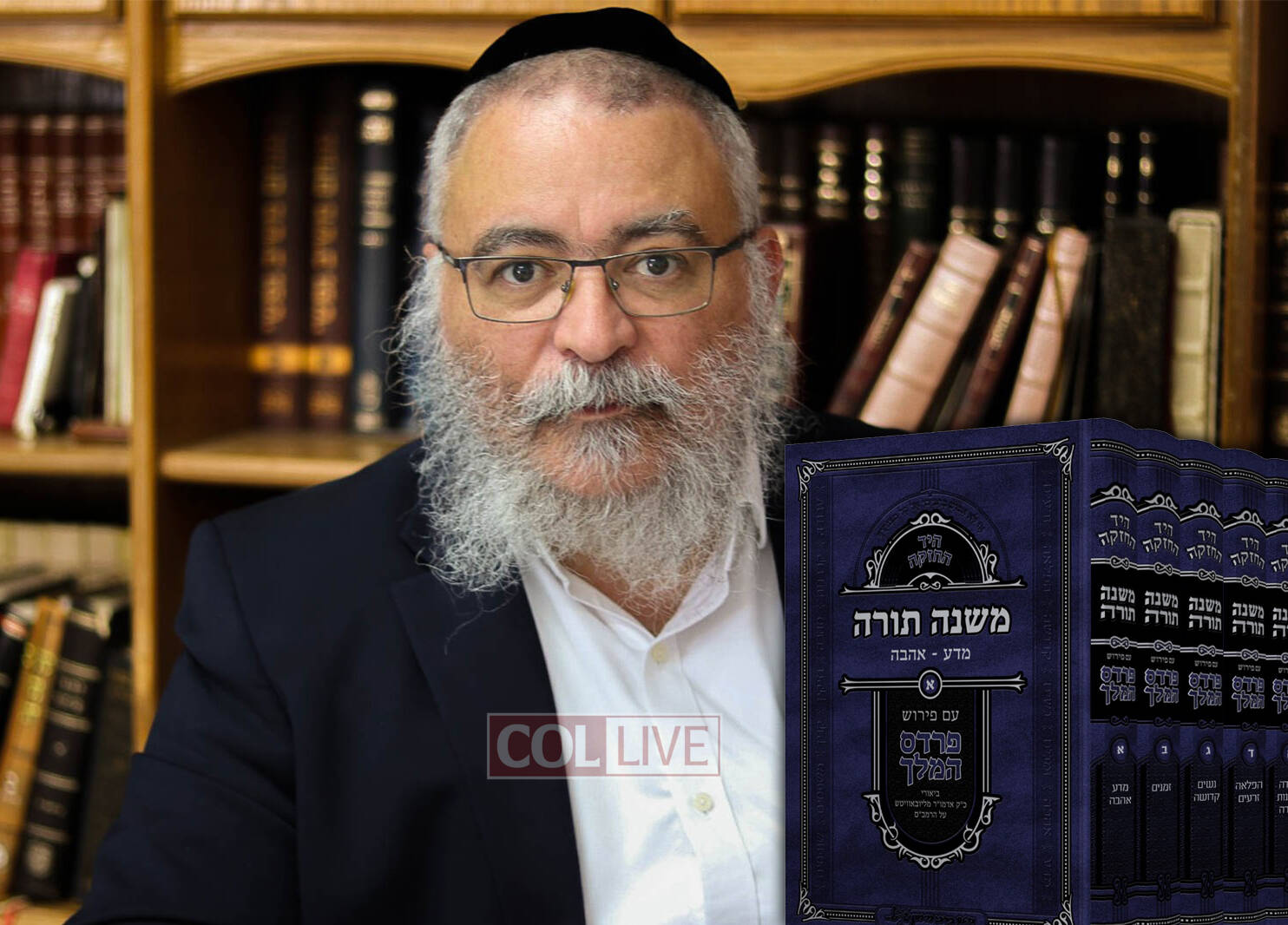
Rabbi Meir Elituv is one of the world’s greatest authorities on the Rebbe’s sichos and ma’amorim. The world knows about the Rebbe’s stature as the preeminent leader of Klal Yisroel; Rabbi Elituv has spent more than two decades bringing the Rebbe’s stature as an unmatched giant in Torah to the masses. Just in time for this fortieth cycle of Rambam Yomi, Rabbi Elituv- along with a team of talmidei chachamim (under the auspices of Hagaon Hachassid Rabbi Tuviah Bloi, Hagaon Hachassid Rabbi Avrohom Michoel Halperin, and Hagaon Hachassid Rabbi Sholom Dov Rabinowitz)- has published a game-changing work: Pardes Hamelech, the Rebbe’s Rashi-like commentary on the Rambam, collected from over one-thousand-five-hundred different places in the Rebbe’s writings.
I caught wind of the impending publication, and called Rabbi Meir Elituv to ask to meet with him and to hear about his connection with the Rebbe’s Torah. Rabbi Elituv graciously agreed, and we met this week near his home in Beitar Illit.
I began by asking Rabbi Elituv a question that has long bothered me:
Why is it that the Rebbe is known for his awe-inspiring greatness of leadership, for his love of every Jew, for establishing the greatest teshuva movement in Jewish history, and for his army of emissaries, the shluchim serving in every corner of the globe- but the average man does not realize that the Rebbe was a giant of Torah scholarship, the preeminent master of his day in every field of Torah? Be it Chumash, Navi, Talmud, the commentaries of Rishonim and Achronim, Halacha or Chassidus- the Rebbe is the master of them all, his sichos and enormous body of responsa shedding light and giving unique, penetrating insight into every sphere of Torah, leaving the Torah greats who were his audience gasping in awe. How is it that the extent of this superhuman scholarship, this ultimate mastery of the depth and breadth of the entire Torah, goes under-recognized- both in Chabad and beyond?
Rabbi Elituv smiles and guides me to the preface of one of his previous books, where he raises this very question. He offers several possible explanations, before arriving at the following: Sometimes, he explains, there is a burst of light so great that while one is enveloped within it- one does not have the capacity to realize its intensity. It is only after some time that its brightness actually registers upon us. We are a generation who lived with the brightness of the Rebbe’s Torah, and we do not yet have the capacity to realize the light which he has cast upon every realm of Torah.
Ufaratzta- Bursting forth!
Rabbi Elituv is both warm and compelling; he has made inroads well beyond Chabad circles, and enjoys a warm relationship with Hagaon Rabbi Berel Povarsky, Rosh Yeshiva of the Ponivezh Yeshiva, who frequently invites him to discuss matters of Torah and halacha, including subjects that arise in the Rebbe’s Torah. I’m excited to hear about this, and seeing photos of these talks seems almost surreal; this is ufaratzta, a felling of boundaries, at its very best. Six years ago this warm relationship with the non-chassidic Rosh Yeshiva caused a quite a stir when published in Kfar Chabad magazine; this has only helped Rabbi Elituv introduce the Rebbe’s Torah to additional groups within Klal Yisroel.
Beyond his scholarship- he himself is the author of a commentary on maseches Bava Kama- Rabbi Elituv is an engaging and sought-after speaker, whose boundless energy is a function of his constant connection to the Rebbe through his encyclopedic knowledge of the Rebbe’s Torah. I look at the beautifully printed and impressively bound sefer in front of him, and ask what is unique about the Rebbe’s commentary on the Rambam.
“We’re nearing completion of our third volume” he shares with me, “the Rebbe wrote one hundred and fifty-one Hadranim, showing the essence of each maseches of the Talmud. He always placed great emphasis on the completion, the siyum, quoting chazal that “everything follows the completion”. One example of the Rebbe’s focus on the essence of Torah is his explanation of the Talmudic disagreement regarding who is greater- the Sinai, who knows a great deal of Torah, or the oker harim, who moves mountains with the depth and quality of his learning. Rabbi Meir opines that the oker harim is greater; Rabbi Shimon be Gamliel says that the Sinai, with his quantity of knowledge in every field of Torah, is greater. Due to this disagreement, Rabbi Meir tried to arrange for the removal of Rabbi Shimon ben Gamliel from his position as Nassi, the leader of the Jewish People under Roman rule. Rabbi Meir’s punishment was that he would no longer be referred to by name, but his opinions would now be ascribed to “Acheirim”, others.
Still, not in every one of his opinions is Rabbi Meir referred to as ‘Acheirim’; sometimes he continues to be referred to by name. Why this disparity?
The Rebbe explains that wherever Rabbi Meir is referred to as Acheirim- it is a case where he chose quality of proof over quantity of proof- oker harim over Sinai- the very subject of his ‘rebellion’ against Rabbi Shimon ben Gamliel! Rabbi Elituv analyzes twenty-five of the instances where Rabbi Meir is referred to as Acheirim, and shows that as the Rebbe explains, every one of them is a case where Rabbi Meir based his opinion on the quality of s’vara, of reason, over quantity!
This is but one example of the Rebbe’s all-encompassing knowledge and penetrating view in every area of Torah.
A Chavrusa with the Rebbe
The approach to Talmud and Halacha in the yeshiva world is called ‘lomdus’; the Rebbe brought this ever-so-much higher, to the level of s’chaltonus, an application of intellect and analysis that brings a clarity of vision that brings a joy to one’s learning. The Rebbe approaches the Rambam with great humility; where the Rambam writes that a slave is liable to the death penalty if he refuses to accept the yoke of mitzvos, the Rebbe comments “I do not know the source for this halacha”. When Rabbi Elituv showed this to Rabbi Berel Povarsky, his response was amazement- this source was indeed difficult, but the comment showed that the Rebbe knew the exact source of every law mentioned by the Rambam! (Interestingly, one scholar pointed out that the Brisker Rov, Rabbi Yitzchok-Zeev Soloveitchik, had the same question, but phrased it quite differently- “The Rambam’s words are surprising….”).
In the new edition of the Rambam, the Rebbe’s commentary- Pardes Hamelech- joins the page along with the classic commentators such as the Lechem Mishneh, Kesef Mishneh, and Mishneh Lamelech, for as Rabbi Elituv explains- the Rebbe is one of the major commentators on the Rambam! For a chassid, the Rebbe’s commentary is so lucid, so clear, and so compelling- that it feels almost as if one is ‘learning b’chavrusa’ with the Rebbe.
Rambam “Pardes Hamelech”- available for preorder here on COLlive.





Yasher koach
There are no limits to Torah knowledge… no words.
Please post same sample pages