
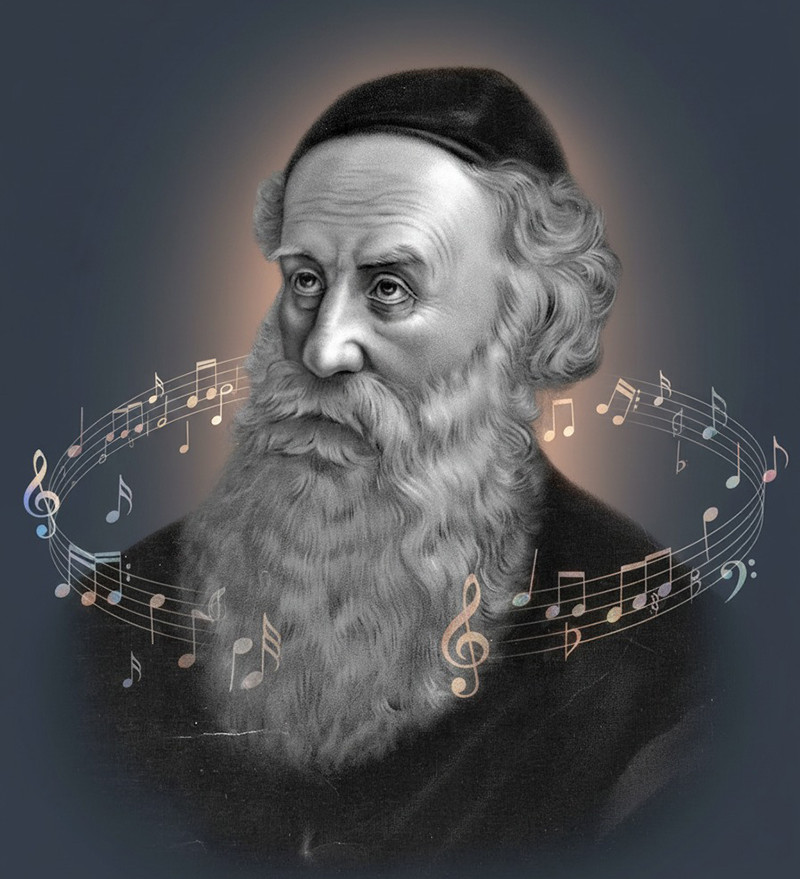
Before the Alter Rebbe even entered the beis midrash of Shklov, controversy was already swirling around his teachings. The scholars of Shklov, known for their sharp logic and fierce resistance to Chassidus, were outraged by one of his early interpretations of a line from Maseches Shabbos: “All bearers of shir (collars) go out with shir and are drawn by shir.”
The Alter Rebbe noted that although the Gemara speaks about collars on animals, the word shir also means song.
“Those who are masters of song,” he taught, “the souls and the angels, rise upward through song and return downward through song.”
A niggun, he explained, is the soul’s rhythm of longing for Hashem and returning to fulfill its mission.
The chachamim of Shklov dismissed this teaching as a distortion of the text and mocked the idea that it referred to song at all.
When the Alter Rebbe arrived in the city, he did not answer them with pilpul or sharp logic. He simply listened as they poured out their hardest questions, the ones they had carried for years, and then he quietly repeated his teaching.
Then he began to sing.
The room fell still. The melody rose and fell with yearning and resolve, drawing each listener into their own thoughts, their own doubts, their unasked questions. Men who moments earlier had been sharpening arguments now felt themselves alone with their struggles, gradually finding clarity. Slowly, confusion softened, tension dissolved, and comprehension gently replaced it.
By the time the niggun ended, every question in the room had been answered, without a single word of explanation.
That day, Rabbi Yosef Kolbo, one of Shklov’s greatest prodigies, became a chossid. He later said that the four most difficult questions of his life were resolved not through argument, but through that melody.
At Nafshi, we sing the niggunim of the Alter Rebbe, melodies preserved through generations, carrying the spiritual imprint of their composer.
Not to reenact Shklov, moments like that cannot be recreated, but to enter the same spiritual current: where a melody draws the listener inward and the yearning cry of a niggun sharpens mental clarity.
This is Nafshi, where melody becomes understanding, and song becomes soul, allowing people from every background to step into a shared space and feel the power of song.
Reserve your seats today and experience the transformative power of song at Nafshi.


. If anyone knows it and has a link to it, please post it
The story is from Likutai Dibburim, i think the Frideker Rebbe says it was a Niggun called the Matten Torah Niggun
Don’t know which Niggun that is
טעמו וראו כי טוב הוי פארזוכט וועט איר זעט אז דער אויבעשטער איז גוט
Chevre we have to first TASTE chassidus in order to see that it’s good
https://www.chabad.org/library/article_cdo/aid/77049/jewish/The-Alter-Rebbe.htm