
Dangerous Years: The Rebbetzin’s Life as the Clouds Darkened in Europe
In honor of the birthday of Rebbetzin Chaya Mushka Schneerson OBM on the 25th of Adar, we present an excerpt from an upcoming publication on her life spearheaded by R’ Mendel Notik, who dedicatedly served the Rebbetzin for many years.
By Dovid Zaklikowski
The Rebbe Rayatz worried deeply about his daughter and son-in-law, Rebbetzin Chaya Mushka Schneerson and the Rebbe, when Germany became increasingly precarious before the Second World War.
“I am not going to conceal that, after everything,” he wrote in the fall of 1929, “I constantly think about you roaming the city, and if you are taking extra precaution?”
During this time, the young couple witnessed the rise of Hitler, during which the depraved German dictator led a nation from intellectualism to barbarism. The Rebbe later spoke about Hitler’s ability to banish G-d from German consciousness and where human life lost value. Decades later, the Rebbe spoke of a nation that prided itself on science, philosophy and moral authority but practiced the exact opposite. It would be the impetus for the Rebbe’s efforts to educate all people that Hashem is, indeed, present and watching every action.
It was not that Hitler forced everyone around him to fulfill his wishes, the Rebbe recalled. “As everyone saw, including myself, they (citizens) were enthusiastic when they greeted him. They hoped that he would fulfill their hearts’ desires and see that Germany is above all.”
On January 30, 1933, the fears of Jews in Germany was realized when Hitler became the country’s chancellor. “I hope that you are keeping your promise to refrain from taking unnecessary walks,” the Rebbe Rayatz wrote to the Rebbe, then known as the Ramash (Hebrew acronym of his name).
After reading the news reports threatening attacks on German Jews, the Rebbetzin wrote a frightened letter to her father. The Rebbe Rayatz did not want her to alarm the entire family and attempted to calm her fears by saying that not everything published in a newspaper comes to fruition.
The Ramash, seeing his wife’s distress, packed up their bags and traveled to Paris to scout the situation there. Two weeks later, the Rebbetzin joined her husband. “I hope that this letter will reach you a few hours before you go to greet the good and pleasant ‘guest,’ your wife, my dear daughter,” the Rebbe Rayatz wrote, ending with the hope that they should find a proper apartment.
Yisroel Aryeh Leib “Leibel” Schneerson, brother of the Ramash, moved with them to Paris. At one point, Leibel decided to continue to to the Holy Land of Israel and was in need of documents from the German government. By then, Germany was in chaos. Books authored by Jews were burned in the streets, and antisemitism was rising. The Ramash offered to make the daring trip to assist his brother, but the Rebbetzin – concerned her husband would be targeted since he was visibly Jewish – volunteered instead.
To cross the border, she filled out a detailed form that raised the suspicion of German officials. Everyone listed, it seemed, was named Schneersohn/Schneerson – her father, her mother, and her husband. Nonetheless, they let her cross into Germany, and she was able to acquire the documents for Leibel before safely returning to Paris.
The Simple Life
The Ramash and the Rebbetzin found a small, unfurnished apartment that suited their basic needs and income (provided by the Rebbe Rayatz). When a local Lubavitcher businessman saw their meager accommodations, he decided to rent and furnish a large apartment for their use. When he told the Rebbetzin about it, she said she would discuss the matter with her husband. The Ramash, however, turned down the offer, preferring to live modestly within their means.
Refusing the large apartment was in line with the Rebbetzin’s disregard for pomp. She had also left behind many of their wedding presents in Riga and Poland. “I always thought that tablecloths, towels and napkins are an extra burden with no purpose,” she wrote to her in-laws.
With little room for their personal items, and surely not their seforim, they lived out of boxes and suitcases. Making the best of the situation, the Rebbetzin would later say that she tried organizing their possessions in an aesthetically pleasing way so that it wouldn’t look like they were always on the move.
In Paris, the Ramash didn’t publicize that he was the son-in-law of the 6th Lubavitcher Rebbe. On the contrary, he begged those who knew not to tell others that he lived in the city. When they first arrived, the Ramash once received an aliya to the Torah at a local shul. As is customary, he pledged a donation to charity and when he brought the money and relayed his name, he was asked if he was related to the Lubavitcher Rebbe. “Moussia is his daughter,” he responded simply.
The Ramash took on increasing responsibility in the work of the Rebbe Rayatz. In the winter of 1933, the Rebbe Rayatz wrote to his daughter that the Ramash’s organizational capabilities developed profoundly. “He takes care of everything. His attention to detail is nothing new to me, but it is to an extent I was not expecting, not only as a son-in-law but even for a daughter.”
While the Rebbe Rayatz was nominally supporting him, the Ramash was encouraged to accept a rabbinical position when it came to further employment. But he refused. To work in other areas would require work permits and that was difficult to obtain.
In the fall of 1939, the Ramash wrote to his father of his attempts to find a job or partnership. “Some of my efforts turned out to be just that, a dream,” he wrote. Nonetheless, he continued to pursue work even though it had been a challenging financial year for everyone. “One needs to think that whatever elapsed until now was for the good, but in the future it will be better, and even much better, because there is no limit on increasing goodness,” he penned. The Rebbetzin mostly took care of the home and performed seamstress work on the side to supplement their income.
The couple made plans to remain in Paris, seemingly for a long time. However, they were having difficulties obtaining documents, a fact which weighed heavily on the Rebbetzin. “Life is very hard without being settled,” she wrote to her in-laws back in the Soviet Union.
At some point, the Rebbetzin was eager to move into a larger apartment, but in a letter to her in-laws, she described, “It is difficult to decide, because in the meantime there is no work, and it does not look like there will be one soon. In this situation, it does not make sense to take upon high expenditures.”
The couple ultimately decided on a small two-room apartment that they could afford. While there are always pros and cons to be discovered, she wrote, what convinced her to rent the apartment was the sunlight shining through the windows. “I surmise, my dear in-laws, that you are laughing at me for worrying so much about such a small matter!”
Milk and Bread
Living in Paris, there were few kosher options for the couple. The Rebbetzin would make food from scratch. To obtain dairy, she would travel with a bucket to a farm in the suburbs and oversee the milking of the cows.
When it came to purchasing poultry at the butcher, they first went together to observe the koshering of the chickens. When the Rebbetzin affirmed that it was done correctly, the Ramash began to purchase there.
They purchased bread from a local bakery, but the Ramash was once stopped by someone who inquired in surprise, “A religious person like you eats bread from here?” The couple stopped frequenting the bakery. Decades later, the Rebbetzin would playfully say, “G-d helped us that there would also not be bread.”
As it were, the person who derided the bakery had just opened a bakery of his own. However, once there was doubt surrounding the matter, the Rebbetzen said that the Ramash would not return to that bakery.
When a local businessman came to their home when the Ramash was out, the Rebbetzin kept open one of the doors to the outside. “Why are you doing that? It’s cold outside!” the man asked. She responded, “Have you forgotten that one should not be in seclusion [with a non-relative of the opposite gender]?”
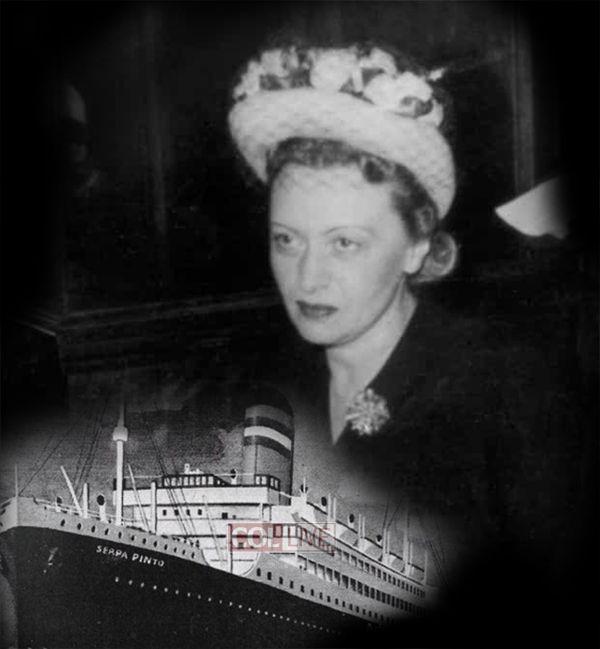
In September 1939, bombs hit close to Lubavitch headquarters of the Lubavitch movement in Otwock, Poland. It was the beginning of European Jewry’s devastation. It would take much effort, but finally on a spring morning in 1941, the Ramash and Rebbetzin disembarked the Serpa Pinto, marking the beginning of a new journey.
For the first time in their married lives, they would be living in the same city as the Rebbe Rayatz, becoming an integral part of the movement.
—
This article first appeared in the COLlive Magazine for Adar 5782
Read the magazine online: https://issuu.com/collive.com/docs/collive_magazine_-_adar_5782



I’ve read as many knew of these stories and details. Nevertheless, as I read this again. Great inspiration and interest increases due to each of our connection. The ultimate Mesiras Nefesh and hidur Mitzvah is of great.
Thank you for sharing this again n again.