
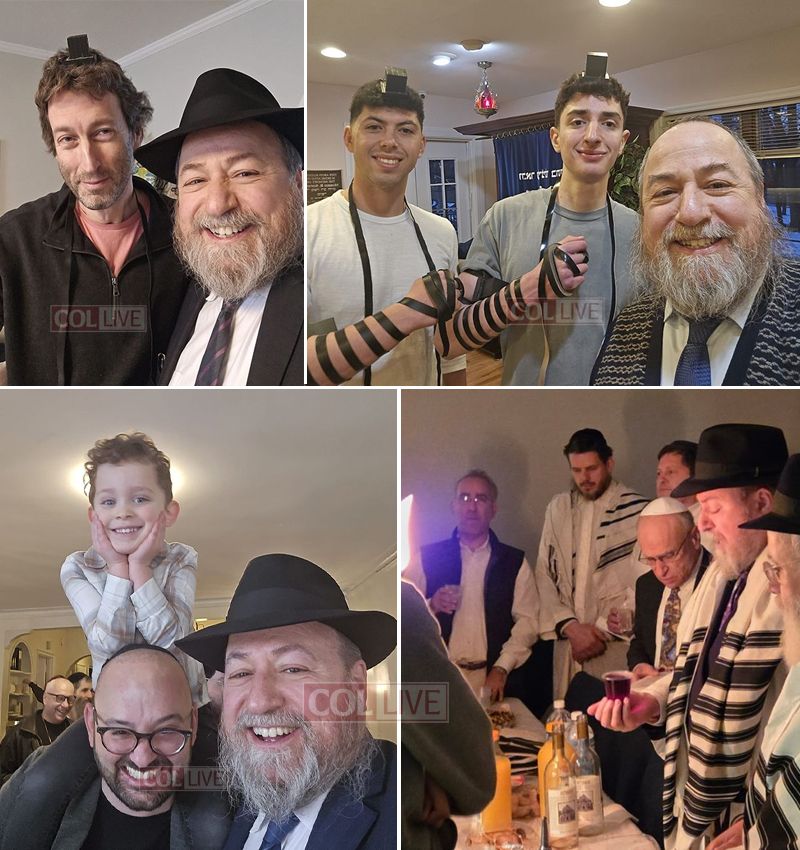
Rabbi Levi and Sorah Shemtov, Chabad Lubavitch of the Bronx, Riverdale, New York
By: Chaya Chazan
I grew up in a home so permeated with Chassidus and chassidishkeit, joining the ranks of the Rebbe’s devoted shluchim was a foregone conclusion. I was zoche to live in Crown Heights and be able to attend every farbrengen, and even have yechidus a couple of times. From a very young age, I was taught to think and act like a chassid – which meant doing whatever the Rebbe asked, no matter how challenging.
My in-laws, Dr. Moshe and Miriam Feldman A”H, first became close to Chabad in Nashville, through Rabbi Zalman Posner. They later moved to the Bronx, and continued their connection to Chabad through Rabbi Mordechai Altein. My father-in-law became the Rebbe and Rebbetzin’s personal physician, and attended to the Rebbe after his heart attack on Shemini Atzeres. Almost everyone in Crown Heights was in his office at some point or another, and he was a beloved member of the community.
Both my wife and I knew we wanted to go on shlichus, and each of us – separately – made it a condition of any shidduch prospects.
Soon after our wedding, we moved to a small city in Florida to begin our shlichus. For various reasons, it didn’t work out, and we wound up back in Crown Heights, determined to try again. We continued looking for other options and researched every prospect that came up.
A friend of mine was the first to suggest Riverdale. Tucked into the northwest corner of the Bronx, Riverdale enjoys verdant lawns, vast seafront vistas, and breathtaking views from its many hills. In the late 1940’s, the Frierdiker Rebbe asked Rabbi Mordechai Altein AH to establish a yeshiva in the Bronx, which majorly impacted the Jewish community over time. When we were seriously considering Riverdale as an option, I knew we first had to speak with Rabbi Altein.
My wife had attended his school as a girl, and he was good friends with my in-laws. He was overjoyed to hear his legacy would be upheld by his own students, and readily gave us his bracha.
When we got married, in late ‘88, very few Chabad houses were established in the five boroughs. Of course, now, it’s hard to go more than 2 miles anywhere in the city without passing by a Chabad house or two, but we were only the third couple to begin a shlichus in New York City.
The Va’ad was happy to give their approval for our move, but asked us to take on the entire borough, not just the neighborhood of Riverdale.
“If you don’t do it, who will?” they pressed. “We need you to be responsible for the entire area.”
We were a bit apprehensive to take on such a gargantuan task, but in shlichus, pushing the limits of your comfort zone is the name of the game.
————————-
We were still in the research phase, and decided to make an event to gauge the interest of the community. We held a Chanukah party, with a public menorah lighting, olive press, dreidel house – the works! Baruch Hashem, it was a great success, and I sent a report to the Rebbe, including some pictures.
The Rebbe’s answer came quickly, and it was surprising. “I received your letter with great pleasure,” the letter began, in the Rebbe’s customary greeting. “Hashem should grant you success bakol – in everything.”
Oftentimes, the Rebbe gave standard answers to the myriads of letters and requests he received every day. Of course, the regulatory words did not contravene the Rebbe’s deep concern and care for every individual, which was only accentuated when the Rebbe added other, non-standard responses.
While the first sentence was expected, the second sentence was unusual. We were thrilled to receive such a bountiful bracha and approval for our new shlichus, and the very memory of it was enough to inspire us on our mission.
The bracha also resonated for another reason. In Parshas Chayei Sara, when Avraham is described as being blessed with “bakol – everything,” Rashi comments that the word refers to his son, Yitzchak. My wife and I had been married for a couple of years without any children, and we looked forward to the completion of the Rebbe’s bracha, when we, too, would be blessed with “bakol” – “everything;” children of our own.
The fulfillment of the Rebbe’s bracha was a while incoming, but 9 years later, we welcomed our twins, Chaya Mushka and Menachem Mendel, and, three years after that, their younger brother!
—————-
Jay’s* voice sounded equal parts urgent and somber. “Rabbi, we have to get to Crown Heights, immediately!”
“What happened, Jay?” I asked, concerned. I’d only recently met his family, and everything had seemed fine then.
“We must get a dollar and a blessing from the Lubavitcher Rebbe!” he replied, his voice shaking. “My mother-in-law was just diagnosed with cancer, and the doctors are giving her months!”
I quickly arranged for us to join the line for Sunday dollars, and we spent the time awaiting our turn whispering fervent chapters of Tehillim.
When we approached the Rebbe, I introduced Jay and his wife as “supporters of Chabad of Riverdale,” and began to explain the issue.
Before I could complete my sentence, Rachel*, Jay’s wife, jumped in. “Please, Rebbe! My mother is very ill and needs a big blessing! Can you bless her to make it to my son’s bar mitzvah, a few months from now?”
The Rebbe looked at her solemnly, and gave her a bracha that her mother should be “healthy, and live a long life.”
Rachel nearly floated out of 770, hanging on to the hope of the Rebbe’s bracha. I accompanied Jay and Rachel to my in-law’s home a few blocks away, and Rachel wasted no time repeating exactly what the Rebbe had said.
“That’s a beautiful bracha!” my father-in-law told her. “But one thing I’ve learned is that we must make ourselves into vessels to hold the blessing. When we take on a new mitzvah, we become a keili into which the bracha can flow.”
Jay and Rachel both looked thoughtful, but didn’t say much else.
A few days later, we held our inaugural Chanukah party. At the end of the event, Jay approached me with an open checkbook.
“I’m here to make my keili, Rabbi,” he said. “I trust that will help my mother-in-law recover. How much?”
I was confused.
“How much did this event cost?” he persisted. “We’ll cover it entirely.” He stood expectantly, his hand poised over the book.
“$5,000,” I told him, and watched in amazement as he smoothly wrote a check for $5,000 to Chabad of Riverdale, and handed it to me.
Baruch Hashem, Rachel’s mother was able to celebrate her grandson’s bar mitzvah, and enjoyed a healthy, normal life for a number of years afterwards.
———————
One day, I got a call from my colleague, Rabbi Yehuda Tiechtel, Chabad shliach in Berlin, Germany.
“One of our community leaders is visiting Riverdale soon. Can you introduce yourself, invite him for meals, and learn with him while he’s there?” he asked.
“It will be my privilege!” I answered.
Herr Freundlich* and his wife spent a few weeks in Riverdale, visiting old friends in the area, and we built a friendly rapport with them.
A few weeks later, Rabbi Tiechtel called me again.
“Do you have another Berlin couple coming for a visit?” I joked.
“No,” he answered. “I wanted to thank you for welcoming the Freundlichs. He told me he’d heard of you many years ago, and I finally put the pieces of the puzzle together!”
“What do you mean?” I asked.
“Before we moved to Berlin,” he explained, “the community council held a meeting to decide whether they’d allow Chabad in or not. Most were apprehensive that we were too ‘frum,’ and would stir things up too much. But then, Herr Freundlich got up.
“‘I just got back from visiting Riverdale,’ he told everyone. ‘My good friend, the rabbi of the Reform Temple there, was recuperating from an operation. I went to visit him in the hospital, and he told me I’d just missed the Chabad rabbi who’d come to visit him and blow the shofar for him. Now, gentleman, if this is what Chabad has to offer – if they’re the type of people to visit Reform rabbis and blow shofar for them – I say we welcome them with open arms!’
“Herr Freundlich’s statement shifted the mood, and we were able to move here a short while later.”
——————
For our first Purim party, we wanted to make it an especially memorable yom tov, so we arranged a concert with the Piamenta brothers. We advertised it everywhere, and the entire borough looked forward to it with great excitement. Every shul joined, and the Chassidic rock-n-rollers electrified an audience of hundreds!
We did the same thing the next year, and again, hundreds of people rocked out to Piamenta’s signature songs and enjoyed a lavish Purim seudah afterwards.
After arranging these Purim concerts and parties for a few years, we realized attendance had dwindled, and we wondered where the hundreds had gone.
A community member explained that the other shuls had been happy to join Chabad for years, but eventually, they’d decided to make their own shul events and programs.
We were so happy to hear that! Our Purim hullabaloo had inspired them to make Purim more meaningful for their communities, too. Now, Purim could be celebrated properly, with laughter, joy, and simcha, across the whole city – the more, the merrier!
————————–
It was a Friday, our first day in our new building. I wanted to solidify our Chabad house, and started asking around for Jews to whom I could offer tefillin.
“You can try Max*,” my landlord suggested. “He has a business, right upstairs.”
With all the eagerness my freshly minted shliach status could give me, I ran upstairs and knocked on Max’s door.
“Hi,” I said, a huge smile on my face. “Would you like to put on tefillin?”
My smile froze on my face as Max leveled an icy glare at me.
“What are you talking about? I’m a busy man; I don’t have time for games,” he answered, brusquely.
“Tefillin?” I asked again, still hopeful. “The things you wore at your bar mitzvah!”
“I never had a bar mitzvah,” Max said. “And I’ve never heard of tefillin.”
“I can show you,” I said, fumbling in my eagerness to take the tefillin from their velvet pouch. “It will only take a minute, and -”
“I’m not interested,” Max interrupted me, coldly. “And I don’t have time for this. My wife would probably be interested, but I’m not.”
I was utterly dejected by his harsh rejection of my first tefillin attempt as an official shliach, but his final words gave me hope. My wife contacted his wife, and she gave her a far better reception than Max had given me! Ayala*, Max’s wife, agreed to take classes with my wife, and she loved everything she heard. Soon, their kitchen was kashered, and they began keeping Shabbos.
Ayala and her children were committed to a Torah-true life, but Max was still ambivalent. To assuage the tension, we invited them for a Friday night meal. In the convivial atmosphere, everyone let their guard down, and we enjoyed a beautiful night of singing, discussion, and inspiration.
As the meal drew to a close, Max slid into the chair next to mine. “Rabbi, I have a problem to discuss with you,” he said.
Oh no, was my first thought. After such a beautiful meal? What could possibly have gone wrong?
“Every week, Ayala and my kids make me sit down at the Shabbat table. I go through the motions to make them happy, but as soon as the meal is finished and the kids are in bed, I go straight back to my store and work for a few more hours. Ayala doesn’t like it, but she begrudgingly accepts it. But now…” he paused for a moment. “This meal felt different. I don’t see how I can drive to work now after this incredible night. What should I do?”
I wish everyone had such problems! I thought. Aloud, I said, “You’ll go home with your family, and come to shul tomorrow. The work can wait! You have all Saturday night, and even Sunday, if necessary, to catch up. This day is for G-d.”
Max followed my advice, and came to shul the next day. On Sunday, he roared up to our shared building on his motorcycle and greeted me with a big smile.
“Do you recognize this?” he asked, removing his helmet to reveal a kippah. “I got it from your house on Friday night. It’s been on my head since then, and, Rabbi, it’s never coming off!”
Max and Ayala continued to grow in their commitment to Yiddishkeit, and they ultimately decided to move to a larger Jewish community to give their kids the best possible Jewish education.
Years later, at the wedding of Max and Ayala’s daughter, Max stood up and pointed to me. “Does everyone see Rabbi and Rebbetzin Shemtov here? It’s because of them that we now have 12 grandchildren, all following the Torah!”
———————-
“Is this Chabad?” asked a belligerent voice on the phone.
“Yes,” I answered. “How can I help?”
“My niece just had a baby, but she refuses to give him a bris!” he explained. “You need to make sure the baby has a bris!”
“I can try talking to her -” I suggested.
“No, it’s no use! I’ve tried over and over. You just need to make sure the baby has a bris!”
“I really want to help,” I responded, gently. “But if my only option is to sneak into the house, kidnap the baby, and bring him to a mohel, it will only end with me in jail. I don’t think that will work.”
“But you’re Chabad!” he persisted. “I’m counting on you!”
There was nothing I could do at the time. About 12 years later, the boy – and the younger brother who’d been born since – were removed from their mother’s care. Now that the father had custody, he was finally able to make sure his sons had brissim. He called to ask me to arrange them, requesting it be done quietly, so as not to upset the boys’ mother.
I was zoche to be sandek for brave, 12-year old David*. I stayed close by while he was whisked to the recovery room. I’ll never forget when his eyes slowly blinked open, his face wrinkled with confusion and pain, and he asked, “Did I already have my bris?”
“Yes, Dovid!” I answered. “Mazal tov!”
“Good,” he said, smiling faintly while his eyes drifted closed again. “I feel like a rock has rolled off my chest. Thank you!”
Tears stung my eyes as Dovid the Hero fell asleep, the smile still hovering on his face.
Years later, Dovid invited me to his own son’s bris. “I know it’s a far drive, early in the morning,” he said. “I’ll completely understand if you can’t make it.”
“Can’t make it?” I repeated in astonishment. “Dovid, there’s no way I’m missing your son’s bris!”
*Names changed to protect privacy



Kol Hakavod!!!
Rabbi Shemtov and Sorah are incredible shluchim!
So grateful to have sent my children to their camp years ago
Beautiful…yasher koah..may you continue to lead the way helping to bring moshiach now!!!
Such inspiring stories! Thankyou. May you continue mechayil el chayil always bakol 🙂
How lucky is Riverdale to have Rabbi Levi & Rebetzin Sara
How lucky is Riverdale to have Rabbi Levi & Rebetzin Sorah!! Foot soldiers of the Rebbe who are definitely bringing Moshiach!!
Wishing them uber Bracha & Cont’d Hatzlacha!!
Uncle Chaim & Auntie Freida
Beautiful stories from beautiful shluchim!