
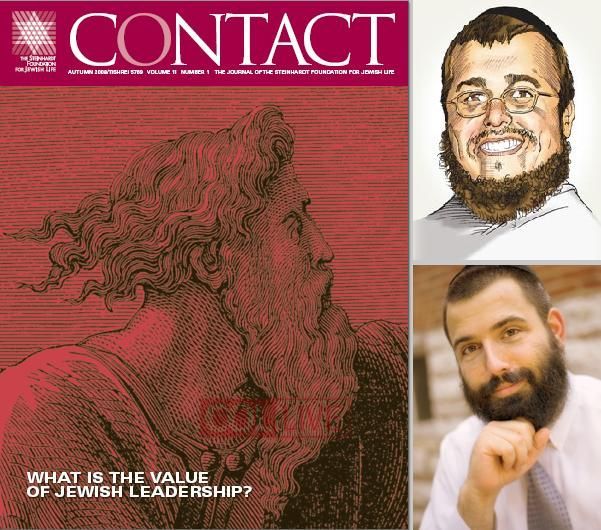
BY RABBI HERSHEY NOVACK AND RABBI DOV WAGNER
Today’s young people and academics celebrate their individuality, and don’t enjoy following others. As campus rabbis serving American universities, we are regularly confronted with a conundrum: how to effectively serve a diverse group of individuals, each with his or her own weltanschauung, while retaining a firm commitment to our own values. In other terms, is there a model of leadership that allows people to be engaged participants without compelling them to automatically agree with their leaders?
One model of Jewish leadership can be found in the life of Moses. Moses led a people almost eternally conflicted. They complained about water, they complained about bread, they complained about meat. They complained about his efforts to take them out of Egypt, and they complained about the land towards which he was leading them. They complained about Moses’ personal life, and his communal duties.
Yet Moses remained dedicated to each member of his flock. Moses proclaimed the people of Israel — all the people — to be “the people I am among” (Num. 11:21).
Biblical commentaries interpret this as an endearment; Moses considered each member of his community as critical. This includes such rebels as Korach, Dasan and Aviram, and so many others who would challenge Moses at every turn.
We learn that a critical measure of a Jewish leader is her/his ability to value each individual as integral to the complete whole of Klal Yisrael despite their differences with — or even challenges to — the leader.
Similarly, when Moses prepares to seek a successor, he asks “the G-d of spirits of all flesh” to appoint one (Num. 27:16). The classical commentator Rashi explains the unusual reference to “G-d of the spirits” as follows: “Master of the Universe. Before You is revealed and known the mind and spirit of each individual, and no two are alike. Appoint for them a leader who will tolerate each person according to their individual character.”
Leadership, according to this rendering, does not mean merely to seek out those who agree. On the contrary, its defining quality is the ability to include others who disagree as part of the community.
The teachings of Rabbi Shneur Zalman of Liadi (1745-1812) help us understand how Moses was able to lead people of all stripes.
In his foundational work of Chabad Chasidic philosophy, the Tanya (chap. 32), Rabbi Shneur Zalman posits that true Ahavat Yisrael (care and concern for a fellow) can be only achieved by relating to the internal qualities that each person shares — their Pintele Yid, or “Jewish spark.”
When looking at other people through the prism of the physical — body or mind — it is impossible to love the other as oneself. Only in terms of the soul — the Neshama — is there a shared reality that unites every person and which transcends differing mindsets and ideals.
(From our own perspectives as campus rabbis, two other practical results emerge from this approach. First, it changes the nature of the relationship between campus rabbi and student, creating a mutually beneficial interaction rather than a hierarchical one. Second, it allows for true concern for the student’s entire being — including personal and scholastic identities — rather than a limited focus solely on the student’s Jewish activity and engagement.)
We can identify this model of leadership in the actions of the Lubavitcher Rebbe, Rabbi Menachem M. Schneerson, of blessed memory. A second-year university student from England related his impressions after he visited with the Rebbe during the 1960s. “[The Rebbe’s] leadership — rare almost to the point of uniqueness in the present day — consists in self-effacement. Its power is precisely what it effaces itself towards — the sense of the irreplaceability of each and every Jew.”
The student, Sir Jonathan Sacks, later became Chief Rabbi of the United Kingdom. In another article, Rabbi Sacks put it this way: “[P]eople had profoundly misunderstood him. They thought that the Rebbe was interested in creating followers. He wasn’t. He was interested in creating leaders. That was his greatness. He believed in people more than they believed in themselves.”
This encapsulates our vision on campus as Chabad Lubavitch rabbis: we find it possible to lead a diverse group of individuals without compromising our own values because we choose to focus on the Pintele Yid. We don’t see our leadership as changing our students into something they are not.
Rather, we view our role as both teaching, and yes, learning from our students, while providing them with tools — material, intellectual and spiritual — to develop into literate and participatory Jews.
Rabbis Hershey Novack and Dov Wagner, respectively, are founding directors of the Chabad on Campus chapters at Washington University in St. Louis and the University of Southern California in Los Angeles.